Composition
How elements are arranged within the frame to guide the viewer's eye.
FinalFrame note chaque photo de 0 à 10 : un 6 est solide, un 8 est digne d'un portfolio et un 9 est de qualité d'exposition. Comment fonctionne la notation
Ce que c'est vraiment
Composition is routinely taught as arrangement: where to put things inside the rectangle. That definition produces tidy, dead pictures. Composition is the choreography of a stranger's attention. A photograph is a set of instructions to an eye that owes you nothing: where it enters the frame, the order in which it travels, where it is allowed to rest, and where it is never allowed to go. The stranger part matters. You walk your own frame with a guide: memory of the place, the effort of getting there. The viewer arrives cold, and their eye obeys a physics you cannot override by wishing: brightness pulls, contrast pulls, a face pulls hardest of all. Composing is deciding, on purpose, where those pulls send an eye that has never seen the scene.
And half the craft is subtraction. Every element in the frame is either doing work or doing damage; there is no neutral. The bright twig at the border, the second doorway, the sliver of sky in a top corner: each one bids for attention against your subject. The frame edge is not a boundary you ended up with; it is the most powerful exclusion tool you own.

Générée par IA
Pourquoi un 6 n'est pas un 8
A 6 is correct, and correctness is exactly its ceiling. Subject on a third, horizon level, nothing amputated, background acceptably clean. Every box ticked, and the frame is an inventory, not a structure. The eye lands on the subject at once and then has nothing left to do: no second element worth traveling to, no route back, so it either sits or drifts out an edge. Here is the tell from the judging chair: imagine moving or cropping any single element. In a 6, almost nothing breaks: shift the fence, lose the shadow, and it is the same picture. Nothing is load-bearing, which means nothing was designed.
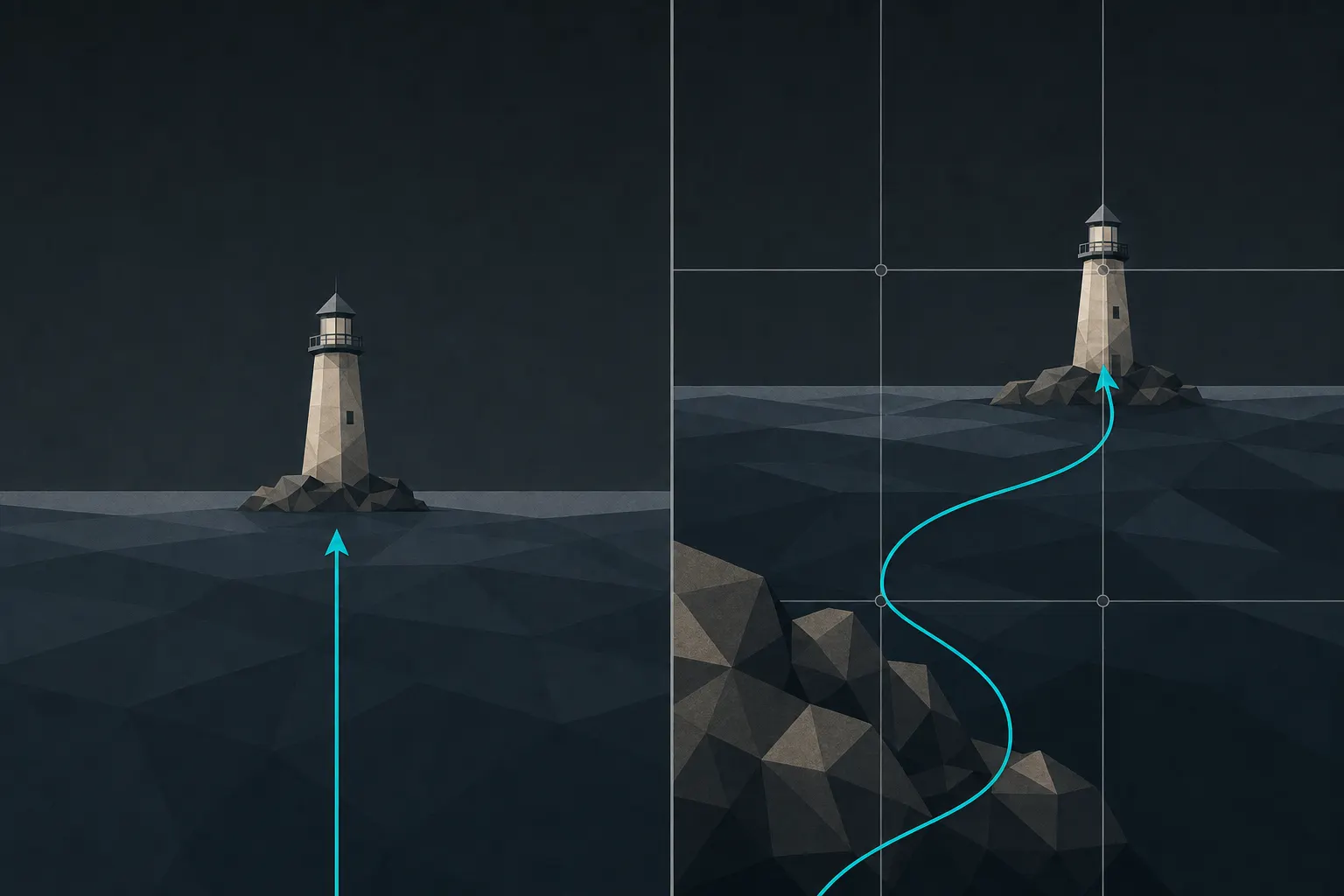
An 8 feels inevitable. There is an entry point: usually the brightest or highest-contrast mass, and it is either the subject or a deliberate doorway to it. From there the eye is routed: a line, a gaze, a tonal step to a secondary element and back to the subject (a loop the viewer rides without noticing they were steered). The edges are sealed. And every element earns its place: move one and the balance genuinely collapses. Judges have a phrase for the difference: seen, not snapped. A 6 shows me a subject someone found. An 8 shows me a decision about attention someone made: I can feel that the frame was built, not taken, without being able to point at any single rule that says so. That felt necessity, not any placement formula, is the whole distance between the two scores.
Avant de déclencher
Three diagnostics. All free, all before the shutter.
The squint test. Squint until detail dissolves and the scene collapses into tonal masses. Where does your eye snap first? That is where the stranger's eye goes: brightness and contrast win, and sentiment doesn't vote. If the brightest mass is the sky above your subject, or a white car behind them, the composition has already failed, whatever the subject is doing.
Edge patrol. Walk all four borders in the viewfinder, corner to corner, slowly. You are hunting two things: leaks (bright shapes or lines that touch the edge and hand the eye an exit) and tangents, where two elements kiss without overlapping: a horizon through a head, a pole grazing a shoulder, a branch touching a roofline. A tangent reads as a flinch the viewer feels and cannot name.
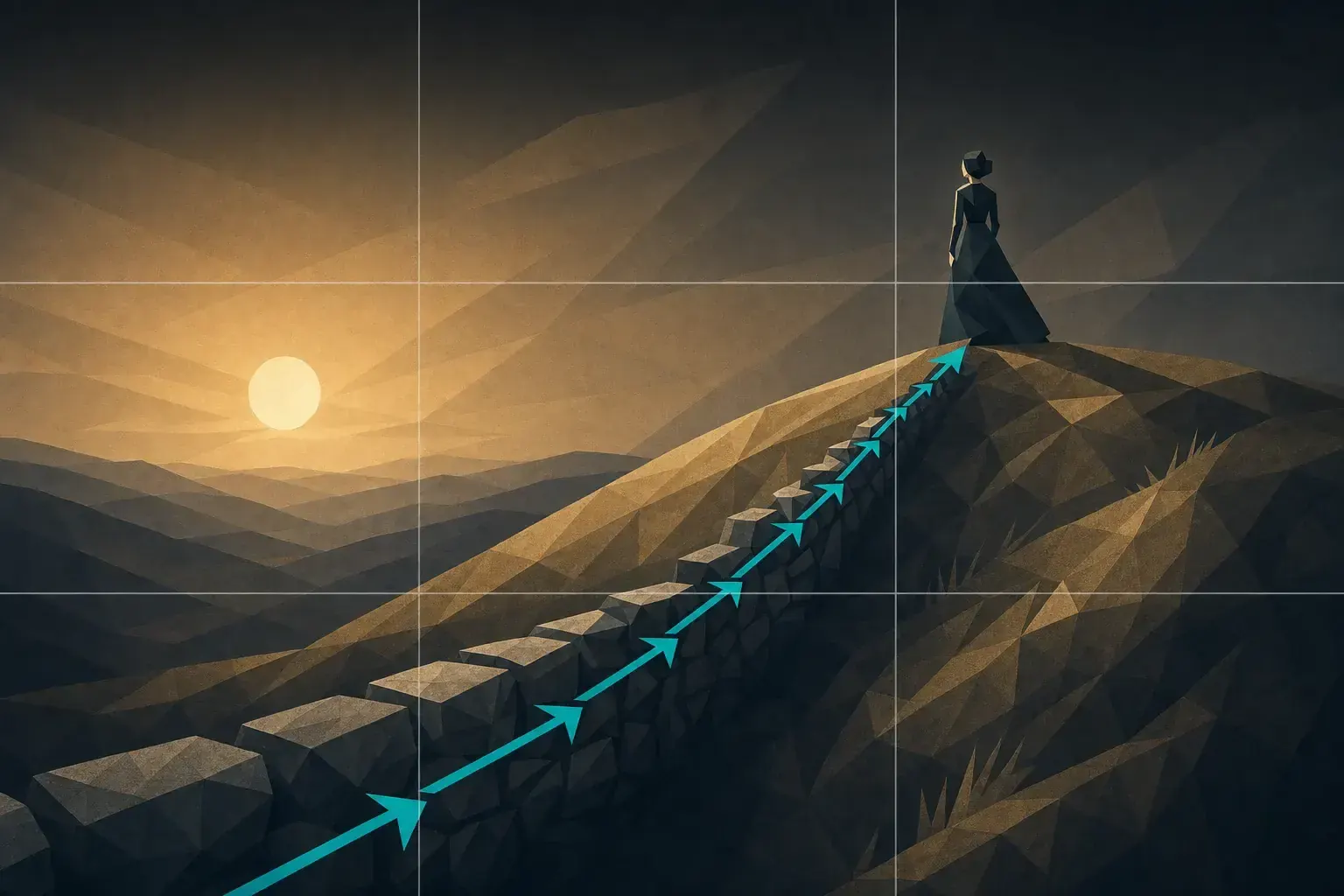
Say the route out loud. Entry, second stop, third stop, in words: "the eye enters at the lit face, drops to the hands, follows the table edge back." If you cannot narrate the path, there isn't one: you are hoping, not composing.
À la prise de vue
Move your feet first. Position is the most under-used tool in photography: most compositional problems are standing-in-the-wrong-place problems wearing a disguise. One step sideways separates the two elements that merge; two steps forward evicts the clutter at the borders; a crouch slides a foreground anchor under your subject and turns a flat scene into a deep one. And abandon eye-level as your default: it is usually the weakest viewpoint in the frame (the one every passerby already has). The zoom ring is not a substitute for any of this.
Choose focal length for relationship, not reach. Wide and close makes the near thing loom over the far thing: a statement about how they relate. Long and distant stacks them compressed and intimate: a different statement. Matching the crop by zooming from one spot changes nothing that matters: the geometry between elements is set by where you stand, and only by where you stand.
Build in layers: foreground, midground, background. A frame with one plane is a poster; a frame with three is a place. Exception: a deliberate top-down frame (the aerial nadir, the flat-lay) is a one-plane graphic by design, judged on pattern and division, not depth. And seal the edges in the viewfinder, not the crop later. Run edge patrol before you press, then wait. Let the pedestrian clear the corner, let the car leave the border. The discipline of the last two seconds is where 6s become 8s at zero cost.
En post-traitement
The crop is a second composition, and it deserves the same seriousness as the first. Recrop to move the subject off a dead placement, to seal a leaking border, to cut away the tangent you failed to see, to open the lead room a subject that looks or moves one way needs, to reduce the frame to the route that actually exists inside it. A subject shoved against the edge it faces reads as trapped or already leaving; the same subject with space opened ahead of its gaze or its stride reads as moving into the frame: the eye travels with a subject that has somewhere to go, and the crop can grant that room after the fact. Straighten a tilted horizon, then clone out the small edge distraction a crop can't reach without losing the subject: the litter, the sign corner, the bright speck bidding from a border. One ethics fence: in documentary work that clone is off the table (removing anything that stood in front of the lens breaks the genre's truth contract, and nature competition categories draw a similar line) so seal that edge with the crop or the burn instead. Then re-route with tone: dodge and burn are composition by other means. Darken the bright corner and the exit closes; lift the subject slightly and the entry point moves onto it. Attention follows luminance: you can redirect the stranger's eye after the fact by re-weighting the tones.
Now the honesty clause. Post cannot change where you stood. The angle, the perspective, the overlap of one element on another were fixed the instant the shutter closed. No crop builds the foreground relationship you didn't crouch for. No slider un-merges the pole from the head, because the merge lives in the geometry, not the pixels. A crop only subtracts: it can find a smaller, better photograph hiding inside yours, but it cannot add a viewpoint. One geometry exception: converging verticals on buildings are projection, not position (a perspective/keystone correction plumbs them convincingly in software, at the cost of some crop). When the diagnosis is position, the frame is capture-limited, and the honest fix costs nothing and cannot be bought in software: your feet, next time.
L'échelle
- Beginner: rules satisfied. Subject on a third, horizon level. The checklist passes; the eye lands and stalls. Placement without a path.
- Competent: edge-clean but static. Borders patrolled: no tangents, leaks, or amputations. The frame is hygienic and inert: nothing wrong, nothing moving.
- Strong (the serious amateur's working level): routed, with depth. An entry point, a statable eye-path through layered planes, and a return to the subject. The frame now directs attention instead of merely containing a subject.
- Advanced: composes by necessity. Every element load-bearing, negative space working actively, and the rules broken on purpose when the subject demands it: dead-center for confrontation, a hard edge-crop for unease. At this rung the frame doesn't follow the instructions; it writes them.
Allez le photographier
One static subject: a chair, a doorway, a lone tree, a parked bicycle. One window of even, unchanging light, so light can't take credit for anything. Now shoot it several distinct ways, changing only your position and keeping the subject (and, if you can, the lens) fixed: eye-level and honest, low and close, high and looking down, hard left, hard right, and one frame that places a found foreground element between you and the subject. Position is the only variable, because position is the lesson.
Import the set and grade it like a judge, not a parent. Squint-test each frame: in which does the brightest mass land on the subject? Edge-patrol each: which borders are sealed, which leak the eye out a corner? Then rank the whole set on one criterion only, eye-path clarity: in which frame can you narrate entry, route, and rest without lying? Notice which position won. It will rarely be the eye-level frame you would have taken by default, and the gap between the default and the winner is the exact size of the habit you came here to break.
Then close the loop. Re-critique the winner: just that one frame. A critique named composition as your ONE bottleneck, which is why you are reading this; the shoot is the experiment that tests whether the diagnosis still holds. If the route you built is real, the next critique should name a different bottleneck, and the FinalFrame Score has room to move with it. And if composition is named again, that is information, not indictment: either the route you built is real but subtler than one scene can prove, or your six positions circled a subject that only ever offered one honest frame. Both are worth the frames to know. The score is not the reward: the moved bottleneck is.