How to stack stars to cut noise
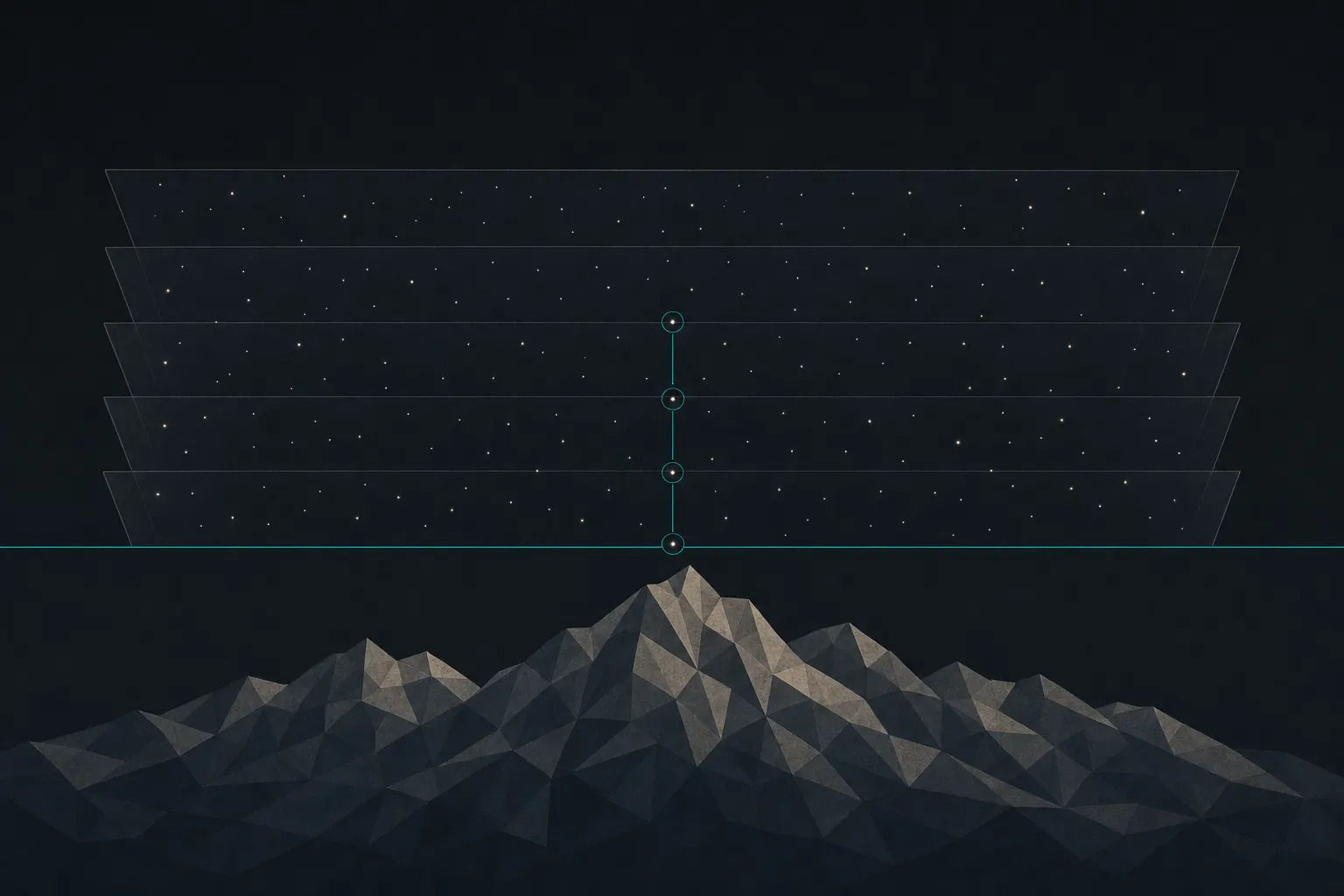
The night sky offers almost no light, and the sensor's answer to darkness is noise, so the single astro frame is trapped between two failures. Expose briefly at high ISO and the stars sit in a swarm of chroma speckle; leave the shutter open to gather more light and the Earth's rotation smears every star into a short trail, because past roughly 500 divided by your focal length in seconds (a guideline, not a law: high-resolution sensors show trailing sooner), the sky visibly moves. You cannot fix night noise by exposing longer. Star stacking dissolves the trap with arithmetic: shoot MANY short frames, each inside the trail limit, align them on the stars, and average them. The signal (the stars, the Milky Way) repeats identically in every frame; the noise is random and different each time, so averaging cancels it. The gain runs as the square root of the frame count: sixteen frames average roughly four times cleaner than one. The craft on site is mostly the same night discipline as the astro field guides: focus set once at infinity on a bright star and never touched again, an intervalometer running the sequence, the tripod untouched for the duration. The one twist is the ground: the aligner rotates the frames to follow the stars, which smears the un-moving foreground, so a serious frame shoots the land separately (one clean exposure) and joins sky to ground in the blend.
Starting points
- Per-frame shutter
- Under the trail limit: ~500 ÷ focal length (full-frame equivalent) in seconds (20mm ≈ 25s as a ceiling); use ~300 ÷ focal length if your sensor is dense or your standards are strict.
- Aperture & ISO
- Wide open (or a third-stop down), ISO 1600–6400, and expose BRIGHT. Underexposing 'to keep noise down' backfires: the noise is revealed when you lift the file, and the stack can only average what the frames gathered.
- Frame count
- Start at 10–20 frames; the improvement runs as √N, so 16 frames ≈ 4× cleaner, and going from 16 to 64 only doubles that again. More frames always help: at diminishing rates.
- Sequence
- An intervalometer (or the built-in one) with a 1–2s gap between frames, camera and tripod untouched for the whole run. Identical settings across every frame: the stack depends on it.
- Focus
- Magnified live view on the brightest star, focused once to a tight point, then locked in manual. A soft star field cannot be stacked sharp.
- The ground
- One separate, longer exposure for the foreground (the land doesn't move: it can go minutes at low ISO), blended with the stacked sky afterwards.
In the field
- Compute the per-frame ceiling (≈500 ÷ focal length) before leaving the house; know your number.
- Focus once at infinity on a bright star under magnification; lock to manual and tape the ring if you must.
- Set aperture wide, ISO honest, and confirm the first frame's histogram sits off the left wall.
- Run the sequence on an intervalometer: hands off the rig for the duration.
- Shoot the ground as its own longer, cleaner exposure while the tripod still stands.
- Stack the sky frames aligned on stars, blend the ground back in, and only then judge the noise.
When it fails
- Every star is a short dash instead of a point
- The per-frame shutter exceeded the trail limit for your focal length: the sky moved while the shutter was open, in every single frame, and the stack faithfully averaged the smear. Shorten the per-frame exposure below ~500 ÷ focal length and make up the light with more frames.
- The stack looks barely cleaner than a single frame
- The frames were underexposed, and lifting them in post amplified the very noise the stack was meant to cancel: averaging improves what was captured, it cannot conjure signal that never reached the sensor. Expose each frame brighter (the histogram off the left wall) and add frames: the gain is √N, so meaningful improvement needs dozens, not a handful.
- Sharp stars over a smeared, doubled foreground
- The aligner rotated every frame to follow the stars, and the un-moving land rotated with it. That is not a mistake in the stack: it is the reason the ground gets its own frame. Shoot one longer, low-ISO exposure for the foreground and blend it under the stacked sky.
Stitched or compressed: get the honest read.
A technique assembles the frames; a critique reads the result. Upload your finished panorama or a standout single frame and FinalFrame returns the full diagnosis: what works, what limits the frame, and whether the fix lives at the desk or back in the field.
Critica una foto