How to photograph lightning
Lightning shots fail empty: a night of frames with no bolt in any of them. Reaction is the wrong tool: a strike is finished in a fraction of a second, and by the time a hand answers what the eye saw, the sky is dark again. This is the purest case of what the timing lesson calls anticipation: you do not catch the moment, you build a trap for it. At night the trap is a long shutter aimed at the active cell and run back-to-back, so that a strike finds an open shutter to expose itself onto: the bolt, like a firework, is self-luminous, and aperture rather than shutter length decides how bright it writes. In daylight the same trap needs help: a strong ND filter to stretch the shutter into seconds, or a lightning trigger doing the reacting no hand can.
Safety
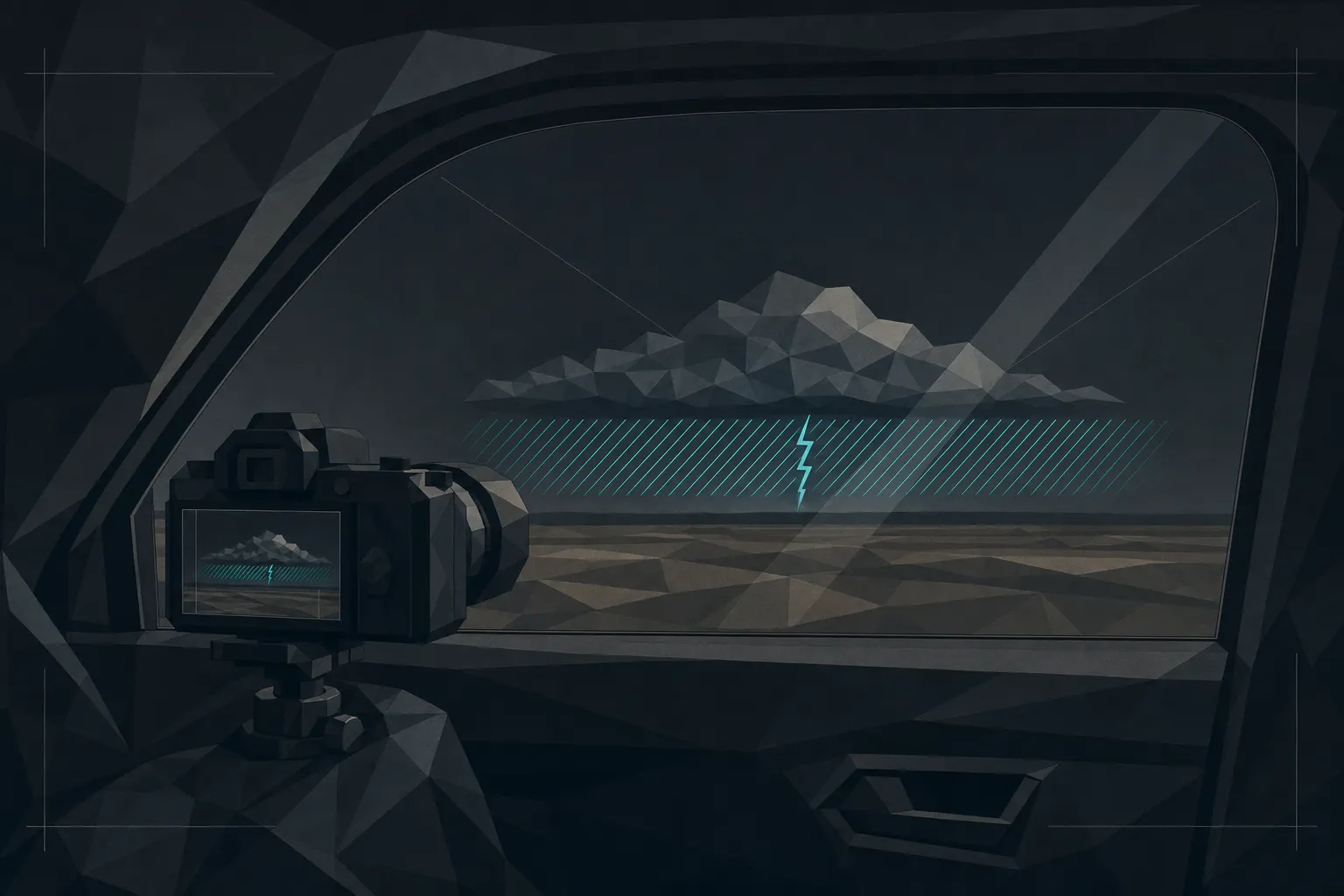
Distance first, photograph second. Count the seconds between flash and thunder: thirty or fewer means the storm is inside strike range (shoot from inside a car with the windows up or from a solid building, or point the lens at a distant cell instead of the one arriving). Standing in open ground beside a mounted tripod makes you one of the tallest things in the field with a hand on metal; no frame is worth that. Shooting through glass from shelter costs a little clarity, and it is the honest trade.
Starting points
- Shutter
- 10–30 s at night, run continuously: the strike exposes itself; the shutter's whole job is to be open when it happens.
- Aperture
- f/5.6 for distant cells; f/8–f/11 as the storm nears. Bolt brightness answers to aperture: the same law as fireworks.
- ISO
- 100–400. Bolts are bright; low gain keeps structure in the strike instead of clipping it.
- Focus
- Manual at infinity, confirmed on a distant light at magnification, then untouched.
- Cadence
- Intervalometer at zero gap. Every pause between frames is sky the trap is not watching.
- Daylight
- A strong ND filter to bring the shutter back into seconds, or a lightning trigger: reaction delegated to a circuit.
In the field
- Choose the shelter before the composition: a car, a building, or a distant cell (read the safety note first).
- Compose toward the active cell with real foreground; a bolt in an empty sky is a specimen, not a photograph.
- Lock manual infinity on a distant light, then start the intervalometer and leave it running.
- Re-aim as the cell walks: storms move, and the trap has to follow.
- Review sparingly; every review pause is an open-shutter gap surrendered.
When it fails
- Hours of frames, no bolt
- The trap had gaps. Strikes land between exposures whenever the camera waits: run the frames back-to-back with no review pauses, and widen the composition to cover more of the cell. The storm sets the hit rate; the trap only sets the odds.
- A bolt caught, but blown to a shapeless white flare
- Aperture too wide for the strike's distance. Close down (nearer, brighter bolts want f/8–f/11 where a distant cell tolerated f/5.6) and keep the ISO low; the branching structure inside the bolt is the first thing overexposure erases.
- Everything slightly soft
- Autofocus hunted a dark, low-contrast sky and settled somewhere useless. Focus manually on a distant light (a far streetlamp, a lit horizon) confirm at magnification, then leave the ring alone for the night. The focus lesson calls this plane discipline; here the plane is simply infinity.
Brought a frame back? Get the honest read.
A recipe is a starting point; a critique reads the result. Upload the night's best frame and FinalFrame returns the full diagnosis: what works, what limits the frame, and whether the fix lives at the desk or back in the field.
사진 비평받기