How to photograph a meteor shower
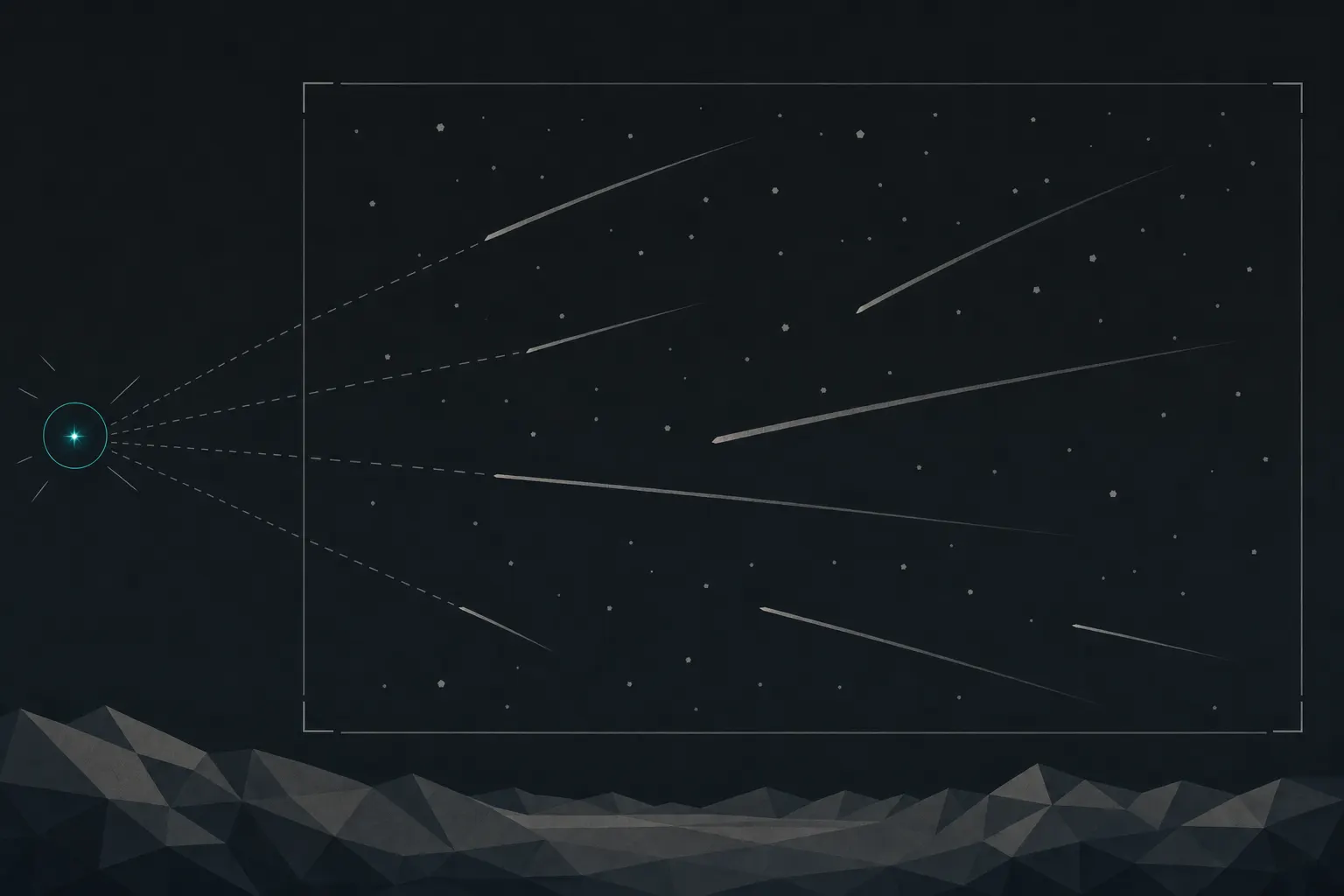
Meteor photographs fail invisibly: a whole night out and not one streak on the card, or hundreds of frames whose stars are all a hair soft. No reflex catches a meteor; a streak is written and gone in under a second, so the craft abandons reaction entirely and becomes a harvest: a wide frame, an intervalometer running back-to-back, and hours. The meteors land where and when they will; the frame count does the catching. Two decisions set the yield before the first exposure. The moon: a bright one washes the faint majority of streaks out of the sky, which is why the new-moon window around a shower's peak is the real appointment (the Perseids peak around August 12–13 each year, the Geminids in mid-December). And focus: every frame of the harvest inherits the one focus set in the dark, so an infinity missed by a hair is missed hundreds of times. Magnify a bright star in live view, make it a point, and re-check during the night. Aim wide of the shower's radiant (streaks grow longer away from it) and if what you actually want is the stars themselves drawing arcs, that is a different recipe: deliberate star trails belong to the long-exposure lesson.
Starting points
- Field of view
- The widest lens you have. The harvest scales with sky covered: this is a numbers game before it is anything else.
- Aperture
- Wide open. A meteor writes once, briefly: only aperture and gain decide whether it registers; a longer shutter brightens the sky, never the streak.
- Shutter
- 10–20 s: short enough that stars stay points at your focal length. Longer trades points for trails without adding a single meteor.
- ISO
- 1600–6400. Noise is treatable; a streak the sensor never registered is not.
- Focus
- Manual infinity on a magnified bright star, then hands off the ring, and re-checked during the night; temperature drift moves it on many lenses.
- Cadence
- Intervalometer at minimal gap, batteries and cards sized for hours. Gaps in the sequence are meteors surrendered.
In the field
- Plan the peak night and the moon together: a dark site inside the new-moon window is most of the result.
- Aim well away from the radiant (streaks lengthen there) and put land in the bottom of the frame for scale.
- Focus on a bright star at maximum live-view magnification; confirm it renders as a point.
- Start the intervalometer, then stop touching the camera.
- Re-verify focus after an hour or any temperature change.
- Expect satellites and aircraft in the harvest: a meteor tapers and flares mid-streak, a satellite draws one even line, a plane blinks; cull by that, not by excitement.
When it fails
- Every star slightly soft, all night
- Infinity was missed by a hair and inherited by the entire harvest. The hard stop on the ring is not infinity on many lenses: focus by magnified live view on a bright star, and re-check through the night; cold moves the ring.
- Streaks seen but barely recorded
- The transient was starved. Open the aperture fully and raise the ISO: a meteor's brightness answers to aperture and gain only; stretching the shutter just lifts the sky glow around it.
- An orange-grey sky and a thin harvest
- Moonlight or light pollution raised the sky's floor above the faint streaks. No slider recovers a meteor buried in glow, the fix is the calendar and the map: a darker site, inside the new-moon window.
Brought a frame back? Get the honest read.
A recipe is a starting point; a critique reads the result. Upload the night's best frame and FinalFrame returns the full diagnosis: what works, what limits the frame, and whether the fix lives at the desk or back in the field.
Criticar uma foto