Landschaft
Das Handwerk hinter einem starken Bild – und was eine 6 von einer 8 unterscheidet.
FinalFrame bewertet jedes Foto von 0–10: eine 6 ist solide, eine 8 ist portfoliowürdig und eine 9 ist ausstellungsreif. So funktioniert die Bewertung
Sehen
Landscape is the one genre where the subject holds still and the light does not, which means the story is told by the hour rather than the moment, and the photograph is mostly made before the tripod opens, in the decision about when to stand there and what the frame is about. Start with the sentence test: say out loud what this photograph is about. "A mountain" is not a thesis. "The way the last light separates that ridge from the valley fog" is, and it tells you where to stand, what to exclude, and when the picture exists at all. A scene without a sentence produces a frame without a route.
Then read the light for direction before you read it for color. Golden hour is prized not because it is warm but because it is low: light raking across terrain gives every ridge, furrow, and dune a shadow, and shadow is how a flat print describes three-dimensional ground. Noon light falls from above and describes nothing. Scout at noon; shoot at the edges of the day. And treat weather as material, not obstacle. Fog is the great simplifier, it does tonally what most photographers fail to do in post: near objects render dark, far ones fade pale, and the scene arrives with its planes already separated. A clearing storm hands you a sky the calm evening never will.
Two field habits, both free. Turn around: the light you are pointing into is often lighting something better behind you, and the habit costs one glance. And revisit: the scene is fixed and the light is the variable, so landscape rewards the photographer who returns to a known composition under a better sky more than the one who hunts new ground in dead light.
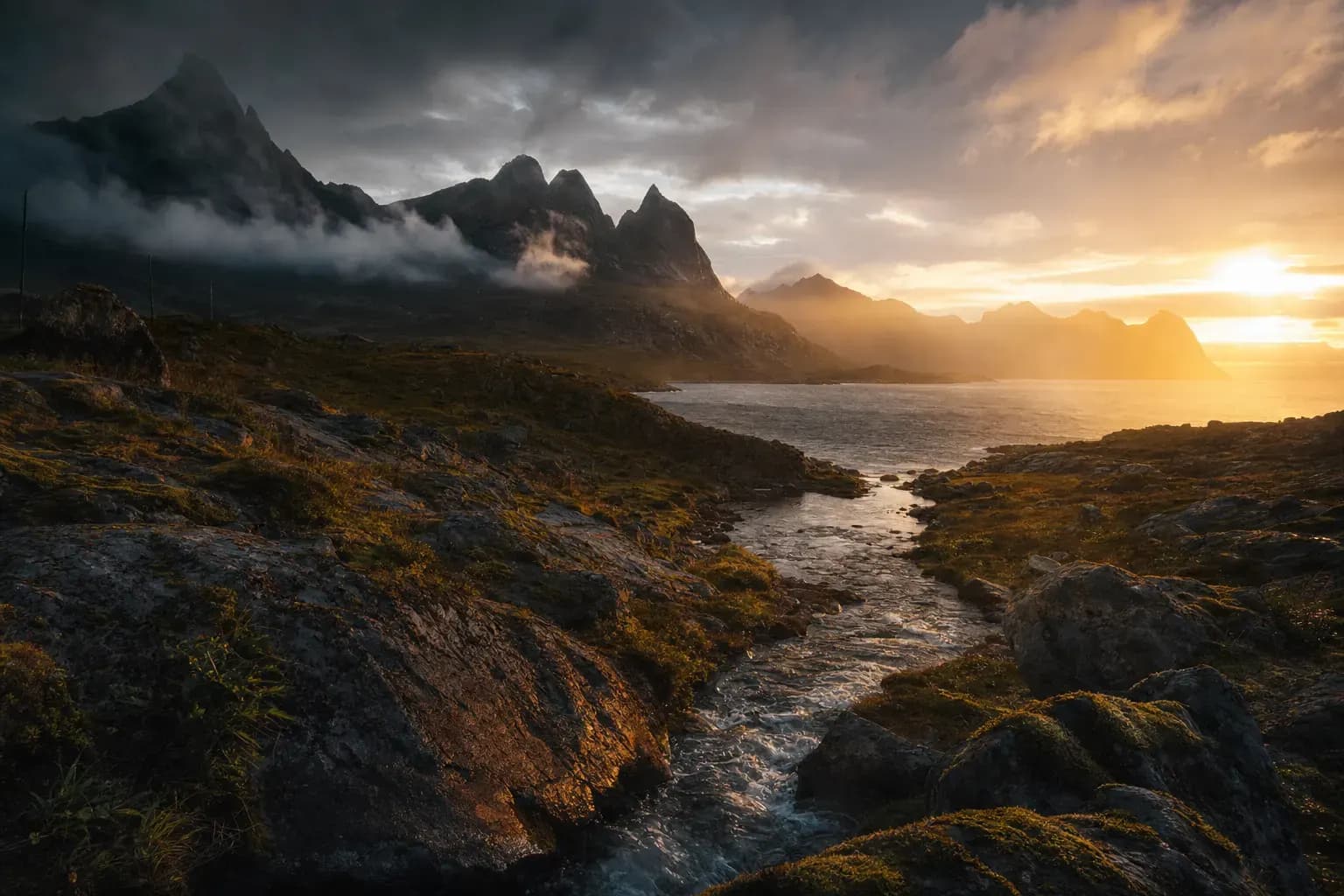
KI-generiert
Aufnehmen
The signature landscape construction is near-far: a wide lens, a low camera, a foreground anchor close enough to touch, and the distance stacked behind it. That construction lives or dies on depth of field, and depth of field is a solved problem: hyperfocal focusing. Focus at the hyperfocal distance and everything from roughly half that distance to infinity is acceptably sharp. In the field, without an app: focus on a point about twice as far away as the nearest foreground element you need sharp, then magnify the far edge on the screen and confirm. Ten seconds, and the guesswork is gone.
Aperture is a genuine sweet spot, not a superstition. Wide open, or even at f/4, a near-far frame simply does not have the depth. Stopped down past f/16, diffraction, light bending at the aperture's edge, begins to soften the entire frame: you buy a little more depth at the near limit and pay for it with acuity everywhere. f/8 to f/11 is the working compromise: inside most lenses' best range, deep enough once hyperfocal focusing is doing its job, before the diffraction tax comes due.
Put the camera on a tripod at base ISO: the ground is not moving, so there is no reason to pay noise for shutter speed. The exception is motion inside the frame: wind in foliage, moving water. Then shutter speed becomes a creative decision again, and you choose it on purpose.
Hyperfocal has one honest limit, and it is the near-far frame's own signature: when the foreground anchor is genuinely close enough to touch and the far distance must stay sharp, no single frame holds both, not even at the diffraction wall.
The answer is not to grind past the sweet spot and eat the softness; it is focus stacking: two or three frames with focus walked from the nearest detail out to infinity, blended in post into one front-to-back-sharp file, tripod locked, framing unchanged, base ISO. It is the same technique macro leans on, borrowed for the one landscape frame a single capture genuinely cannot cover.
Manage tone with the histogram, not the LCD. Expose to the right: the brightest exposure that does not clip an important highlight, because a sensor's data lives disproportionately in the bright half of its range. A modern camera's RAW file holds twelve to fourteen stops or more, which means most scenes fit inside one thoughtful exposure.
When the scene genuinely exceeds that budget, shooting into a sunrise where the sky and the shaded foreground both matter, bracket and blend, or pull the sky down with a graduated filter. Blending is a tool for exceeded range, not a default workflow: if one exposure holds the scene, one exposure is cleaner, faster, and more honest.
- Aperture
- f/8–f/11: the sweet spot; past f/16, diffraction softens the whole frame
- Focus
- hyperfocal: focus ~2× the nearest sharp element, then confirm the far edge magnified
- ISO
- base, on a tripod: the ground isn't moving
- Focus stacking
- 2–3 frames, focus walked near→infinity: when one frame can't hold both
- Dynamic range
- expose to the right; a RAW file holds 12–14 stops, so most scenes fit one exposure
- Exceeded range
- bracket + blend, or a graduated filter: only when one exposure can't hold the scene
Bearbeiten
The first job of a landscape edit is not color. It is tonal hierarchy: decide which plane of the image should be brightest, which darkest, and make the global tone curve serve that order before touching anything local. Then dodge and burn to reinforce what the light started: darken the corner that leaks the eye out of the frame, hold the foreground a half-step down, let the lit ridge carry the brightest tone. You are not decorating; you are finishing the plane separation the hour gave you. Color comes last and matters less than you think: saturation is earned by tonal structure, and poured onto a muddled one it reads as noise.
The classic landscape over-edit is, paradoxically, a flattening. Saturation pushed to the ceiling, shadows lifted everywhere, clarity everywhere: the HDR look. Lifting every shadow deletes the depth cue: when everything is a midtone, the planes merge and the frame goes flat in exactly the way fog un-flattens. The stopping rule: stop when the edit starts announcing itself (halos along the ridge line, water that glows, greens no vegetation grows). Walk away, come back, look at it small.
The honesty clause: post cannot change where the light came from. No slider re-rakes a noon sun across the terrain; dehaze cannot manufacture the atmosphere that separates planes; there is no foreground-anchor tool. If the raw file is evenly lit and every plane carries the same weight, the scene was recorded, not seen: that is capture-limited, and the fix is going back at the right hour, not saturating the record of the wrong one.
Bewerten
Borrow the product's discipline for your own review. The FinalFrame Score is a lane-weighted blend, and the critique names your ONE bottleneck, the single limit costing you the most, rather than handing you a scorecard of sub-grades. Self-critique the same way: do not audit ten things at once; name the one thing this frame is actually limited by, and ignore the rest until it is fixed. For landscapes sitting at 6 or 7, that named limit is usually composition or tonal hierarchy (a route problem or a mud problem) and almost never sharpness, and almost never gear. Above 8 the bottleneck migrates to micro-polish: a processing halo, a bright sliver in a corner, a horizon half a degree off, an edge the crop should have sealed.
- The thumbnail test. Shrink the frame: if the structure survives small, it's structure; if the image depends on detail to work, it has none.
- The route test. Name what the eye hits first, second, third: if you can't say it, your viewer can't see it.
- The hour test: if the frame would look the same in any light, the light did none of the work.
Warum eine 6 keine 8 ist
The 6 is a good record of a beautiful place, and that is the ceiling of a record. Exposure correct, horizon level, the scene recognizable and even enviable. But the eye lands on the vista, sweeps it once, and is finished, because the frame is an account of what was there, not an argument about it. The tonal tell is mud: foreground, midground, and distance all carrying the same visual weight, so the depth the scene actually had collapses to postcard-flat. A 6 proves the place was there. An 8 shows what made it worth a frame.
The 8 is a thesis executed with discipline. The planes are layered front to back with tonal separation between them: each a deliberate step lighter or darker, so depth is felt before it is inspected. The light sculpts rather than illuminates: shadows model the terrain instead of merely accompanying it. And the frame shows restraint: the wide lens invited everything in, and only what earns its place stayed. Remove the foreground stone and the structure collapses; nothing else could go, and nothing more was needed.
The gap is rarely gear and rarely an exotic location: the 6 and the 8 are routinely made from the same tripod holes. The difference is deliberateness, and deliberateness shows: an 8 carries the hour it waited for, the anchor that holds the frame, one tonal plan run from the histogram to the final edit. A 6 carries none of them. The cruelest diagnostic question a landscape can face: could this frame have been made at any hour of the day? A 6 usually could. An 8 could only have been made in the twenty minutes it was.
So when a critique names your bottleneck, shoot it again for that one thing (the hour, the anchor, the tonal plan) and let the next FinalFrame Score tell you whether it moved. And if the same bottleneck is named again, that is information, not indictment: knowing the fix cannot schedule the weather, and the right twenty minutes cannot be summoned, only met. The anchor and the tonal plan are not settings to dial in; they are ways of seeing, and the seeing sharpens with every frame you make, including the ones that stay a 6. Landscape has always been the craft of the return: the scene is fixed, the light is the variable, and the 8 is waiting in the same tripod holes the 6 was made from. Go back.
Verwandte Lektionen
Sieh es an deinem eigenen Foto
Am schnellsten verstehst du den Score, wenn du ihn an einem Bild liest, das du gut kennst.
Foto kritisieren lassen