Reise
Das Handwerk hinter einem starken Bild – und was eine 6 von einer 8 unterscheidet.
FinalFrame bewertet jedes Foto von 0–10: eine 6 ist solide, eine 8 ist portfoliowürdig und eine 9 ist ausstellungsreif. So funktioniert die Bewertung
Sehen
Travel is the meta-genre, and the one where storytelling has to be planned before its frames can be found. It borrows landscape's light, street's timing, portraiture's people, and architecture's lines, but its own subject is none of those things. Its subject is place: the specific, textured fact of somewhere that is not home. The working question before every frame is the same: what does this place feel like that nowhere else does, and is that in the frame? Which makes travel's first enemy the postcard. Arrive anywhere famous and the composition on offer is the one already made: the shared vantage, the frame every visitor carries home, worn smooth by repetition until it says nothing about being there and everything about having been. Take that frame once; it is the establishing note, and refusing it is its own kind of cliché. Then turn around. The photograph of a place usually lives behind the photograph of the place: the alley the monument shadows, the vendor's hands at the stall that feeds the queue, the laundry strung between the facades the guidebook cropped out. Seeing a place freshly is a discipline, not a gift: it means noticing what a local has stopped seeing and a postcard never showed.
The second discipline is coverage thinking, and it is what separates travel from every genre it borrows from. A place is not one photograph; it is a set with three jobs. The wide establishing frame answers where are we: geography, scale, light on the whole scene. The environmental portrait answers who lives here: a person in their context, the human fact of the place. The telling detail answers what could only be here: the texture, the object, the small specific thing that carries the whole culture in close-up. Each frame is judged alone, but each should know which of the three jobs it is doing. A frame that tries to establish, humanize, and detail all at once usually does none of them, and a travel take with no job assignments reads as a walk with a camera, not a portrait of a place.
The third discipline is light in a place whose light is unknown. At home the sun's path is memorized; traveling, there is one morning, maybe two, and no second chance to learn from the first. So scouting compresses: the midday arrival walk is reconnaissance, not photography (note which facades catch the low east light, where the street opens west toward the sunset, where the market spills into shade) and return at the edges of the day, when the low sun rakes texture out of stone and the blue hour balances sky against the first lamps. Midday is not wasted; it is reassigned: shade, interiors, markets under awnings, the detail frames that soft directionless light serves. And mornings hold a quieter advantage: early, a famous place belongs to the people who live there (deliveries, sweeping, the market being built) and for one hour the photograph on offer is the town, not the tourism. Weather obeys the same logic: rain empties the famous square, glazes it into reflections, and puts umbrellas in every frame. What the forecast calls bad is often what the take was missing.
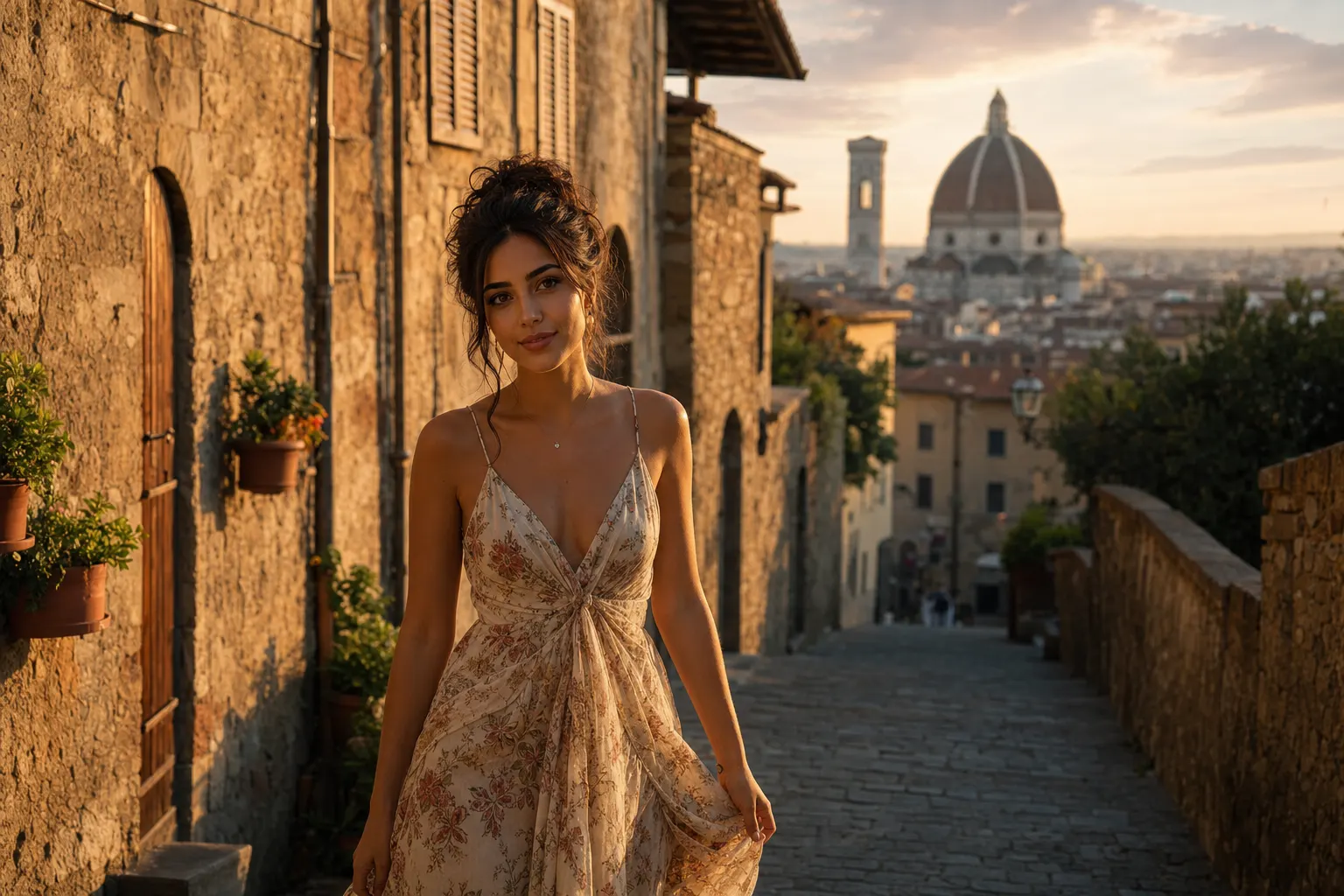
KI-generiert
Aufnehmen
The kit discipline comes first because travel punishes weight like no other genre. The tenth hour on foot is where the day's best light usually falls, and the camera that shoots it is the one still on the shoulder: a body and a versatile zoom, or a small prime pair, chosen once and carried everywhere. Gear resting at the hotel takes no photographs.
Keep the camera set for the street it is walking through (a middle aperture, a shutter fast enough for walking pace, ISO floating) because a place offers its moments unscheduled, and the frame that defines a trip rarely announces itself first.
People carry the strongest travel frames, and photographing them well is as much conduct as craft. The working sequence is exchange first, camera second: buy something at the stall, learn the greeting, ask (a gesture toward the camera and a raised eyebrow translate everywhere). A permitted portrait buys what no focal length can: proximity, eye contact, a subject at ease in their own context (the environmental portrait made from two meters with a normal lens, the workshop or the stall or the doorway wrapping the person in their own story). A long-lens frame taken without consent reads exactly like what it is, and the frame carries that unease on its surface.
The dignity rule is portable across every border: photograph people the way being photographed would be acceptable at home. At worship, at ceremonies, at grief, the moment being lived outranks the frame: some places treat photography as a welcome transaction, some as an intrusion, and reading which one this is is the craft. A travel take that treats people as props scores like it treats them.
Then the frames themselves, by job. The establishing wide needs structure or it collapses into scenery: a foreground that belongs (the boat, the doorway, the rack of drying nets) then a middle distance where something is happening, then the landmark or landscape as context rather than catalog. A wide lens up close inflates that foreground and stretches the near-to-far relationship; that is its power and its trap: the anchor grows, but so does every stray object near the frame's edge. A human figure placed small against the big scene does what no caption can: it gives the place its true size.
The telling detail runs the opposite way, move close, let shallow depth of field lift the specific out of the busy, and fill the frame with texture: the spice pyramid, the worn door handle, the script on the shop sign. And between both sits the street inheritance: find the stage first (the good light, the clean background, the wall the color of the town) and wait for the actor to arrive. In an unfamiliar place the wait is shorter than the search; good backgrounds are everywhere someone hasn't stopped to notice them.
Bearbeiten
A travel take is edited as a set before it is edited as frames. The place has one palette: the render that makes noon and dusk and the market interior all agree about what color the town was is the render that makes the take read as somewhere, not as twelve separate photographs. And the palette belongs to the place, not the slider: the market was already saturated, the sea already turquoise; pushing color past what the light actually delivered tips memory into caricature, and the travel-filter look (crunchy clarity, haloed skies, saturation at a shout) reads as an effect applied to a place rather than a place seen. The strongest travel processing is the kind that leaves a viewer certain none happened.
The honest work is local and quiet. Recover the sky a stop where the dynamic range fought back, lift the shadowed side of the street, clone the sensor spot from the blue, tighten the crop until the frame commits to its job. Keep the color of light honest above all, the warm cast of evening stone, the tungsten glow of market bulbs against blue dusk: that cast is the place, and neutralizing it to textbook white launders the atmosphere out of the frame. Straighten the horizon, respect the verticals on the wide architecture frames, and stop while the edit is still invisible.
And the honest truth, which travel enforces with a plane ticket: post cannot rescue what the trip did not give. The fog that lifted at seven, the shaft of light that crossed the market for four minutes, the procession that passed once: these are capture-limited, and no edit re-books the itinerary. A frame made at noon cannot be graded into morning; relighting by slider reads as exactly that, because the shadows remember where the sun really was. No crop restores the permission that wasn't asked, and no palette manufactures a sense of place the frame never contained. Editing polishes what the journey brought home. The fix is at capture, next time: an earlier alarm, a longer stay, a different season, or the humility to sit in one place until it starts behaving like itself.
Bewerten
Self-critique with the same lens the product uses. The FinalFrame Score is a lane-weighted blend, and the critique names ONE bottleneck, the single highest-leverage weakness in the frame, not a per-category report card. Read it as the answer to "what do I fix at the next destination," because that is exactly what it is, and it packs lighter than any lens.
For travel frames in the 6–7 band, the bottleneck is most often the sense of place itself or the light: the frame is a competent record that could have been made anywhere (a beach, an old street, a pretty door with no country attached) or it is precisely the postcard, the shared vantage at the shared hour, flat midday light on a famous thing. At 8 and above, the bottlenecks shift to refinement: layering in the busy wide, edge discipline in a crowded market frame, the stray tourist's elbow at the border, highlight handling on whitewashed walls, the human element present but not yet doing anything.
- Cover the landmark with a thumb: does the frame still hold, still say where it is?
- Shrink to a thumbnail: does one subject read at a glance, or does the scene dissolve into busy?
- The harder question, the one that decides the band: does the frame show what the place looked like, or what it felt like to stand in it, and could it have been taken at home?
Warum eine 6 keine 8 ist
The 6 is correct, and correctness is its ceiling. Exposure holds, the horizon is straight, the landmark is identifiable and centered, the sky is blue. But it is the shared frame: made from where everyone stands, at the hour everyone is there, in the flat light of the middle of the day. No one lives in it (no figure for scale, no hand at work, no local fact) and nothing in it could only have happened that morning. It proves presence the way a boarding pass does. The diagnostic tell: the caption it wants is a location pin, not a sentence.
An 8 is a place-portrait. The light was chosen: the frame waited for the hour when the stone goes gold or the market bulbs come on against the blue. The composition is layered: a foreground that belongs to the place, a middle distance where the town is being itself, the famous thing present as context instead of catalog. Someone is in it (met, not taken) or something is: the detail that carries the culture in close-up, the moment that happened once. The 8 makes a viewer who has stood there say that is exactly it, and a viewer who hasn't start checking flights. The distance between the two frames is rarely equipment. It is an earlier alarm, a conversation at a stall, and the decision to walk one street past the photograph everyone else stopped at.
So shoot the next place for the one thing the critique named: the bottleneck travels lighter than the tripod. If it was sense of place, assign every frame one of the three jobs and spend the first hour finding what the postcard leaves out; if it was light, move the wides to the edges of the day and give noon to the shade and the details; if it was the human element, lead with the greeting and let the portrait follow the exchange. If the fix is real, you'll see it in the take before the score shows it: the next critique names a different limit, and the FinalFrame Score has room to move, because the frames have stopped reporting the trip and started describing the place. And if the same bottleneck is named again, that is information, not indictment. Travel carries a constraint no other genre does: the place gets one pass. Its light is learned across mornings the itinerary never granted, its unguarded hours follow a rhythm no first-time visitor knows, and the moment that defines it may simply not have been scheduled for the one day the trip allowed. Sometimes the repeated bottleneck is naming the itinerary, not the eye (five cities in six days is a coverage problem no f-stop solves) and the fix is fewer places held longer, or a return ticket. Read it as a description of what the journey had time to give. The sense of place is still there, waiting past the postcard, and the next departure is the chance to go meet it.
Verwandte Lektionen
Sieh es an deinem eigenen Foto
Am schnellsten verstehst du den Score, wenn du ihn an einem Bild liest, das du gut kennst.
Foto kritisieren lassen