Clutter
Distracting elements that compete with the subject for attention.
FinalFrame puntúa cada foto de 0 a 10: un 6 es competente, un 8 es digno de portafolio y un 9 es de calidad de exposición. Cómo funciona la puntuación
Qué es en realidad
Clutter is attention theft: any element in the frame that draws a share of the viewer's eye and pays nothing back to the subject. It earns a lesson of its own because it has an inventory of its own: the bright patch in a corner, the half-object leaning in from a border, the power line ruling the sky, the pole growing out of a head, the red jacket loose in a muted scene, the signage the eye cannot decline to read. None of these is the composition. Every one of them is a tax on it, collected from the viewer's attention on every single viewing.
Two boundaries keep this lesson honest. The first is with composition: composition choreographs where the eye travels; clutter is the audit of everything hijacking the route. The second is with negative space, this lesson's inverse: negative space is emptiness given a job (room that isolates, balances, lets a subject breathe). Clutter is occupancy without one. The two crafts patrol the same rectangle from opposite ends: one asks whether the nothing is working, the other whether the something is.
Which is why the test was never "is the background busy?" A market scene can be dense and immaculate at once; a bare wall can hold one wrong shadow and be cluttered. The test is whether each element earns its share of attention. Context that feeds the story is content. Anything on the payroll of nothing is clutter.

Generada por IA
Por qué un 6 no es un 8
A 6 has a subject and a rival, and the viewer's eye commutes between them. The frame is otherwise competent (subject placed, exposure fine) but a bright triangle of sky burns in one corner, a stranger's elbow enters at a border, a lamp post kisses the subject's head, a red car parks in the wrong story. Nobody saw them when the shutter fired, because attention was on the subject; every viewer sees them first, because the eye obeys brightness and contrast, not intent. That leak is a fixed cost the image pays each time it is looked at, and it is what holds so much otherwise-competent work short of the frames that win: the skill is visible, the command is not.
An 8 has no rivals. Everything that is not the subject is quietly employed by it, and employed is the word, because an 8 is not empty. It can be layered, even dense; what it cannot be is unaudited, and its edges are patrolled to the last sliver. The judge's tell is a single question: name the SECOND thing your eye visits. In a 6 the honest answer is a distraction: a bright spot, a merge, a stray object with no role. In an 8 the second thing is a supporting element that hands the eye straight back. Judges read that fluency as professionalism because it is the hardest habit to fake: it means the whole rectangle was seen, not just the thing loved in the middle of it. The audited rectangle, not the empty one, is the whole distance between the two scores.
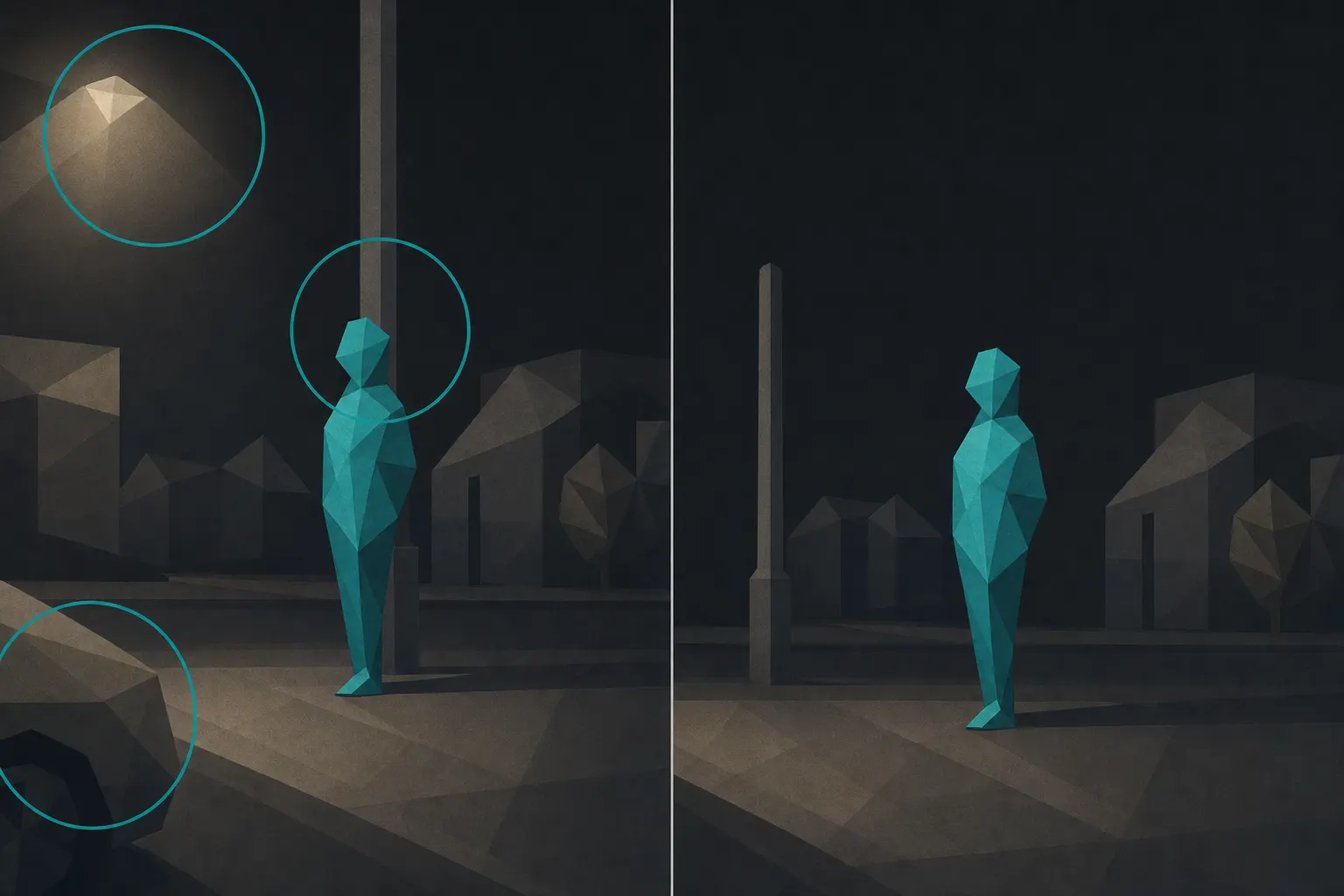
Antes de disparar
Run the inventory before the shutter, because almost every distraction is already visible in the viewfinder: to anyone looking at the rectangle instead of the subject. Take the two tools the composition lesson gave you and aim them at this one failure class.
Squint first. Detail dissolves into tonal masses, and any bright mass that survives the squint and is not your subject is thief number one. The eye goes to brightness and contrast before anything else, and warm, sharp, and human-shaped all jump the queue. Then patrol the edges for half-things: partial objects entering the frame, limbs and poles and door frames that belong to nothing, bright slivers where the background burns through a border.
Then hunt the merges, the overlaps that flatten space: a branch growing from a hat, the horizon slicing a neck, two heads fusing into one silhouette. Merges are invisible while you watch the subject and glaring in the finished frame, because a photograph collapses depth in a way standing at the scene never does: two eyes and a moving head keep the planes apart in the world; the print has one eye, and it never moves. Last, scan for the two magnets the eye cannot refuse: a saturated color pop in an otherwise quiet palette, and text (the eye reads writing compulsively before it grants any subject a second look).

En la cámara
Your feet are the de-clutter tool, exactly as they are the composition tool. One step sideways un-merges the pole and the head; a knee bend drops a cluttered horizon out of a neck and into clean background; two steps forward evict the stranger's elbow without surrendering a pixel to the crop. Change the angle and you have changed the entire background: the same subject shot from slightly above trades a busy street for quiet pavement. All of this costs seconds and zero image quality, which is why it beats every post-processing fix ever invented.
When you cannot move, change the optics or the moment. A longer focal length narrows the angle of view until the background is a sliver you can choose: selection, before blur, is the long lens's real de-clutter power. And the levers of background blur stack: a wider aperture, a longer lens, a closer approach to the subject, a background pushed deeper behind it (together they melt what you could not exclude). Some clutter is temporal: the pedestrian mid-frame, the car that will pass, the flag that will drop in the lull between gusts. Compose the clean frame and wait for the scene to clear it. Patience is a de-cluttering instrument, and it is free.
En la edición
Post gives you a real toolkit here: in escalating order of intervention, and the order is the discipline. Crop first: the cheapest removal redraws the border so the distraction was never in the picture, and a slight tightening kills most edge junk. Then demote with tone: burn down the bright corner and you have not deleted the thief so much as fired it (darkened, it stops pulling the eye, and tonal demotion almost always reads more naturally than erasure). Desaturate the color pop selectively for the same demotion in the color channel. Only then clone or heal: small, discrete objects on clean backgrounds (a can on pavement, a wire against open sky) vanish convincingly, and that is exactly what the tools are for. One ethics line while the healing brush is in your hand: in documentary work this step is off the table entirely (removing anything that stood in front of the lens breaks the genre's truth contract, and the standard is not whether anyone would notice but whether the RAW, set beside the edit, would tell the same story); demote with tone and crop instead. Nature competition categories draw a similar line: read the rules before the brush touches an entry.
The honesty clause: post removes objects, not relationships. A merge that runs THROUGH the subject (branches woven into hair, a pole overlapping a jaw) cannot be healed cleanly, because there is no true edge behind it to rebuild; the repair reads as smudge. A background busy at the subject's own focus distance cannot be convincingly blurred after the fact: synthetic blur wraps the outline in a telltale glow. And a frame whose clutter is structural, a scene that never organized around anything, is a composition problem wearing clutter's clothes. All three are capture-limited: the fix was one step sideways, one knee bend, one beat of patience before the shutter, and no brush performs it afterward.
La escalera
- Beginner: sees only the subject. Discovers the photobombing lamp post, the burnt corner, and the merge at home, frame after frame; the rectangle was never looked at, only the thing inside it.
- Competent: patrols edges and catches the big offenders. Still misses merges and tonal leaks, and reaches for the clone tool as a first resort instead of a last.
- Strong (the serious club competitor's level): runs the full inventory in the viewfinder. Squint for bright thieves, edge patrol for half-objects, a deliberate merge-check around the subject's outline; moves feet first, waits the scene clear, and uses post for demotion more than deletion.
- Advanced: audits the rectangle by reflex. Works dense, layered scenes where nothing is idle and every background element is employed; kills distractions at capture so consistently the healing brush becomes a rarity, and knows when the apparent clutter IS the story, and keeps it.
Ve y dispara
Find one subject in a genuinely messy environment (a market stall, a busy corner, a cluttered kitchen) and fix the light, the subject, and your exposure, so nothing else can take credit for what changes. First, shoot the frame you would have shot anyway: subject in your attention, one exposure, no audit. Then make FIVE more frames, removing exactly ONE distraction per frame, capture tools only: step sideways to break a merge; crouch or climb to swap the background; tighten the framing to evict the edge junk; wait out a moving distraction; and for the last frame, use closeness and aperture to melt whatever remains. No cloning afterward: the constraint is that every removal happens before the shutter, because the lesson is that it can.
Import all six and run the second-thing test on each, out loud: name the second element your eye visits. Watch the answer migrate across the sequence: in frame one it is a thief; by frame six it should be a supporting element that hands the eye straight back to the subject.
Then close the loop with a single re-critique of frame six. Clutter is why you are on this page (a critique named it as your ONE bottleneck) and five deliberate removals are exactly the evidence that should un-name it, with the FinalFrame Score recovering whatever the thieves were costing. Two other readings are worth being ready for, and neither is an indictment. If the new bottleneck is composition, take it as confirmation rather than contamination: clutter is composition's failure class, and an audit that cleaned the rectangle has simply uncovered the next question (where the eye should go, now that nothing steals it). And if clutter is named again, run the second-thing test on frame six once more and believe your own answer: either one distraction outlived the whole sequence (information, cheap to fix next frame) or the scene never had a clean frame to give, which is a lesson about choosing scenes that no amount of edge patrol replaces. Both are worth six frames to know. The audit is the skill; the score only reports whether the rectangle passed it.