Negative Space
Empty areas in the frame that give the subject room to breathe.
FinalFrame puntúa cada foto de 0 a 10: un 6 es competente, un 8 es digno de portafolio y un 9 es de calidad de exposición. Cómo funciona la puntuación
Qué es en realidad
Negative space is emptiness given a job. Every frame divides into two territories: positive space (the subject, the stuff) and negative space, the field around it. The beginner composes the first and inherits the second: to them, the empty area is what the picture is not, the background that happened to be there once the subject was placed. To a photographer working at this craft, the empty area IS the picture: a shape with its own weight, its own edges, its own task, designed as consciously as the subject it surrounds and sometimes the more interesting of the two. The whole craft is that promotion: emptiness raised from leftover to element.
And here is the paradox that makes the craft worth having: emptiness does not shrink a subject (it crowns it). A subject occupying a sliver of the frame can own all of its attention, provided the rest is genuinely empty, because an uncontested element wins every glance; each path the eye takes ends on it. Breathing room is not generosity toward the viewer. It is dominance handed to the subject.
Two boundaries make the term precise, because it sits between two lessons it is not. It is not composition: composition choreographs the whole arrangement (entry, route, rest); negative space is one instrument inside that orchestra, the specific craft of making nothing do positive work. And it is emphatically not the absence of clutter, though the two patrol the same rectangle from opposite ends. De-cluttering subtracts: it removes distractions to protect the subject. Negative space adds: the deliberate presence of void contributes what the subject cannot carry alone (isolation, scale, silence, tension, room to breathe). A clean background is merely uncontested. Negative space is a clean field with a purpose.
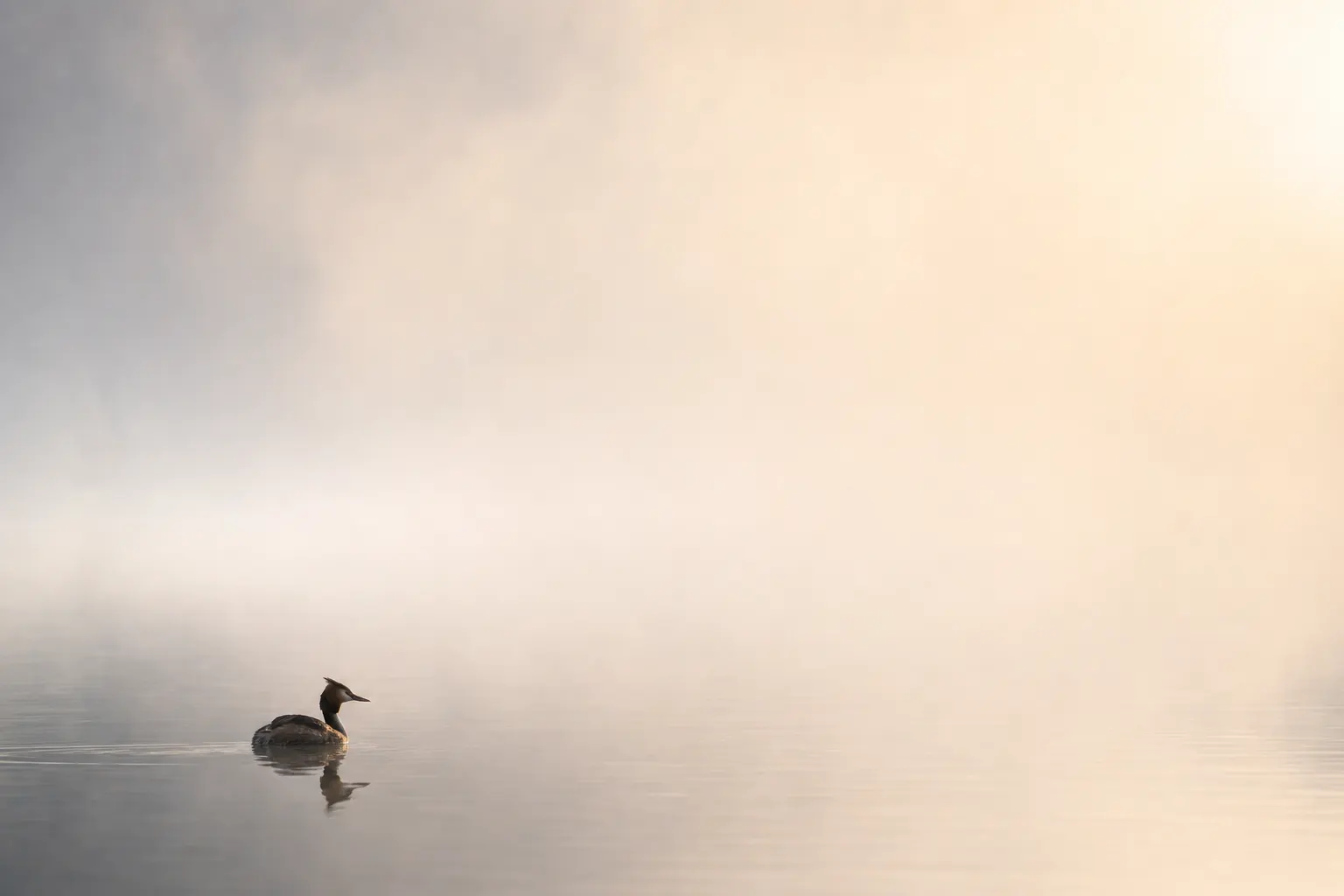
Generada por IA
Por qué un 6 no es un 8
A 6 has empty space; an 8 has negative space, and the whole gap is whether the emptiness is doing a job or merely present. The 6's void is inert. The subject is small and there is a lot of nothing around it, but the nothing has no shape, no balance, no reason, and the eye delivers its verdict at once: the subject got lost, or the camera stood too far back, never "it was left alone on purpose." Most such frames land in the timid middle of the subject-to-space ratio: a margin too generous to read as a tight frame and too meagre to read as a statement (precisely the amount that reads as an accident).
An 8 commits. The void is a designed shape with weight and a task: most often dominant, the subject a small, confident accent against a vast field, though a spare and deliberately tight margin commits just as hard; what an 8 never does is split the difference. Its field is clean and unbroken, because emptiness only works while nothing contests it: one bright patch, one stray mark, and active void collapses back into background-with-junk. And it is placed: the space sits where it balances the subject and aims its energy, opening in the direction a face looks or a figure moves. The judge's tell is the composition lesson's load-bearing test aimed at the nothing: fill the void, or crop it away (does the picture collapse)? In a 6, nothing is lost, because the space was leftover. In an 8 the frame dies, because the emptiness was structural. That promotion, void made load-bearing, is the entire distance between the scores: the 6 has room in it; the 8 is about the room.
Antes de disparar
See the frame as two interlocking shapes, not a subject on a background. The negative shape is as real as the positive one: it has corners, mass, a silhouette of its own. Squint until the scene reduces to those two masses and ask the question the fill-the-frame reflex never asks: is the negative shape designed, or is it whatever was left over? A leftover shape is the tell of inert space; a considered one, a clean field weighed against the subject, is where the craft begins.
Then run three checks on the void itself. Cleanness first: emptiness works only while it is uncontested, so patrol it for survivors (a bright fleck, a distant figure, a change of texture, a speck of dust). One incident and the void stops being active emptiness and becomes a background with a thing in it. This borrows the clutter lesson's eye and spends it differently: clutter is a tax on the subject; a mark in the void is a tax on the emptiness, which had exactly one job. Direction second: where does the space sit relative to the subject? Opening in front of a gaze or a motion, it reads as room and calm; pressing behind, the same quantity reads as confinement and tension. The void is directional, and its placement is a decision. Commitment third: read the subject-to-space ratio. Is there enough emptiness to be a statement, or so little it reads as a mistake? Negative space lives at the extremes and dies in the timid middle.
En la cámara
Fight the reflex to fill the frame. "Get closer" is sound advice for a portrait and poison for a picture about isolation, the craft here is the discipline to underfill on purpose: step back, go wider, and let the emptiness dominate when the picture is about air, scale, or silence. Then commit to a ratio. Place the subject small and off toward a third so the void becomes the dominant shape, or frame tight with a spare, deliberate margin: either commitment reads as intent; the mushy middle reads as a miss.
Find a field that can BE the void. Emptiness needs a clean surface with no incident (open sky, still water, fog, snow, sand, a plain wall, deep shade, a wash of backlight) and your feet keep it pure: a step sideways or a change of height drops a distraction out of the emptiness exactly as it un-merges a subject in the clutter lesson, except the aim here is not to guard the subject but to keep the void uncontested so it can work. Expose the field as a single confident tone (a clean high-key white, an even low-key dark) so the emptiness reads as one deliberate value rather than a broken gradient. The mechanics belong to the exposure and tonal-hierarchy lessons; the intent here is a void with no seams.
Then aim it. Where you leave the space decides what it says: open it in the direction the subject faces or travels and the frame breathes and settles; back the subject against a border with the void pressing behind and the identical emptiness turns to tension and confinement. Same quantity of nothing, opposite feeling: placement is the lever. Compose the void as deliberately as you compose the subject; in these frames it is carrying half the meaning.
En la edición
Crop is composing the void after the fact, and it is the real post lever here. Rebalance the emptiness: trim one side to move the subject off-centre and open the space in front of it, or tighten a loose frame whose void has gone slack. Clean the field: heal or burn down the survivors the capture left in the emptiness (a speck, a distant bird, a bright corner) and let dodge and burn smooth a broken field into one confident tone, taking a gradient or a blotch out so the nothing reads as a single deliberate value. These honest moves matter more here than almost anywhere, because the entire effect lives or dies on the cleanness of the void. Honest, that is, outside documentary and nature-competition work: there the heal is off the table (that distant bird stood in front of the lens) and the void is cleaned by crop and burn, never the brush.
But the honesty clause has a hard floor, and it is geometric. Post cannot create emptiness the file does not contain. A crop can only subtract (it tightens, never widens, and every crop makes the subject larger in the frame, never smaller) so a filled frame holds no void to crop toward, and a timid margin cannot be promoted into a dominant one without inventing the pixels that would fill it. The air had to be photographed. Generative expand and content-aware fill will manufacture sky or wall to fake it, and the manufactured field is precisely the tell a judge reads (the repeated texture, the invented horizon, the too-perfect nothing) and most competition rules restrict it besides. When the frame is full and the picture needed air, that is capture-limited in its plainest form: the fix was one step backward and a wider frame, before the shutter, and no slider owns it after.
La escalera
- Beginner: fills by reflex. Every subject shot as large as the lens allows; when emptiness does appear it is leftover and inert, and it reads as a subject lost or too small, not a subject deliberately alone.
- Competent: leaves room without designing it. Knows emptiness can be a choice: gives an isolated subject some space and keeps the field roughly clean, but treats it as "space around the subject" rather than a shape of its own, and usually lands at the timid ratio that is neither tight nor spare.
- Strong (the serious amateur's working level): composes the void. Commits to a ratio, keeps the emptiness uncontested, and places the subject so the space balances it and aims its energy, room opening ahead of a gaze or a motion, reading the negative shape as carefully as the positive one.
- Advanced: lets the emptiness lead. Builds frames where the void carries the mood and the nominal subject is an accent; balances a tiny positive element against a vast confident negative with exact weight; and, the real mark, knows when to fill the frame instead, withholding negative space when the picture is about density or belonging rather than isolation.
Ve y dispara
Pick one small, singular subject you can place (a lone tree, a person, a bird on a wire, a single cup on a bare table) and one clean field that can serve as the void: open sky, a plain wall, still water, snow, deep shade. Fix the light and the subject. The only variable is the emptiness: how much of it there is, and where the subject sits inside it.
Shoot it SIX ways. (1) Fill the frame, subject large, almost no void, the "get closer" reflex: your control. (2) Subject dead-centre with a modest, even margin all around: the timid middle. (3) Subject small on a third, the void dominant and OPENING in the direction it faces or moves: committed, room to breathe. (4) The same dominant void, but the subject backed into a corner with the emptiness pressing BEHIND it: the same quantity of nothing, reversed. (5) The extreme: subject tiny, void vast, isolation and scale pushed as far as the scene allows. (6) A clean dominant void with ONE thing left in it, a bright fleck, a speck, a second small object: the contaminated-void control. Frame 6 will feel pointless to shoot. Shoot it anyway; you need to feel a void collapse.
Import all six and read each as two shapes, positive and negative, asking of the emptiness alone: does it have a designed shape and a job, or is it leftover? Watch frame 2 read as under-committed, neither tight nor spare. Watch frame 6 stop being active emptiness the instant one mark contaminates it and become a background with a thing in it. Then set frames 3 and 4 side by side (the same void, opposite feelings, from placement alone) because that is the deepest thing the exercise teaches: emptiness is directional, and where you put it is the picture. Rank the six by how intentional the void feels, never by how full the frame is.
Then run it as an experiment, not a victory lap: re-critique the one frame where the emptiness was committed and clean (frame 3, or whichever you ranked first). A critique named composition as your bottleneck, and negative space is one lever under that word, so this is a test with a real chance of failing. If committed emptiness was the missing piece, the next critique should land on a different limit, and the FinalFrame Score has room to move with it. And if composition is named again, that is information, not indictment: either the void read as intended but the subject still lacked route or balance in the larger arrangement (the whole-frame job that lives one level up, in composition) or the field was never quite clean enough for the emptiness to work, and a survivor you can now find contaminated it, which sends you one lesson over to clutter with a sharper eye. Either outcome earns its six frames.
Lecciones relacionadas
Velo en tu propia foto
La forma más rápida de entender la puntuación es leer una sobre una imagen que conozcas bien.
Criticar una foto