Real estate
FinalFrame scores real estate under the Architecture genre with a client-delivery eye: sell the space, but accurate is the whole job.
FinalFrame note chaque photo de 0 à 10 : un 6 est solide, un 8 est digne d'un portfolio et un 9 est de qualité d'exposition. Comment fonctionne la notation
Ce que c'est vraiment
Real estate photography is architecture photography with a client, a clock, and a promise attached. Start with how the product reads it, because there is no separate real-estate genre: the classifier scores these frames under Architecture, and the Client Delivery lane is the intent brief that matches the job (technically weighted, judged the way a client judges a deliverable). Set that lane and the critique evaluates your frame as exactly what it is: a photograph that has to represent a property to a stranger who will act on it. The architecture lesson is this page's foundation (the geometry, the light, the hours all transfer) and this page is about what the client changes.
What the client changes is the ethic. In most genres, flattering interpretation is the craft; here the photograph is a promise the property must keep, because the viewer does what no gallery viewer does: they show up. The buyer walks through the door holding your photograph in their head, and the distance between the two is measured in trust, on the spot. So the genre's defining discipline is a double bind: make the space its best self without making it a different space. Everything in this lesson (the height, the lens, the windows, the staging, the post) operates inside that bind. The good news is that honest and flattering are less opposed than they look: most listing photographs fail not by lying too well but by documenting too carelessly, making rooms darker, smaller, and messier than they actually are. The craft below mostly consists of stopping that.
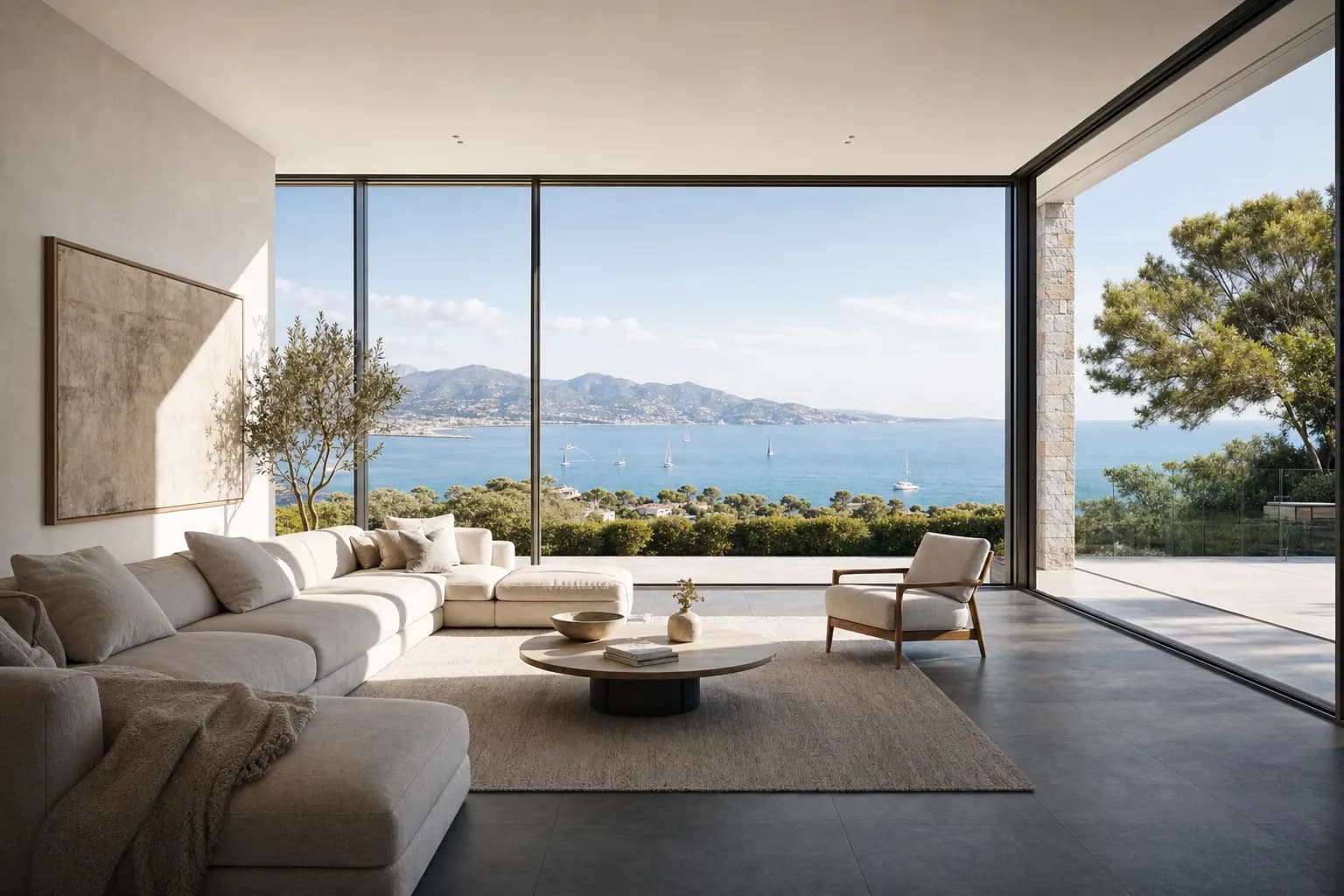
Générée par IA
Pourquoi un 6 n'est pas un 8
The 6 is the walk-through document, and in this genre the 6 costs money. The room is exposed and recognizable, the verticals may even be corrected, and the windows are blown to white, so the view a buyer would pay for is a blank. The color is split, orange lamps against blue daylight, so the room reads vaguely off in a way no viewer can name. The camera stood at eye level, so every counter and tabletop wedges open and the surfaces stack. The clutter was tolerated (the cables, the bin, the bottles by the sink) because the room was the point. And the widest lens did the framing, so the near sofa balloons and the far wall retreats. Nothing in the frame is exactly false. Everything in it is slightly worse than the house, and buyers scroll past it at the speed of a thumb.
The 8 is ordered, honest, and lit. Verticals plumb, camera at chest height so the planes read as planes, the room committed to one color temperature, the windows holding the view, pulled by bracket or flash, so the frame sells the light and the outlook, which are the two things a listing actually trades on. The surfaces are styled down to deliberate objects, the focal length is no wider than the room can defend, and at the top of the set sits the dusk exterior, warm windows against a cool sky, the house describing itself from inside. Here is the judge's test, and in this genre it is also the client's: does the photograph make a promise the showing keeps? The 6 fails in both directions at once: too dull to book the showing, and somehow still less than the house. The 8 books the showing and survives it. That, in a delivery genre, is the entire definition of the score.
Avant de déclencher
In this genre, seeing is done with your hands, and it happens before the tripod opens. The walkthrough is the composition. Counters cleared to two or three deliberate objects; cables tucked; bins, toiletries, fridge magnets, and pet bowls gone; cushions plumped and squared; chairs aligned to the table; towels folded and hung straight; toilet lids down, every time. Depersonalize while you're at it: family photographs and name art pull a buyer out of the one imaginative act the listing needs from them, which is picturing themselves in the space. And apply the edge rule as you stage: any object near a frame border is either included whole or removed entirely, because a chopped lamp at the edge reads as carelessness in a genre being judged on care. Ten minutes of this beats an hour of cloning, and the cloned version loses anyway: a room tidied in software reads tampered with, and tampering is the one read this genre cannot afford.
Then read each room for its one selling feature, because a room photographed from its doorway by default is an inventory, not an argument. The light, the view, the fireplace, the proportions, the ceiling height, every room that deserves a frame has one thing that sells it, and the frame is built to serve that thing: shoot from the corner that puts the feature at the end of the room's depth, not the angle that happens to fit the most furniture. While you walk, take the lighting census the capture will depend on (which rooms run on daylight, which on lamps, which on both) because that census decides the white-balance commitment room by room before the first frame. And run the architecture lesson's reflection patrol with special paranoia: bathrooms are wall-to-wall mirror, and the photographer in the vanity is this genre's most reliable self-disqualification.
À la prise de vue
Verticals and level are non-negotiable here, and the architecture lesson already said why: in documentation work, a leaning wall reads as error, full stop. Keep the back of the camera parallel to the wall, keep it dead level, and let the composition live inside that constraint. The full geometry (why verticals converge, the three honest fixes, when convergence is a choice) lives in the architecture lesson; this page assumes it and adds the discipline that goes with it: height. Chest height, 1.2 to 1.5 meters, roughly the midpoint of the room. From there counters and tabletops read as thin clean planes and the floor-to-ceiling proportion divides the frame honestly; from standing eye level every horizontal surface wedges open and the room loses its order. Height is a decision, the same decision, in every room: make it once at the first setup and hold it through the set, and the whole listing inherits a consistency buyers feel without seeing.
The window is the genre's technical exam. The gap between a daylit window and the room it lights beats a single exposure, and a blown window throws away the view: often the listing's most valuable single fact. Two professional answers. Bracket and blend: three to five frames across the range, blended at the desk (no gear beyond the tripod, works at any scale, and it is the right call for a modest gap, a natural-light look, or a kit that has to travel light). Its risks are inherited color (the blend keeps whatever mixed temperatures the room had) and the over-cooked tone-mapped look when the software is left to its own taste. Flambient, flash plus ambient, is the listing trade's standard: one ambient frame for the room's warmth, one flash frame bounced off the ceiling behind the camera for clean, neutral, evenly-lit color and honestly exposed windows, composited so the ambient supplies the mood and the flash supplies the truth. It solves the window pull and the mixed white balance in a single move, which is why it earns its gear: at the price of carrying a flash and learning the composite. The honest fork: blend when the gap is modest and the light is good; go flambient when color fidelity and clean windows are the deliverable, which in listing work is most of the time.
Now the lens, and the obligation that comes with it. A 14mm room lies. The near furniture balloons, the far wall retreats, and a three-meter room reads as five, and in this genre that lie is not a style choice, it is a misrepresentation the buyer discovers in person, standing in the doorway of a room half the size of its photograph. Accurate spatial representation is a real-estate-specific obligation, and it binds harder than taste. The working band for most rooms is moderate wide, roughly 16 to 24mm full frame, wide enough to describe the space, narrow enough not to invent one. Reserve the extreme end for genuinely tiny rooms, and even then step back before you go wider. And watch the corners: wide-lens edge stretch turns the armchair at the border into a boat, which is both an aesthetic fault and a small dishonesty about the furniture. The rule that holds it all: never photograph a room wider than its showing can survive.
Then end the shoot where the listing begins: the dusk exterior hero. The same twenty-to-forty-minute window the architecture lesson books for blue hour is the listing's scroll-stopper: every interior light on, the sky holding deep tone, the windows glowing warm against the cool, the house describing itself from inside. Shoot it from slightly below chest height to lift the roofline against the sky, and take the window seriously as a schedule item, because it is short and it does not reschedule. Day-to-dusk composites exist and the trade uses them; the real frame beats them anyway, because a composite's windows glow with a light the rooms never had: a small lie, and this genre's whole discipline is that small lies compound.
En post-traitement
Geometry first, exactly as the architecture lesson orders it: plumb the verticals before any tonal or local work, since the correction re-projects the frame and moves everything under it. Then the blend, and the blend has one law: the window must read as a view, not a poster taped to the wall. Keep the window's luminance inside the room's logic: a window is the brightest thing in a daylit room, and a pulled window rendered darker than the interior walls reads instantly, bone-deep false, even to a viewer who has never edited a photograph. The same honesty governs the tone map: the genre's most recognizable processing failure is the over-cooked blend (halos along the window frames, gray shadows, interiors glowing like screens). If the room looks lit by its photograph rather than its windows, the edit went past the house.
Cleanup follows the rule the walkthrough already taught, now with teeth: remove the temporary, never the permanent. The bin at the curb, the car in the drive, the garden hose: temporary; the showing won't include them; fair game. The power lines, the cell tower, the water stain, the neighbor's wall: permanent; they will greet the buyer at the door, and removing them is not retouching, it is concealment in a transaction, the exact fault this genre is professionally forbidden. Skies sit on the same line: lifting a gray sky toward the blue that exists at that address on other days is trade practice; pasting in a sunset is a promise the address cannot keep. When in doubt, apply the showing test to every clone and every swap: will the buyer, standing here, see what the photograph told them? If not, undo it.
And the honesty clause, which in this genre doubles as the business case. Post cannot move the camera: the eye-level wedge is geometry, recorded, and no crop un-wedges a counter. Post cannot cleanly unmix three light temperatures committed at capture: masks can chase the split room by room, but the result is painting, and it reads that way. Post cannot tidy a house at scale without the tampered look that costs more trust than the clutter did. All three fixes were free at the scene, which is where this genre is won, and the scene is unusually forgiving about return visits, because the architecture lesson's consolation holds: the room waits. What does not wait is the listing date. That clock, not the software, is why the capture disciplines above are the job.
L'échelle
- Beginner: documents the walkthrough. Eye level, available light, windows blown, rooms as found; the camera records the house the way a phone does, and the listing inherits every accident.
- Competent: level and corrected. Verticals plumb, brackets shot, the worst clutter cleared, but the windows still read white, the color is still mixed, the height is still standing habit, and the widest lens is still the default. Hygiene without delivery.
- Strong (the working listing standard): delivers. Chest-height planes, one committed temperature per room, windows pulled clean by bracket or flash, rooms staged before the tripod opens, focal length chosen per room instead of inherited, and a dusk hero at the top of the set.
- Advanced: sells the space without lying about it. Light managed room by room, the flash invisible in the result, the set sequenced like a showing from hero to threshold to rooms, and every frame passes the only review that counts: the buyer walking through the door and finding the house the photographs promised.
Allez le photographier
One room: the best room in whatever home you can shoot, ideally one with a real window problem. Shoot it twice, and change everything this lesson taught while keeping the room the same, because the discipline is the variable and the discipline is the lesson. Frame one is the phone habit, taken honestly: from the doorway, standing eye level, available light, room as found, widest lens you have. Do not sabotage it: expose it well; that is the point. Frame two is the full protocol: ten minutes of staging with your hands, tripod at 1.2 to 1.5 meters, dead level, verticals plumb, the room committed to one temperature, the window pulled by bracket or flash, the focal length no wider than the room needs.
Run both through a critique: the classifier will read them as Architecture, and the Client Delivery lane is the brief that matches the job. Read the divergence. The as-found frame's bottleneck will land where every walk-through shot fails (exposure for the blown window, clutter for the counters, composition for the doorway default) and its worth-it read will tell you what a buyer's thumb already knows. The protocol frame should move the bottleneck somewhere new, and the gap between the two reports, on the same room in the same hour, is the exact cash value of the discipline: nothing in frame two required a better house. It required decisions.
And if the same bottleneck comes back on both: information, not indictment. Most often it is the window: the room's range beat your blend, and the fix is the other technique (the flash if you bracketed, the bracket done properly if you flashed) or the trade's oldest answer, the dusk hour, when the window and the room finally agree. Reshoot for that one named limit, because this genre offers the cheapest reshoot in photography: the room waits, holds its light on schedule, and grants the same experiment every day. If the fix is real, the next critique names a different limit, and the FinalFrame Score has room to move, and in this genre alone, the moved bottleneck has a price tag: it is the difference between the listing a buyer scrolls past and the one that books the showing. The score is not the reward. The showing is.
Leçons liées
Voyez-le sur votre propre photo
La façon la plus rapide de comprendre le score, c'est d'en lire un sur une image que vous connaissez bien.
Critiquer une photo