Faune
Le savoir-faire derrière une image forte, et ce qui sépare un 6 d'un 8.
FinalFrame note chaque photo de 0 à 10 : un 6 est solide, un 8 est digne d'un portfolio et un 9 est de qualité d'exposition. Comment fonctionne la notation
Voir
Wildlife is the genre where the subject sets the schedule, and where the story is in the behavior, which means the photograph is mostly made before the animal appears, in the homework. Learn the subject the way you would learn a location: when it feeds, when it rests, what makes it react. Behavior telegraphs itself to anyone who has watched long enough. A perched bird that stops preening and rouses, the full-body feather shake, is seconds from flight. A predator's posture changes before the chase does: weight settles onto the haunches, the head drops level, the ears lock forward, and you have two or three seconds of warning that the still frame is about to become an action frame. The photographer who knows the tell is already composed on the empty air where the action will land; the one who reacts to the action is photographing where it was. Plan the same way at the scale of seasons: breeding displays, migration staging, the weeks when the behavior worth photographing is concentrated and predictable rather than lucky.
The second half of seeing is geometry you choose before anything happens. Eye contact lifts a wildlife frame the way expression lifts a portrait, so position along the animal's likely line of gaze, not perpendicular to its path. And read the background before you read the animal: the frame you are about to make is the animal plus everything behind it, and only one of those two is negotiable once the moment starts.
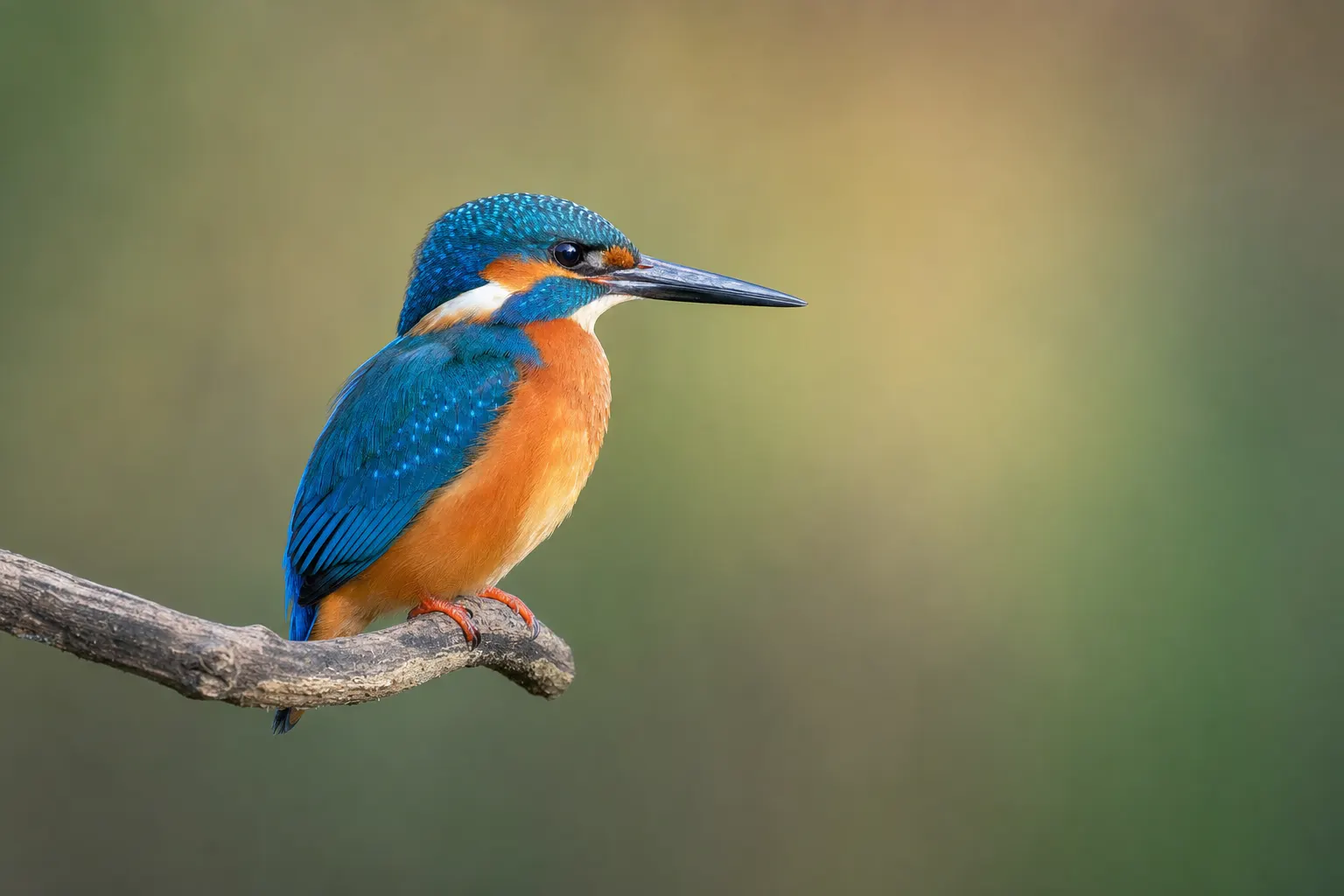
Générée par IA
Capturer
Autofocus first, because nothing downstream survives it. Continuous AF, always: wildlife does not hold a focus plane. Use a cluster of points rather than a single point: a lone point slides off a moving animal the instant your tracking hand is imperfect, while a small zone gives the system something to hand focus across. If the body has animal or bird eye-detect, use it and verify it is actually holding the eye, not the near wing. Move focus off the shutter button onto a rear button: hold to track, lift to lock, and the shutter finger does nothing but time the frame (no re-acquisition every time you fire).
And know the honest limits of the glass: a 100–400 zoom at f/5.6 on the long end feeds the AF system two stops less light than a 400mm f/2.8, and in dusk or low contrast it may hunt where the prime keeps tracking. That is not a verdict on the lens; it is a budget. Work where your autofocus can work.
The near eye must be critically sharp. Not the flank, not the wingtip: the eye nearest the lens. If the eye is soft, the frame fails, whatever else it does.
Which is why the exposure rule of this genre is: ISO is free, moments are not. When light drops, push ISO and protect shutter speed, never the reverse. A sharp, slightly noisy frame of the fish-catch beats a clean, slightly soft one every single time; modern sensors are entirely usable at ISO 3200–6400, and noise is a texture where softness is a failure. Action shot at 1/500 when it needed 1/2000 produces nothing at all, not a flawed frame, no frame.
Working figures: birds in flight live around 400–600mm at 1/2000 or faster; a mammal portrait around 200–500mm holds at 1/500 and up. Treat those as floors that rise with the action.
Between the settings and the frame sits the skill no spec sheet mentions: closing the distance. It starts downwind: a mammal's nose defeats you long before its eyes do, so read the wind the way you read the light and approach with it in your face. Keep something behind you: an animal reads a shape against the skyline at absurd range, and the same shape against a hedgerow or a slope is furniture. Then move like something harmless: low, slow, diagonal rather than straight-in, advancing while the head is down to feed and freezing mid-step when it comes up. A direct march with a fixed stare is the signature of a predator, and every prey animal alive knows it; angle the path, break the gaze, and let the animal conclude you are boring.
Better than approaching is not needing to: arrive first and let the distance close itself. A blind at the water's edge, a long lens through a car window: most animals that would flee a walking human will feed beside a parked vehicle, which makes the car the best hide most photographers already own. And the whole craft has an ethical floor: the working distance is the animal's decision, not yours. A lifted head, stopped feeding, that same pre-flight rouse when you are the reason for it: you are already too close, and the fieldcraft answer is to back out, because a stressed animal gives you one nervous frame and an empty habitat for weeks. Baiting and distress calls buy the moment at the animal's expense: reserves commonly ban them, competitions demand disclosure at minimum, and a frame that needed them was never fieldcraft.
Then isolation, which is mostly where you put your body. Shoot from the animal's eye level: kneel, sit, lie in the wet grass. From standing height the ground a meter behind the subject is the background; from eye level that same ground drops away and renders as distant, soft color. The ratio of subject distance to background distance drives blur quality more than aperture alone: f/5.6 with a background forty meters back beats f/2.8 with a bush at one.
And a clean background is not the same as an empty one: habitat, a natural frame of branches, weather in the air (environmental context beats a bare perch, because the bare perch tells no story about where this animal lives).
- Autofocus
- continuous, always; a small cluster of points, not one; eye-detect verified on the eye
- Focus trigger
- moved to the rear button: hold to track, lift to lock
- Near eye
- critically sharp: the eye nearest the lens, or the frame fails
- ISO
- push it; 3200–6400 is usable: protect shutter, never the reverse
- Shutter floors
- birds in flight ~1/2000+ at 400–600mm · a mammal portrait ~1/500+ at 200–500mm
- Approach
- downwind, something behind you, low and diagonal: advance when the head is down, freeze when it lifts; the parked car is the best hide you own
- Background blur
- subject-to-background distance beats aperture: f/5.6 at 40 m back over f/2.8 at 1 m
Traiter
The wildlife edit is mostly restraint applied in the right order. Noise reduction before sharpening, and gently: over-reduced fur and feathers turn to plastic, and texture is the genre's currency. Sharpen the eye and head locally at output size rather than the whole frame globally. Spend the rest of the edit on the background's tone: burn down the bright leaf, the hot sliver of sky, anything that outbids the eye for attention; hold the animal a half-step brighter than its surround so the hierarchy is felt before it is noticed. Go carefully with saturation on plumage: it tips into the unreal fast.
The honesty clause: post can calm a background a little (a darkened highlight, a touch less clarity behind the subject) but it cannot create eye detail the sensor never recorded, and it cannot manufacture the moment. A soft eye is a reshoot, full stop. A missed peak (wings already folded, the fish already swallowed) is a reshoot too; no crop rediscovers the half-second the shutter missed. And if the frame is bound for a nature competition, cloning the branch out is not an edit, it is a disqualification. The background gets fixed in the field or not at all.
Évaluer
Borrow the product's discipline for your own review. The critique returns one lane-weighted FinalFrame Score and names ONE bottleneck: the single limit costing the frame the most. There is no per-category scorecard to hide in, and your self-review shouldn't have one either: name the one thing this frame is limited by and ignore the rest until it is fixed.
A 6 in this genre documents the animal without revealing it: subject small in the frame, background cluttered, the eye almost sharp. Accordingly, the bottleneck named on wildlife frames at 6 or 7 is usually one of three: sharpness (nearly always the eye), subject-separation, or timing. Above 8 the named limit migrates to micro-polish: noise-reduction texture on fur, one bright twig at the edge, a crop that crowds the gaze, a sharpening halo along a wing.
- Zoom to 100% on the near eye: critically sharp, catchlight present?
- Does the background separate as tone and color, or is it competing detail?
- Is anything happening (behavior, gaze, tension) or is the animal merely present?
- Was it made at eye level?
- Does the subject fill the frame from the field, or from the crop tool?
A heavy crop shows (in noise scale and softness) and reads as distance that fieldcraft never closed.
Pourquoi un 6 n'est pas un 8
The 6 proves the encounter happened. It is identification-grade: the animal present and correctly exposed, but small in a frame made from standing height, the ground rising close behind it as clutter, the eye a hair short of sharp, and nothing occurring (the animal simply is). The eye finds it, confirms the species, and is finished.
The 8 captures behavior or connection, and every technical choice serves that. The near eye is critically sharp with a catchlight, and the gaze does work: toward the lens, toward prey, toward somewhere the viewer now looks too. The background dissolves because the frame was made at the animal's eye level with distance behind it, not because a slider tried. The subject fills the frame without the cropped-in look, which means the distance was closed with knowledge and patience rather than pixels. And the moment (the rouse before flight, the look back, the catch) is in the frame because it was predicted, not chased.
That gap is fieldcraft, not luck and not glass. The 8 knew the bird shakes before it flies.
So when the critique names your bottleneck, go shoot it again for that one thing: the eye, the angle, the anticipated half-second. If the fix is real, the next critique names a different limit, and the FinalFrame Score has room to move. And if the same bottleneck comes back, that is information, not indictment: wildlife rations your attempts like no other genre (the heron leaves once per morning, the chase happens or it doesn't) so a habit rebuilt on three chances a day simply takes more days. The animal will not repeat the moment because you are ready now. Keep going back until you are ready when it happens.
Leçons liées
Voyez-le sur votre propre photo
La façon la plus rapide de comprendre le score, c'est d'en lire un sur une image que vous connaissez bien.
Critiquer une photo