Curation
Choosing which frames earn the slots: the judgment that only exists in the plural, where a frame competes against its neighbors instead of a standard.
FinalFrame हर फ़ोटो को 0–10 पर स्कोर करता है: 6 सक्षम है, 8 पोर्टफ़ोलियो-योग्य है, और 9 प्रदर्शनी स्तर का है। स्कोरिंग कैसे काम करती है
What it means
Curation is the judgment that only exists in the plural. Every other lesson in this curriculum interrogates one photograph and can finish its work without ever seeing a second: is the plane on the eye, is the key tone placed, is there a claim in the frame at all. Curation cannot start until there are several. It asks the question no single frame can answer: of the ones that survived, which earn the slots?
Hold the boundary hard, because the lesson next door does the opposite job. Worth-it is ABSOLUTE: it holds one frame up against a standard and rules on whether there is a keeper here at all, whether this file deserves the hour (→ /learn/worth-it). Curation is RELATIVE: it holds the keepers up against each other and rules on which of them earn a finite number of slots. The two verdicts come apart constantly, and the gap between them is where this skill lives: a frame can be a genuine, honest 7.5 and still be the wrong frame for this set, and no absolute judgment ever reaches that verdict, because nothing is wrong with the frame. What is wrong is its relationship to its neighbors.
That is possible because the unit of judgment has changed. A photograph judged alone answers to itself. A photograph judged inside a set answers to the set, and a set has properties no member carries: variety, range, cohesion, an order, a shape. Twelve individually strong frames assemble into a weak body of work far more easily than anyone expects, and twelve merely good ones can assemble into a strong one, though never from below the bar: coherence amplifies a standard, it does not manufacture one. Nobody arrives at this by getting better at editing. It is a separate skill with its own failure modes, exercised at the same desk on the same afternoon, which is exactly why it gets mistaken for the same act.
FinalFrame gives the skill two surfaces. A Curation takes a batch and returns a best-of selection with a reason per frame, a read on how the set holds together, and the gaps it still has. Which Shot takes two frames, and its verdict comes in two parts that are not the same kind of judgment: worth being precise about, because this lesson turns on the difference. The winner badge is derived from the two frames' independent, absolute critiques: rank at n=2, by this lesson's own definition. The prose beside it (the decisive factor, the dimension-by-dimension separation) is the genuinely relative read: what actually divides this pair. Read Which Shot for the second part. And keep its limit in view: a pair has no set to be redundant against, so Which Shot is where a set decision bottoms out, the last comparison standing, not where set judgment happens.
AI से बनाई गई
Why it matters
Here is where the skill shows: two photographers, the same take, the same craft, and the sets they hand in are not close. The difference is not that one of them edits better. It is that one selected by RANK and the other by CONTRIBUTION, and that single substitution reorganizes everything downstream.
Rank is the intuitive method, and it has a specific blind spot. Order the survivors best to worst, take the top eight, done, and eight frames chosen that way routinely contain three views of one moment, because a moment good enough to produce your best frame usually produced the second and third best too. Rank cannot see that, because rank never compares two frames to each other; it compares each one to a standard, separately, and then sorts. The set now spends three of its eight slots saying one thing, and three-eighths of a body of work is an enormous amount to spend on a repetition. Contribution asks a different question at every slot (not is this good, but what does this add that nothing else here is carrying) and a near-duplicate answers that question with silence.
Then the property photographers discover last: a set needs range. Eight strong frames in one tonal key, at one distance, in one hour's light, reads flatter than a set carrying a genuine 7 that does something none of the 8s do. That is not a concession to weakness; it is how sets are actually experienced. A viewer scrolling a portfolio or a judge walking a panel reads the whole before any part, and the whole is made of the differences between its members. Some competition circuits build this into the judging: an RPS Distinctions submission or a club print panel is scored as a panel, and a monotonous one is marked down however sound each print is alone. The big salon circuits do the opposite: PSA and FIAP score every image independently, shuffled among strangers' entries, so redundancy across your own entries costs nothing there (→ /learn/competition-score), which is exactly why a photographer raised on salon feedback can shoot for years without ever being asked to develop this skill. Variety is not decoration on a set. It is a property of the set that individual excellence cannot supply.
The judge's tell takes ten seconds and you can run it on your own work: pull one frame out and look at what remains. In a set that is really a pile of good frames, nothing happens: it is a shorter pile. In a set that was built, something goes missing that you can NAME: the only close-up, the only quiet one, the only frame that faced the other way. Every member load-bearing, nothing removable without collapse: that is the same test the composition lesson runs inside a single frame, run one level up (→ /learn/composition). A set that survives it was designed. A set that doesn't was sorted.
How to read it
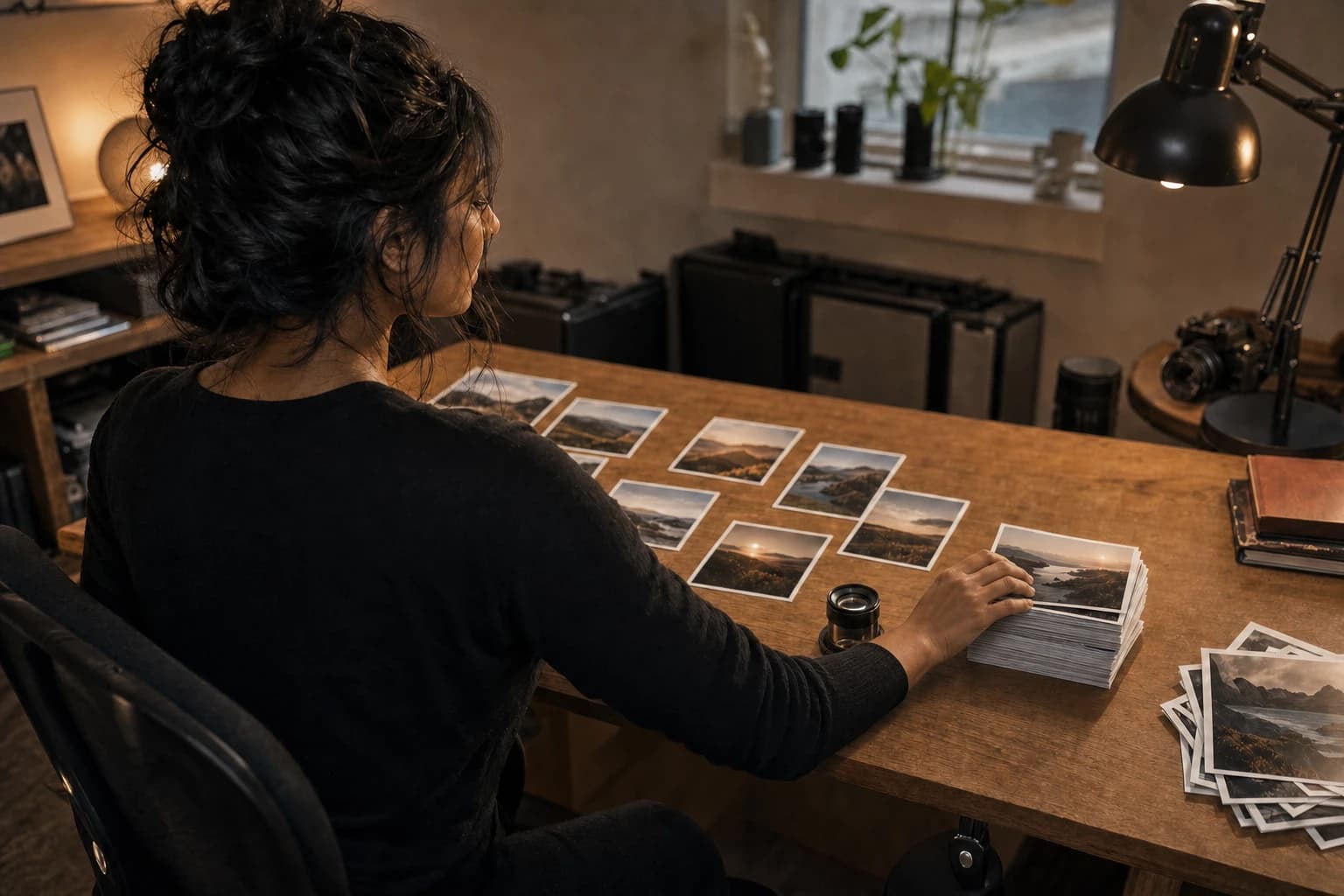
Relative judgment needs simultaneity: a set cannot be read through a viewport that shows one frame at a time. So the first act is physical and it is not optional: get every candidate visible at once, as a contact sheet, a grid view, or prints on a table. And keep them small, because small is an advantage here rather than a compromise. At thumbnail size the technical merits go quiet (nobody reads a nailed focus plane at 200 pixels) and what survives the shrink is precisely what operates at set level: tone, shape, color, subject, distance. Frames that still look different from each other when they are small are genuinely different pictures. The ones that converge were always one picture in two files.
That hands you two reads, and they must stay separate, because they pull in opposite directions on purpose. The REDUNDANCY read is about subject: group the frames by what they are of (any two frames of the same moment at the same distance are one picture, whatever their timestamps say). Now say what each GROUP claims, in a phrase: "the crowd surging at the chorus," "the empty road under weather." Two groups making the same claim means one of them is about to spend a slot for free. The RANGE read is the squint: let the frames collapse into tonal masses and look at the spread of masses (all one key is a set that made one photograph tonally, however varied its subjects). Keep the two axes apart: range wants same-key frames of different subjects to coexist; redundancy kills same-subject twins whatever their key: a low-key portrait and a low-key landscape squint alike and are nothing like one picture. It is the same squint the composition lesson uses to find where a stranger's eye lands, aimed across frames instead of within one.
Then read the set for what is missing, which is harder, because absence has no thumbnail. Run the axes: are these all long lenses, all one hour, all one tonal key, all the same distance from the subject, all the same weather? A set uniform on every axis is a set that made one photograph several times. And treat the opposite failure with equal suspicion: a set so various it shares nothing reads as a drive on shuffle rather than a body of work. The target is variety inside a recognizable register: one voice, several sentences.
Last, be honest about the count before you form any opinion, because the count is what makes everything above binding. Ask how many slots genuinely exist: the panel's required entries, the album spread, the portfolio page, the number of frames a stranger will look at before they stop. If the answer is "as many as are good," you are not curating yet. You are still running worth-it on a larger pile.
The move it drives
Fix the number before you look at a single frame. "Pick the good ones" produces a pile; "pick exactly ten" produces a set, and the difference is not discipline, it is arithmetic. Once the slots are finite, every frame you add evicts one, which converts absolute judgment into relative judgment by force, whether or not you were ready to do it voluntarily. Sometimes the number is handed to you and is genuinely hard: competition panels routinely specify an exact entry count, and a set delivered over or under it is not judged generously (it is judged out). When no external number exists, invent one and make it uncomfortably small. Six chosen from forty is a stronger object than fifteen chosen from forty, nearly every time, and the only reason is that six forced the comparisons fifteen let you avoid.
Then fill by contribution. The first slot goes to your strongest frame outright; that one is free. Every slot after it takes a different question: not what is next best, but what does this set not yet have, and which frame supplies it. Work the gaps the spread exposed. Give one slot to a GROUP, never one slot to each near-twin inside it. And take the trade this produces honestly, because it is the trade that makes the method feel wrong the first few times: you will sometimes seat a slightly weaker frame over a slightly stronger one, and the set will be better for it. That is not a lowered standard. The standard moved up a level, from the frame to the thing the frames are making.
When the comparison narrows to two, run the tiebreaker properly, because this is the atom and most photographers do it badly. Put both frames at full size, side by side, on one screen, at the same scale, never one after the other, because memory is a poor comparator and the second frame always looks fresher for reasons that have nothing to do with the photograph. Then work the separators in order. First the GESTURE, which decides it in anything with a living subject: the truer instant wins, and it is nearly always visible in one small thing: a hand not yet closed, the corner of a mouth, the angle of a head, an eye fully open one frame earlier (→ /learn/timing); when nothing in the pair is alive (a landscape pair, a still), the first separator is the LIGHT instead: which frame's hour, direction, or weather is doing more of the work. Second the EDGE: one of the two almost always has a cleaner border (a limb uncut, a bright shape gone from a corner, an intruder half a step further out). Third the CARRY-TONE at 100%: between two frames that look identical fit-to-screen, the plane landed on exactly one of them, and it is worth ten seconds to find out which (→ /learn/focus). And one fence around all three: do not break the tie on processing. Compare them unedited, or identically edited. Whichever frame you have already spent an hour on will win a comparison it never earned, and that is the single most common way a worse photograph enters a set.
If the pair survives all three separators, the tie is genuine: pick either and move. What you must not do is keep both. "I couldn't decide" is not a neutral outcome in a fixed-count set: it is a decision to spend a slot on a repetition, taken out of another frame's pocket.
Two smaller moves close the job. Sequence deliberately, because order is a property only the set has: open strong and close strong, separate the frames sharing a tonal key instead of letting them sit adjacent, and let the middle rise and fall rather than run level. A well-chosen set in a careless order reads worse than it is. Then leave it and come back cold, ideally the next day: the same adaptation that hides an over-cooked edit from its own maker hides a redundant set from the person who assembled it (→ /learn/stop-editing).
Common misreadings
Five ways this gets misread, and every one of them ends the same way: a slot spent on a frame that was not adding anything.
Selecting by score. The most common and the most expensive, and it is seductive precisely because the numbers are honest: a FinalFrame Score is a sound absolute judgment of one frame, and it is silent on redundancy by construction. Two frames of the same moment score nearly the same because they nearly ARE the same, so rank order seats both without ever noticing they are twins. Use the scores for what they measure (establishing which frames belong in the keeper pool at all, which is worth-it's job) then choose from that pool by contribution, with your eyes, on a spread. One caveat about which numbers are which: a Curation result's per-image scores are set-relative by design (a 7 inside a set can be a 5 standalone) so those are not even the absolute leaderboard this misreading sorts by; the standalone critique's score is.
Keeping both. Indecision feels like neutrality and behaves like a choice. In a fixed-count set, a tie you refuse to break seats a redundant frame at the expense of a different one, and never having consciously chosen it is exactly what makes it invisible afterward.
Confusing variety with incoherence. Once the redundancy problem becomes visible, the natural over-correction is a sampler: twelve frames sharing nothing, which reads as a hard drive on shuffle. Range is measured WITHIN a register, not against it: a set should look like one photographer saying several things, not several photographers each saying one. And the quieter sibling of that over-correction: filling a gap with a frame that never cleared the bar. Contribution decides among keepers (it is not a way past worth-it) and the set is only as strong as its weakest member: a weak frame seated to fill a gap still weakens the set. Better a gap than a weak link.
Reading a cut as a verdict on the frame. It is not, and the distinction is precise enough to state plainly: a frame cut here lost a comparison to a specific neighbor for a specific slot. Change the set and the same frame wins. That is a different sentence from a false worth-it flag, which says the editing hour is not worth spending on this file. Curation never says the photograph is weak. It says this frame's job is already being done by another frame in this set.
Curating warm. The strongest bias at this desk is not taste, it is memory. You rank the frame you remember making (the cold morning, the hour of waiting, the near-miss you recovered) and the viewer receives none of it, because a photograph transmits only what it shows. This is the concept lesson's stranger test applied to a whole set, and it is the reason the cold pass exists: the frames you cannot defend in the morning were being defended by something that was never in them (→ /learn/concept).
सीढ़ी
- Beginner: publishes the take. Everything that cleared the "I like it" bar goes out, in the order the camera wrote it, so the set carries three views of the best moment and a couple of near-misses nobody killed. The redundancy is invisible from the inside and obvious to the first stranger who scrolls it.
- Competent: culls hard, still selects by rank. The failures are gone and the survivors are genuinely strong, but they were taken top-down off a mental leaderboard, so the set is uniformly good and quietly repetitive: the same subject at the same distance in the same light, three times, because those were the frames that scored.
- Strong (the working method of a photographer who shows work): selects by contribution against a fixed count. Names the number before looking, spreads every candidate at thumbnail size, groups the near-duplicates and spends one slot per group, reads the set for its gaps, and settles close pairs side by side at full size instead of by feel.
- Advanced: treats the set as the work. Shoots already knowing what the set still lacks, sequences for arc as deliberately as the frames were composed, cuts a personal favorite without flinching when it repeats a neighbor, and can say out loud what each surviving frame is doing that nothing else in the set does.
Try it on your work
No new frames for this one: the exercise is to build one set twice, by two different methods, and read the difference between them. Take a shoot you have already culled, so what you are holding is survivors rather than a whole card, and fix the count before you look at anything: ten if the take is large, six if it is small. The number has to be smaller than the number of frames you like, or the exercise has no engine.
Round one, by rank. Order every survivor best to worst on your own judgment and take the top N. Write the list down. This is the method almost everyone already uses, and the only reason to run it deliberately is to have it on paper where it can be compared against something.
Round two, by contribution. Start from an empty set. The first slot goes to your strongest frame outright. For every slot after that, do not ask which frame is next best: ask what this set does not yet have (a different distance, a different moment, a different tonal key, a different thing said) and seat the frame that supplies it. One slot per group of near-twins. Where two candidates are genuinely close, put them side by side at full size and run the separators in order: the truer gesture, then the cleaner edge, then the carry-tone at 100%, and never the one you have already edited.
Now compare the two lists, because the disagreements are the entire lesson. The frames in round one that are absent from round two are the redundancy rank could not see, and there will almost always be some: usually two or three views of whatever moment produced your single best frame. The frames in round two that are absent from round one are the ones you would have cut for being individually weaker while being the only frame carrying something. The size of the overlap is a fair measure of how relative your judgment currently is, and it moves with practice.
Then close the loop on the product's side, in both directions. Run the same batch through a Curation (or as much of it as your plan's set size takes) and set its selection beside your round two, not to be graded by it, but to find where the two disagree, because a disagreement is a frame one of you is reading for something the other isn't, and that is the only feedback here that teaches anything. And take the one pair you genuinely could not call (the tie you broke by coin flip) and put exactly that pair through Which Shot, with the same fence you used at the desk: upload them unedited, or identically edited, or the hour of processing one of them carries will win a verdict it never earned. Then read the result the way this lesson reads the product: on a genuine tie the winner badge can turn on a fraction of a point between two absolute reads, so the badge is the least of it (the decisive factor and the dimension-by-dimension separation are the relative read, and a named reason on the pair you couldn't settle is worth more than ten verdicts on pairs you could).
The falsifiable check comes last, and it needs a night. Leave the finished set alone until tomorrow, then come back and pull one frame out at random. If what you assembled is a pile of good frames, nothing happens: it is a shorter pile, and the exercise has told you honestly where you are. If you built a set, something will go missing that you can name in a phrase: the only close-up, the only quiet one, the only frame that faced the other direction. Being able to say that sentence about every frame BEFORE the cut is the top of the ladder, and this is how it gets built: one set at a time, by running the comparison you would rather not run.
संबंधित पाठ
इसे अपनी फ़ोटो पर देखें
स्कोर समझने का सबसे तेज़ तरीका है उसे किसी ऐसे फ़्रेम पर पढ़ना जिसे आप अच्छी तरह जानते हैं।
किसी फ़ोटो की समीक्षा कराएँ