How to photograph the moon
Moon shots fail two opposite ways: a white featureless disc with the craters burned off, or a bright pinhead lost in a black frame. Both come from misreading what the moon is. It looks like a night subject, so the meter reads the vast dark sky around it and overexposes the one bright thing present, but the moon is not lit by the night at all. It is a rock in full sunlight, the same sun that lights a noon landscape, so it wants a daylight exposure, not a night one. The anchor is the Looney-11 rule, the sunny-16 sibling for a sunlit moon: at f/11, set the shutter near one-over-the-ISO (ISO 100, about 1/100) and adjust from the histogram. Spot-meter the disc or work fully manual; never let the black frame set the exposure. The second failure is scale: the moon spans only about half a degree of sky, so below ~300mm it renders as a pebble, and the detailed disc people picture needs long glass or a heavy crop. And when a total lunar eclipse arrives, the recipe inverts for a clause: the disc slides into Earth's shadow, loses its direct sunlight, and drops many stops darker (often ten or more) and deep red, the blood moon, so Looney-11 no longer holds and you meter it like the faint subject it has briefly become, closer to earthshine than to a sunlit rock.
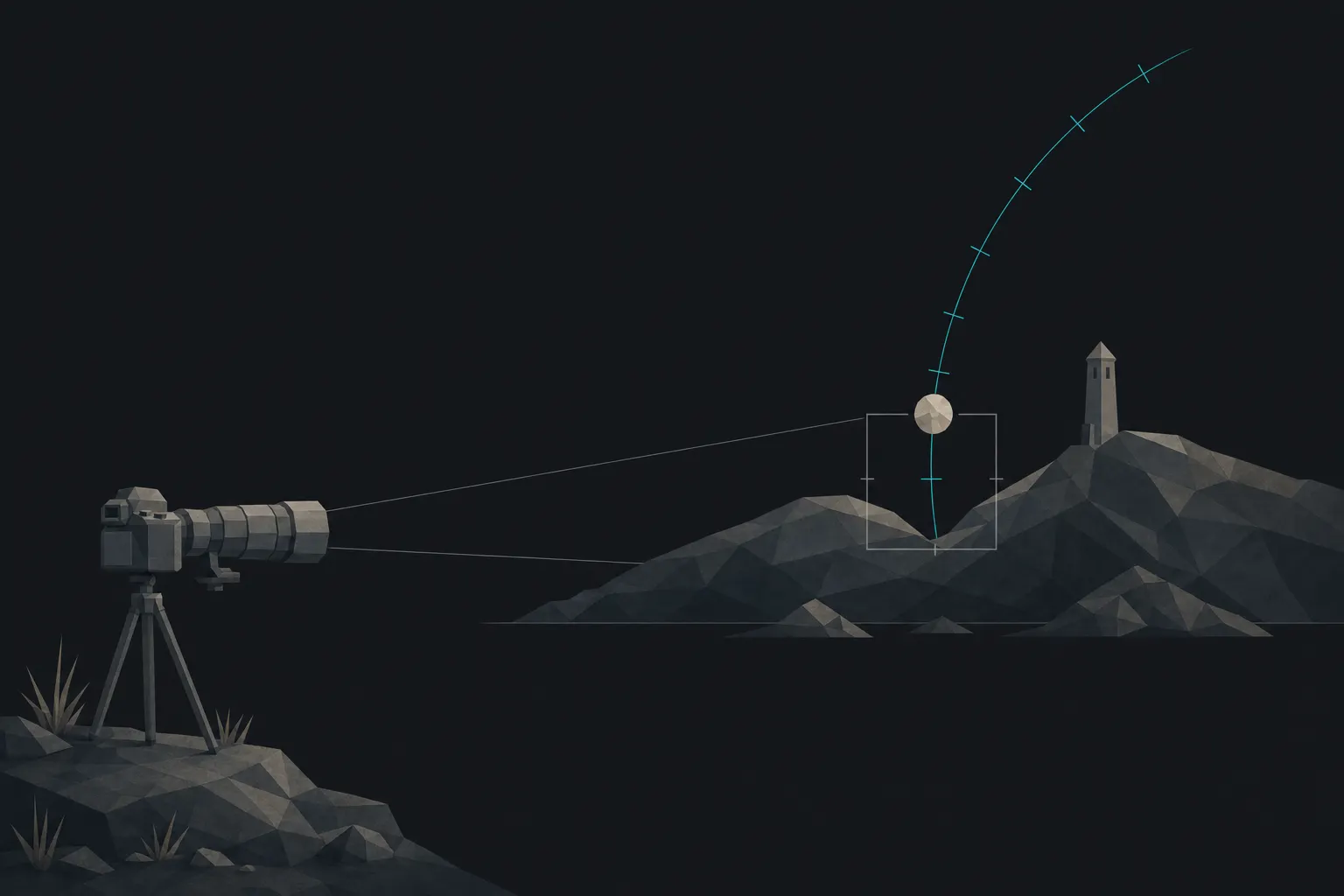
Starting points
- Mode
- Manual. The black sky wrong-foots every automatic meter, while the moon's own brightness is fixed and predictable: set it once and stop letting the frame renegotiate.
- Exposure & aperture (full moon)
- Start from Looney-11, f/11 with the shutter near one-over-the-ISO (ISO 100 → about 1/100), and read the histogram; the disc should hold grey texture, not clip to white. f/8–f/11 is also the lens's sharp middle, so exposure and sharpness want the same aperture here.
- ISO
- 100–200 for the bright full moon. Raise it only for a thin crescent or an eclipse, where far less light reaches the sensor.
- Focal length
- 300mm renders a small moon; even at 500mm the disc is under a fifth of the frame height: a teleconverter or a crop finishes the job. Below ~200mm, plan the moon as one element in a wider scene, not the subject.
- Focus
- Manual, magnified on the terminator: the day–night line, where crater shadows run longest and give the eye a hard edge to snap to. Autofocus holds a bright full moon but drifts on a crescent.
- Eclipse & earthshine
- When totality dims the disc, abandon Looney-11: open the aperture, lift the ISO, and lengthen the shutter into the range a faint subject needs. The red is real light, not a white-balance error to correct.
In the field
- Check the moon's phase and rise time first: a low moon near the horizon looks larger and pairs with a landscape; a high full moon is a disc alone. A supermoon is only marginally bigger, so it changes the pairing, not the settings.
- Set manual exposure from Looney-11, then confirm on the histogram, not the bright rear screen.
- Focus manually on the terminator at maximum magnification; the crater shadows are the sharpness cue.
- For a scene with foreground, expose for the moon first: one frame cannot hold both a sunlit disc and dark land, so plan a blend or a separate exposure.
- During an eclipse, re-meter continuously; the moon darkens many stops, often ten or more, into totality and brightens again after.
When it fails
- A white disc, no craters
- The frame's darkness fooled the meter into overexposing the one lit object. The moon is a sunlit rock, set a daylight exposure (Looney-11: f/11 at shutter ≈ 1/ISO), spot-meter the disc or shoot fully manual, and reach for highlight recovery only when the capture is already close; a fully blown disc holds no crater detail left to pull back.
- The moon a lonely pebble in the frame
- Focal-length reality, not an exposure mistake. The moon spans only half a degree, so below ~300mm it will always render small. Either reach for longer glass or a teleconverter to fill the frame, or commit to it as one element in a wider composition with a foreground that earns the empty sky.
- Sharp on screen, soft in the file
- Autofocus drifted on a low-contrast disc, or a long lens amplified the smallest shake. Focus manually on the terminator at magnification, and on a long focal length treat shutter and support like any focus problem: a solid tripod, a remote or delay release, and stabilization off once the camera is mounted.
Brought a frame back? Get the honest read.
A recipe is a starting point; a critique reads the result. Upload the night's best frame and FinalFrame returns the full diagnosis: what works, what limits the frame, and whether the fix lives at the desk or back in the field.
사진 비평받기