Techniques: capturing across space and time
Some photographs are not made in a single frame, or not in a single plain press. A panorama stitches frames across space into one wider image; a timelapse compresses hours into seconds; a long exposure holds one frame open while time paints through it; a focus stack builds front-to-back sharpness plane by plane; a bracket assembles a brightness range no sensor holds in one shot; a star stack averages the night sky clean; a star-trail stack lets the same sky draw its own turning; a panning shot, a zoom burst or a rear-curtain flash blurs part of a single frame on purpose and keeps one element sharp to show it was meant. Every one of them trades the one-press reflex for a plan set in advance: decide the result before the first frame, lock what must not drift, and let the exposure or the sequence build what a reflex press could not. Each guide below opens with why the technique fails, gives settings as honest starting points (start there, then read the scene; the conditions outvote any table), and links the lessons it is built from, because a technique composes the fundamentals rather than replacing them. And when you bring a frame back, judge it the way you would judge any other: how to critique a photo runs the method.
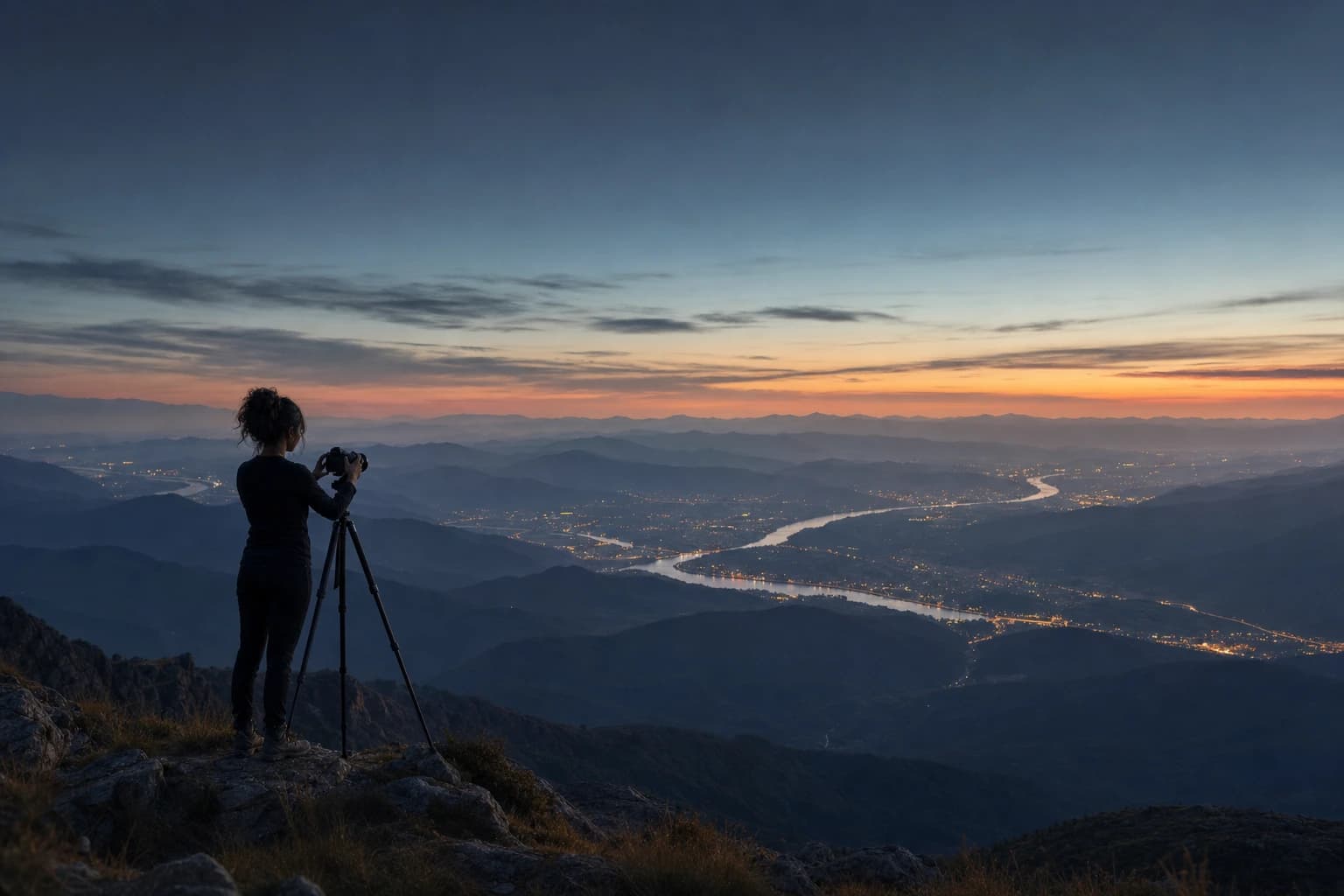
AI 생성
Panorama
A panorama promises resolution and a sweep no single frame can hold; it fails on the seam that shows.
Timelapse
A timelapse is not a fast video: it is a sequence of stills fired at an interval and played back at video speed, so hours compress into seconds.
Long exposure with an ND filter
Silky water, streaked clouds, a plaza where the crowd dissolves into ghosts: every one of those is the shutter left open for seconds while the world moves through the frame.
Focus stacking
Up close, depth of field collapses.
Exposure bracketing & HDR
Some scenes simply outrun the sensor: a dark room against a bright window, a sunset sky over land already in shadow.
Star stacking
The night sky offers almost no light, and the sensor's answer to darkness is noise, so the single astro frame is trapped between two failures.
Star trails
Star trails fail at both ends: thin dashed arcs that read as a mistake, or one heroic hour-long frame that comes back as a washed-out sky full of hot pixels.
Motion blur on purpose: panning, zoom burst, rear-curtain flash
Panning, a zoom burst and rear-curtain flash all fail the same way: nothing in the frame stayed sharp enough to prove the blur was meant.
Finished the sequence? Get the honest read.
A technique assembles the frames; a critique reads the result. Upload the finished image (for a timelapse, a standout frame) and FinalFrame returns the full diagnosis: what works, what limits the frame, and whether the fix lives at the desk or back in the field.
사진 비평받기