How to shoot star trails
Star trails fail at both ends: thin dashed arcs that read as a mistake, or one heroic hour-long frame that comes back as a washed-out sky full of hot pixels. The sky turns 15 degrees an hour, and the astro genre's shutter ceiling (roughly 500 divided by the focal length, in seconds, and sooner on a high-resolution sensor) exists to keep stars as points. A star trail crosses that ceiling on purpose, and the frame to fear is the one just past it: stars drawn as short streaks, which no viewer reads as intent. Commit to arcs long enough to read as a drawing, or stay under the ceiling. The modern way across is a stack. One continuous hour lets the sky glow climb toward clipping, pays the heat tax of hot pixels and thermal noise in full, and has no undo: one aircraft or one headlamp and the night is gone. Shoot the same hour as 120 back-to-back 30 s frames and blend them in Lighten mode, which keeps the brightest value each pixel saw. A star is always the brightest thing at its pixel, so the trails build frame by frame, while the sky stays close to one frame's brightness, the brightest of them rather than their sum. The stack also keeps the brightest moment of the run: start in twilight and the twilight sky stays; one car's headlights light the land for the whole night. A ruined frame, though, is dealt with on its own. What a stack cannot do is close a gap: time the shutter sits shut between frames is bitten out of every trail at once, invisible while shorter than a star is wide, a row of dashes once longer, which is why the drive and noise-reduction settings in the recipe matter more than any exposure value. Where you point decides the shape: the whole sky turns about the celestial pole, so aim at it and the trails ring a still point; aim east or west and they cross the frame as near-straight slanted lines; aim low on the side opposite the pole and they bow. That makes the arcs a composition decision made in daylight with a planning app, and the land under them matters as much as in any nightscape: a hub with nothing under it is a diagram. The general duration craft, and why the foreground must stay tack-sharp to prove the blur was chosen, is the long-exposure lesson's territory.
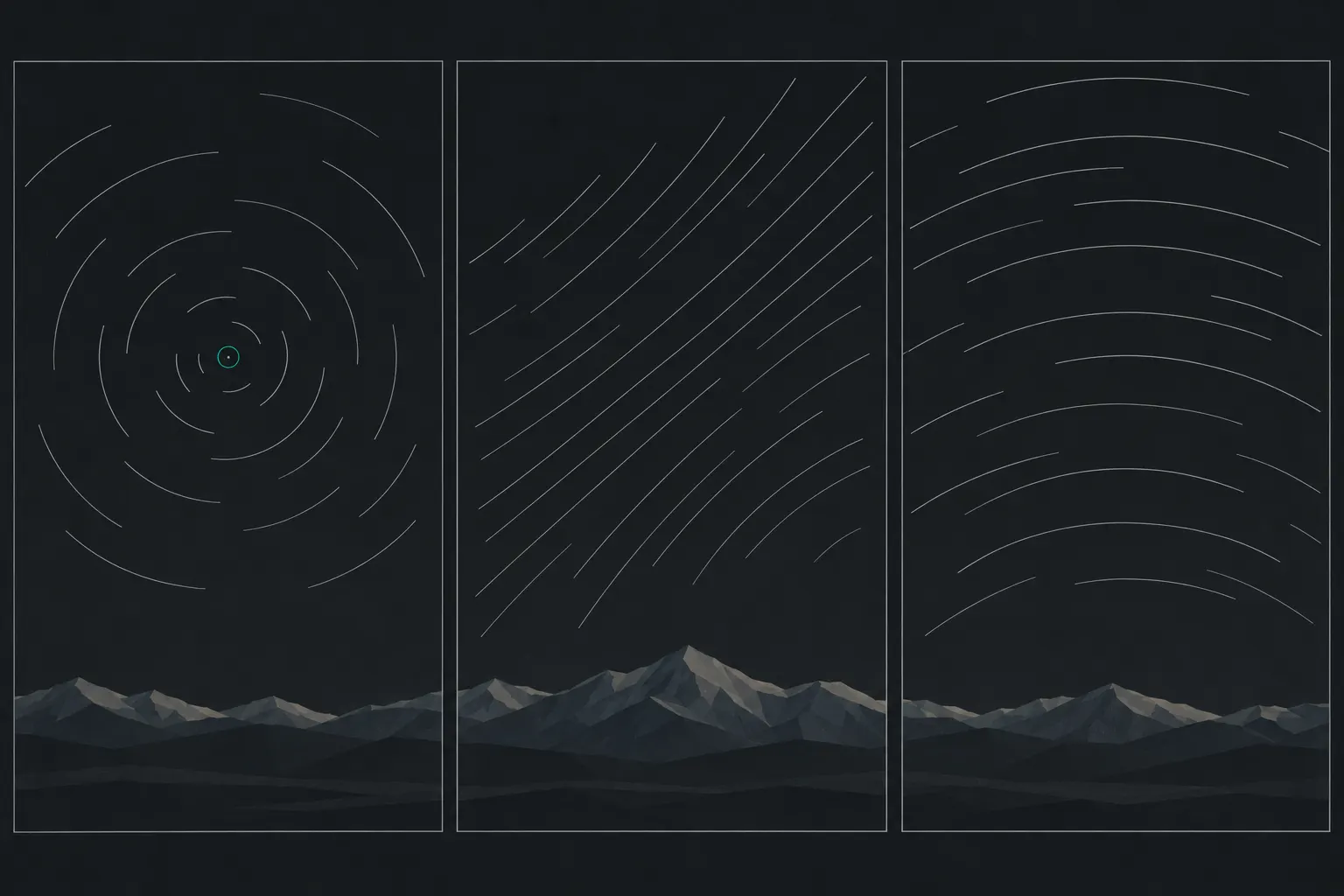
Starting points
- Where to point
- Decide the shape in daylight: the pole in frame for arcs ringing a still point, east or west for slanted near-straight lines, low on the side opposite the pole for broad bows. The pole stands at an altitude equal to your latitude. North: within two-thirds of a degree of Polaris, found from the two stars at the outer end of the Big Dipper's bowl, base star through rim star and on about five times their gap. South: no bright pole star; run the Southern Cross's long axis from its top star through the bright star at its foot and about four and a half cross-lengths on, landing within about three degrees.
- Mode, drive & focus
- Manual everything, RAW, fixed white balance, stabilization off. Focus by magnified live view on a bright star rolled to its smallest point, then locked in manual and taped. Continuous drive with a remote release locked down, or an intervalometer set about a second longer than the camera's real exposure, counted start to start (a nominal 30 s runs a little over 32 s on many bodies, so 33 s; a trigger that arrives while the camera is still exposing is skipped; a remote that counts the gap after each frame gets one second). Long-exposure noise reduction OFF: it follows every frame with an equal dark frame, so the shutter is shut half the night and every trail is half gaps.
- Per-frame shutter
- 30 s is the longest most bodies offer without bulb and is the working default: long enough that the second-long gap between frames is a sliver of each segment, short enough that one bad frame costs half a minute. Darker sites can run 1–4 minutes per frame in bulb, timed by an intervalometer remote that sets both the exposure and a one-second gap; the gap ratio improves, the undo gets coarser.
- Aperture & ISO
- f/2.8–f/4 and ISO 400–1600, two to three stops below the star-stacking recipe. Expose for the histogram, not the ISO number: the sky a quarter to a third of the way in. The lower ISO buys headroom, not cleaner noise (the light sets the noise): a 30 s frame gathers more sky glow, Lighten keeps the brightest sky each pixel saw, and bright trails hold their color only while their cores stay off the right wall.
- Total duration
- The arc length is the clock: 15 degrees an hour for a star due east or west, less toward the pole. 45 minutes is the floor at which arcs read as arcs rather than dashes; 1.5–2 hours gives the classic figure; a full circle needs a whole day of darkness (23 h 56 min), which only a polar winter supplies, and the longest mid-latitude winter night gives about half. Budget 90–240 frames at 30 s.
- Power, dew & cards
- A USB lens heater or hand warmers banded round the barrel from the first frame, not when the stars start to bloat. Power from a bank if the body runs on USB (some only charge while switched off), otherwise a dummy battery (a battery-shaped adapter fed from the bank). A fast card with room for a few hundred RAW frames, and image review off, so the camera never stalls between exposures.
In the field
- Plan the aim in daylight with a planning app: find the pole for your hemisphere, choose a ringed point, slanted lines or bows, and put a foreground under it that another site could not supply.
- Build the rig at dusk while you can still see: tripod low and weighted, stabilization off, long-exposure noise reduction off, image review off, RAW, manual exposure, white balance fixed.
- Focus on a bright star under magnification, lock to manual, tape the ring, and check one test frame's corners at 100%.
- Expose one 30 s test at f/2.8–f/4 and ISO 400–1600, move the ISO until the sky sits a quarter to a third into the histogram, then touch nothing again.
- Fit the heater and the power, start the run, check that the first two frames' capture times differ by a few seconds more than the exposure, never by twice the exposure, and keep hands, headlamps and feet away from the rig.
- Before packing up, with the tripod still standing, shoot the foreground as one clean exposure and a few lens-cap frames at the same settings (dark frames, which the stacker subtracts to clear hot pixels); then stack in Lighten mode, fix the aircraft frames, blend the land back, and only then judge the arcs.
When it fails
- Dashed trails, a gap every few pixels
- The shutter was shut between frames long enough for the sky to move, and every arc shows the same bite at the same places. A gap shows once it lets a star move a good part of its own width: at a wide angle the usual one-second gap vanishes inside the star, several seconds pinch the arcs, a gap near the pinpoint shutter ceiling breaks them, and a longer lens shows it sooner. Three causes: an intervalometer leaving far more than a second between frames, or set so close to the exposure that it fires while the camera is still busy and every other frame is skipped; long-exposure noise reduction (a dark frame as long as each exposure); and image review or a slow card stalling the buffer. Turn off noise reduction and image review, use a fast card, run continuous drive with the release locked, and treat the stacker's gap-filling as a repair for short gaps, never the plan.
- The second hour soft, then empty
- Dew. The front element cooled below the dew point and the stars bloated, dimmed and disappeared frame by frame, so the stack has sharp arcs fading to nothing at one end; a drifting focus on a cooling barrel does the same more slowly, and a dying battery ends the arcs cleanly instead. None of it is recoverable at the desk: a blurred star has no edge to sharpen. Heat the lens from the first frame (it slows the focus drift too), power the camera from outside, and when a run dies early stack what was sharp: if it clears the 45-minute floor, a short hub beats a two-hour smear.
- Straight lines that are not stars
- Aircraft, and increasingly satellites, write straight lines across the arcs, and a Lighten blend keeps the brightest value at every pixel, so a light that crossed one frame survives the whole stack as if it had been there all night. The fix is per frame, not global: find the frames carrying the line and mask it out of each before the blend. Dropping a whole frame cuts the same bite into every arc that the first failure describes, so drop one only when the stacker's gap-filling can close the notch. Cloning across the finished stack scars the arcs; editing one frame does not.
Finished the sequence? Get the honest read.
A technique assembles the frames; a critique reads the result. Upload the finished image (for a timelapse, a standout frame) and FinalFrame returns the full diagnosis: what works, what limits the frame, and whether the fix lives at the desk or back in the field.
写真を講評する