Astrofotografia
Rzemiosło stojące za mocnym kadrem, i to, co odróżnia 6 od 8.
FinalFrame ocenia każde zdjęcie od 0 do 10: 6 to solidne zdjęcie, 8 to kadr godny portfolio, a 9 to poziom wystawowy. Jak działa ocenianie
Widzenie
Astrophotography is planned or it is luck, and the plan starts on a calendar. Deep-sky light is faint enough that the moon is not an accent (it is a floodlight) so the working window for Milky Way frames is the new moon, give or take three days on either side. Inside that window, the site decides the ceiling: pull up a light-pollution map and drive to genuine darkness, because a sky shot from an orange suburb starts the night already compromised. Then plan the frame itself with an app (PhotoPills, Stellarium) until you know where the galactic core will sit relative to your foreground at a given hour, because the core keeps its own schedule: it is only above the horizon in certain months, at certain hours, and it will not wait while a composition gets improvised in the dark.
Here is the part that separates the genre's 6s from its 8s before any camera is involved: the foreground is the photograph. The Milky Way over your head is the same Milky Way over everyone's head: the same core, the same dust lanes, photographed from every dark ridge on Earth. What cannot be duplicated is the arch of rock, the lone tree, the peak reflected in still water that anchors that sky to one place on one night. So invert the instinct: spend most of the scouting time, daylight time, hunting foregrounds, and let the app tell you when the sky will arrive above the one you chose. A frame conceived as "the Milky Way, plus whatever was in front of me" was finished before the shutter opened.
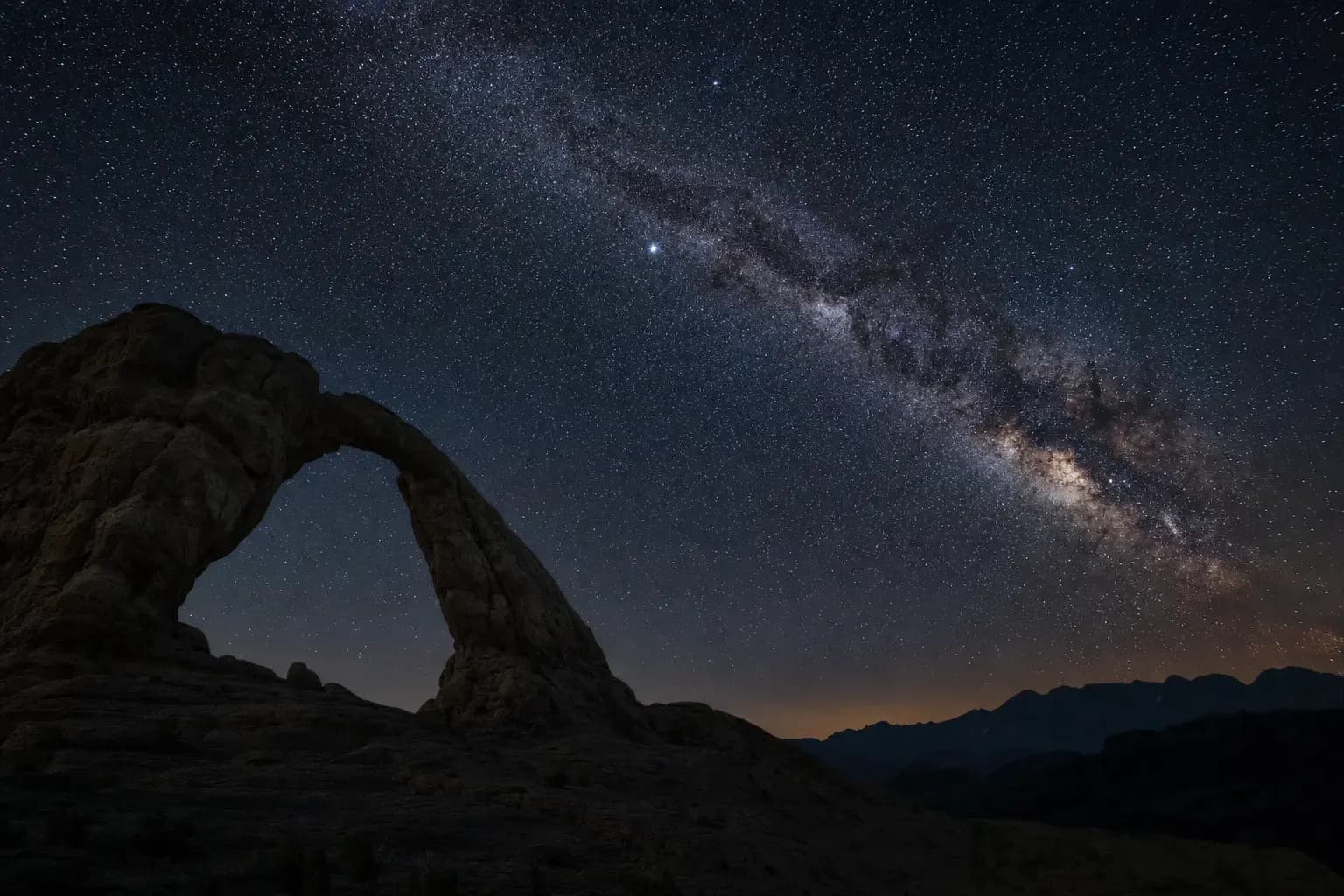
Wygenerowany przez AI
Uchwycenie
The Earth is rotating under the stars, so shutter speed has a hard ceiling before points smear into dashes. The classic starting point is the 500 Rule (500 divided by focal length gives the maximum shutter in seconds) but treat it as a first draft, not a law. The NPF rule is more accurate because it accounts for pixel density, and on a high-resolution full-frame sensor at 24mm the honest limit is closer to ten to thirteen seconds, not the twenty the 500 Rule promises. Dense pixels see smaller trails.
Inside that ceiling, gather everything the night offers: the widest aperture the lens has, ISO in the 3200–6400 range (noise is the tax the exposure math imposes, and it is a better tax than trailing).
Two techniques raise the ceiling itself. A star tracker rotates the camera with the sky, buying two-to-four-minute sky exposures at far lower ISO, then the tracked, trailed-foreground frame is blended with an untracked, sharp foreground frame. And stacking attacks noise directly: twenty to fifty frames of the same sky, averaged in software, and the random noise cancels while the signal stays.
A stack also deserves calibration frames, and they are shot in the field: before packing up, cap the lens and fire fifteen or twenty dark frames at the same shutter, ISO, and temperature as the sky frames. Darks record the sensor's own thermal signal and hot pixels (the part of the noise that is not random, which averaging alone does not cancel) so the stacking software can subtract it; and because that signature shifts with temperature, darks belong to the same night, not to the desk at home. Flat frames, even light shot through the same lens, do the equivalent bookkeeping for vignetting and dust, though a wide nightscape can often live without them.
Focus is its own discipline, because autofocus is blind out here. Switch to manual, magnify live view on the brightest star, and roll focus until the star is its smallest point: infinity minus a hair, never the hard stop. Tape the ring. Then re-check it through the night, because a cooling lens barrel contracts as the temperature drops, and a frame that was sharp at ten o'clock can be quietly soft by two. A whole night's stack can go down to that drift.
And star trails flip the same physics into a subject: instead of fighting the rotation, point at Polaris and let it draw. The working method is stacked, not single-shot, one 45-minute exposure drowns in sensor heat and noise, so shoot continuous 30-second frames back-to-back on the intervalometer (gap-less, or the trails come out dashed) for 45 minutes to 2 hours of total time, then blend the set with a lighten-mode stack, StarStaX, or Photoshop's Lighten blend across layers; the align-and-average stackers named for nightscapes above would erase the trails you came for. Composition decides the figure the sky draws: Polaris in frame gives concentric circles around a fixed hub (under southern skies, the dim pole below the Southern Cross); aim east or west and the trails rake across the frame as diagonals. The general duration craft, and what a soft anchor costs, is the long-exposure lesson's territory; this is its night-sky dialect.
- Shutter ceiling
- NPF ≈ 10–13 s @ 24mm (the 500 Rule overshoots)
- Aperture
- the widest the lens has
- ISO
- 3200–6400 untracked · far lower on a tracker
- Sky frames
- 20–50, stacked
- Darks
- 15–20: same night, same shutter/ISO/temperature
- Flats
- optional for a wide nightscape
- Star trails
- 30 s frames, gap-less, 45 min–2 h total · stack in lighten mode
Obróbka
If the night produced a stack, it is assembled before any editing, in software built for the job. On the nightscape side that means Sequator or Starry Landscape Stacker, which mask the sky from the land, align the stars from frame to frame, and stack the two halves separately: foreground held sharp, sky averaged clean; at the deep-sky end it means DeepSkyStacker, Siril, or PixInsight. And that end is its own discipline (a tracker or a telescope held on one nebula or galaxy through hours of accumulated exposure, a fuller calibration regimen, its own processing tradition) which this nightscape lesson borders but does not cover.
Start with white balance, because it is the edit that makes the galaxy legible: somewhere around 3800–4200K, the core's warmth separates from the cool of the surrounding sky instead of drowning in a single blue wash. Then stretch (curves, worked patiently) to lift the dust lanes, the structure, the actual colors of the stars out of a RAW file that looks flat and dark on first open. Astro is the genre where the file genuinely holds more than the first glance shows, and stretching is how it is revealed.
Which is exactly why the discipline matters: reveal the data, don't invent it. The failure mode of the genre is the over-saturated, over-contrasted sky (purple from horizon to zenith, contrast cranked until the sky looks radioactive) that reflects no night anyone stood under. The real sky has restraint built in; an edit that balances drama with authenticity reads as a place, and one that doesn't reads as a graphic.
And the honesty clause, with no softening. Star trailing from a shutter that outran the 500/NPF limit is unrecoverable: no sharpening tool turns a dash back into a point. Missed infinity focus is the same sentence: the detail was never recorded, and nothing in post records it later. A weak or absent foreground is a re-shoot, not an edit. Stacking and stretching are revelation tools (they average noise down and pull captured signal up) but they cannot manufacture detail the sensor never saw. In astro, more than any other genre, the file is a record of decisions already made in the dark.
Ocena
Borrow the product's discipline for your own review. The FinalFrame Score is a lane-weighted blend, and the critique names ONE bottleneck, the single limit costing the frame the most, not a scorecard of sub-grades. Self-critique the same way: name the one thing this frame is limited by, and ignore the rest until it moves. For astro frames sitting at 6 or 7, the named limit is usually one of three. COMPOSITION: a sky with no foreground, or a foreground that is merely present rather than chosen. SHARPNESS: stars trailed by an over-long shutter, or softened by focus that was near infinity instead of on it. TONAL-HIERARCHY: a flat stretch that never separates the Milky Way from the sky around it, so the structure the sensor caught stays buried. Above 8, the bottleneck migrates to micro-polish: a visible seam where tracked sky meets foreground, halos around the bright stars, a noise-reduction pass that turned the sky to plastic.
- Magnify a corner star to 100%: point, or dash?
- What does the foreground contribute that another dark site couldn't?
- Squint at the frame small: does the core still separate from the sky, or does it all read as one blue mass?
Those three questions are the genre's three usual verdicts, asked early.
Dlaczego 6 to nie 8
The 6 is proof of contact. The Milky Way is there, recognizable, genuinely photographed under a genuinely dark sky, which is more than most frames ever manage. But it is a picture of the sky rather than a photograph of a place: the bottom of the frame is a black void or an accidental silhouette, the stars are slightly elongated at 100%, and the core sits in the sky without stepping forward from it. The eye finds the galaxy, confirms it, and is done. It is an achievement of access (being there, in the dark, in the window), not yet of authorship.
The 8 is a landscape that happens to be lit by the galaxy. A foreground worth scouting anchors the frame and gives the sky scale; the stars are points, held inside the NPF ceiling and focused to a hair; the core shows structure (dust lanes, star color) because the stretch built a hierarchy instead of a wash. And the foreground is lit so naturally, a blue-hour blend or the faintest touch of light-painting, that the join is invisible: one place, one night, one frame of light, not a sky pasted over a silhouette. The gap between them is rarely the camera. It is the daylight spent finding the rock, the thirteen seconds instead of twenty-one, the tape on the focus ring, the stretch that stopped in time.
So when the critique names the bottleneck (the foreground, the trailing, the flat stretch) shoot it again for that one thing. If the fix is real, the next critique names a different limit, and the FinalFrame Score has room to move. And if the same bottleneck is named again, that is information, not indictment: astro meters out its practice nights like no other genre (a new-moon window each month, a core season each year, weather with a veto over both) so a limit that took one attempt to name can fairly take several to move. The sky will stage the same rehearsal next month, same core, same hour. The craft is in what stands in front of it.
Powiązane lekcje
Zobacz to na własnym zdjęciu
Najszybciej zrozumiesz wynik, czytając go na kadrze, który dobrze znasz.
Skrytykuj zdjęcie