Dodge & Burn
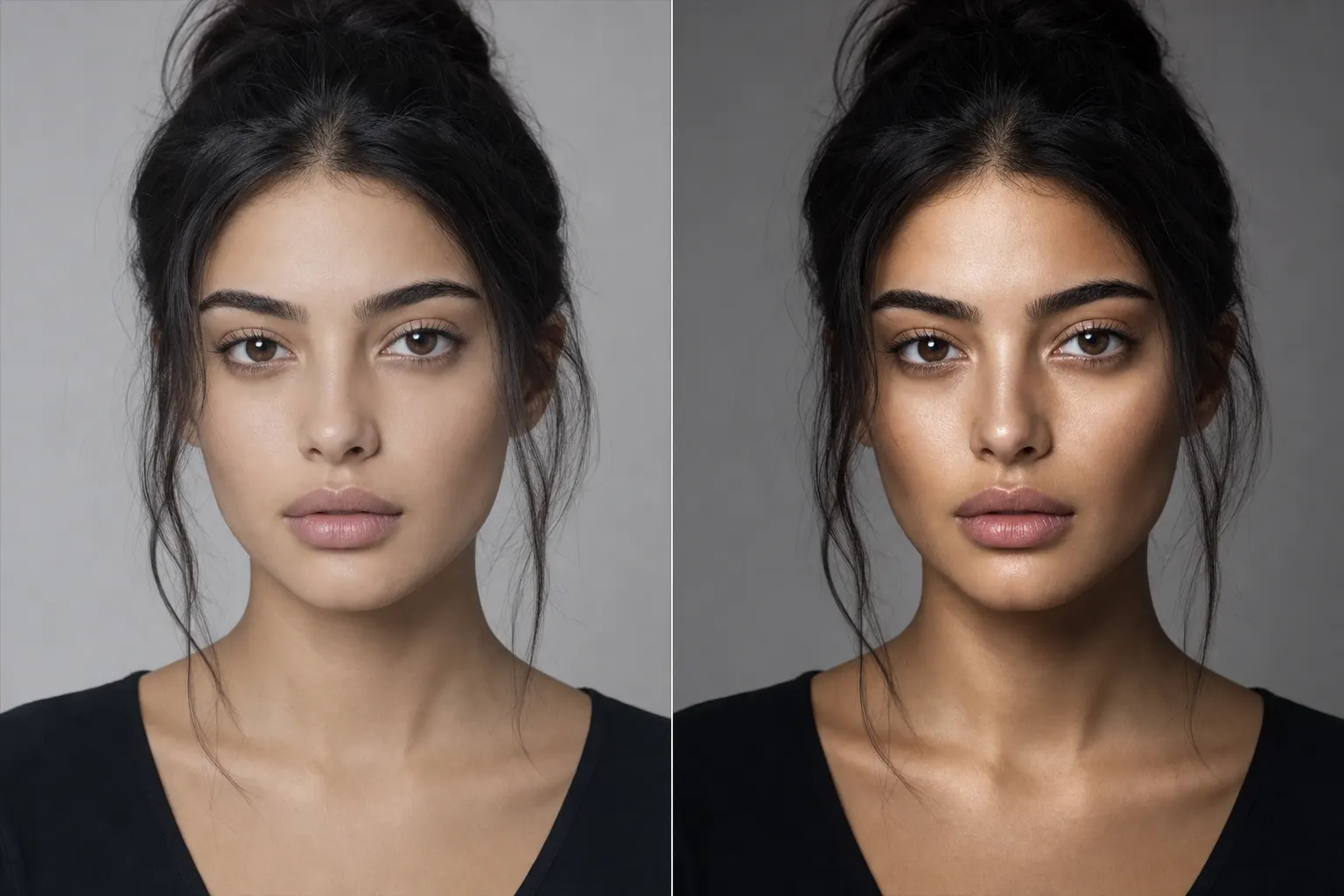
Selectively brightening (dodge) or darkening (burn) areas to guide the viewer's eye.
FinalFrame ocenia każde zdjęcie od 0 do 10: 6 to solidne zdjęcie, 8 to kadr godny portfolio, a 9 to poziom wystawowy. Jak działa ocenianie
Czym to naprawdę jest
Dodge and burn is tonal control taken local: the by-hand shaping of brightness one region at a time. Two verbs with fixed directions: to dodge is to lighten a chosen area; to burn is to darken it. Everything else in this lesson is technique. Those two directions are the entire vocabulary.
The names are a darkroom inheritance, and the physics under them still explains the craft. Photographic paper darkens where the enlarger's light lands. Hold a small paddle over one part of the print during the exposure and that region is starved of light, it comes up lighter: a dodge. Give another region extra light afterward, through a hole in a card or the gap between cupped hands, and it comes up darker: a burn. Withhold light to lighten; add light to darken. The digital versions, a brush on a mask instead of a hand under an enlarger, kept the names, the directions, and the purpose intact.
That purpose is what separates the tool from everything global. An exposure or contrast slider moves the whole frame at once: it can set the tonal span, but it cannot decide that the subject deserves a step of brightness the wall behind it does not. Dodge and burn is exactly that decision, made region by region, and it has three jobs. It realizes a ranking (lift the subject, quiet the rival patch) building by hand the order the tonal-hierarchy lesson plans. It sculpts dimension: deepening the roundness a form's light only implied, the sculpting-with-light the darkroom printers made a discipline of. And it kills local distractions no global move can reach without dragging the rest of the frame along.
In this curriculum it sits one step below tonal hierarchy: that lesson is the plan (what should read bright, what should read dark, and why); this one is the hand that executes the plan. And its governing law is edit discipline narrowed to the width of a brush: the viewer must feel the pull toward the subject and never see the hand that made it.
Wygenerowany przez AI
Dlaczego 6 to nie 8
A 6 either leaves the ranking to a global move or does the local work with the seams showing. The first version is one contrast slider dragged across the whole frame: span set, order untouched, the subject still sharing its luminance with everything around it. The second is a first honest attempt at the brush that betrays itself: a bright rim glowing along a ridge where the burn bled across the edge, a face lifted until it went flat and milky, a darkened corner that reads as a smudge rather than a shadow. The work is visible, and the moment the work is visible, the viewer is looking at the editing instead of the photograph.
An 8 does two things at once and hides both. It ranks: the subject holds the strongest contrast against its surround, and the bright eye-thieves have been burned down into the crowd. And it sculpts: the lit side of a form dodged a touch, the shadow side burned a touch, following the direction of light the scene already had, so the subject carries a roundness the flat file only hinted at. And there is no seam anywhere: no halo, no milky patch, no findable transition. The judge's tell is reconstruction: try to locate the brushwork. On a 6 the burns announce themselves from across the room. On an 8 the eye is pulled to the subject and cannot find the hand that pulled it. One caution against over-crediting the lever: invisible local sculpting is a real part of what separates the two frames, never most of it. It refines a capture; it does not replace one.
Przed naciśnięciem migawki
For a post tool, the seeing runs in two places, and the earlier one is the easier to forget. The darkroom printers previsualized their dodges and burns at the meter: they exposed to hold detail in the regions they intended to lift and the regions they intended to darken, because a burn needs texture to darken into and a dodge over near-blown data returns nothing but grey. Carry the habit: at the scene, know where you plan to sculpt, and protect it.
At the screen, squint the frame down into masses: the tonal-hierarchy squint, now aimed at execution rather than the plan. Two questions: is the subject sitting a step too dark to hold the lead, and which bright patch is stealing the first look? Those answers are the work order. Then, before any brush touches the file, read the direction of the light already in the frame, because it governs everything that follows. Dodge and burn that fights the real light (the shadow side lifted, the lit side darkened) reads as fake on sight; work that follows the light disappears into it.
Last, learn to see your own seams, because adapted eyes forgive their own work. Two zoom levels do not: 100% to hunt halos along the high-contrast edges, then a thumbnail to check that the overall balance has not quietly tipped. Alternate between them and your own tells stop hiding.
W aparacie
You cannot sculpt light that is not in the file, so the capture's one job here is to protect the data the brush will later shape. Hold texture in every region you intend to work (the metering mechanics belong to the exposure lesson, and the latitude belongs to RAW) because a blown white will not accept a burn and a pure black has nothing to give a dodge. And expose the shadows you plan to open more generously than the ones you mean to leave dark: dodging lifts noise right along with luminance, and a starved shadow raised in post arrives gritty.
Then, when the choice is yours, light for dimension. Side light, window light, the rake of a low sun: these hand the frame a modelling to enhance, and enhancing light that exists is the dodge and burn that never shows. Flat, frontal light hands the brush nothing to follow, which forces the edit to invent modelling instead, and invented light is the hardest of all edits to hide. The cleanest sculpt is bought at the scene, in the direction of the light you chose to stand in.
W obróbce
This is where the craft lives, and most of it is discipline. Order first: set the global span before any local move (black point, white point, overall contrast, the tonal-hierarchy lesson's global step) because local work built on an unset frame gets redone the moment you set it. Then go local, and go small. The instrument hardly matters (a masked adjustment painted with a brush, a curve applied through a mask, a luminosity mask that selects a band of tones by itself) because invisibility comes from two settings, not from the tool. Low flow, so the effect builds gradually across passes and you can stop at the exact amount instead of overshooting in one stroke. And a feathered edge, with the radius of any local-contrast move matched to the region it works, a radius too large for the edge it crosses is precisely what smears a bright or dark rim past a boundary, and that rim is the halo: the most legible over-editing artifact a frame can carry.
The moves, in order of yield. Burn the eye-thieves down first, so the bright rival patches stop spending the viewer's first look. Dodge the subject a step up, so it holds the lead. Then, only if the picture wants depth, sculpt: lit side lifted a touch, shadow side deepened a touch, always along the light the frame already carries. Between passes, run the two checks (100% for seams, thumbnail for balance) and toggle before and after. The result should read as the same photograph with its attention re-pointed, never a different one.
Know the overdone version by its four tells, so the hand that makes them can catch them. The halo: a rim bled across an edge by too much radius or too little feather. The muddy dodge: a region lifted until its local contrast collapses into flat, milky grey (luminance raised and texture killed in the same stroke). The hole: a burn pushed past the last shadow detail into dead, featureless black. The smudge: a hard-edged, unfeathered mask reading as a visible patch. Each is the hand performing instead of serving: an edit-discipline failure in a dodge-and-burn costume.
And the honesty clause: the brush shapes light that exists; it cannot invent light that doesn't. Burn a blown highlight and it greys: it does not become cloud; that scar belongs to the exposure lesson, and no brush un-bakes it. Dodge a pure-black shadow and noise arrives before detail does. The deepest limit is directional: flat, even light offers no modelling to follow, and modelling painted onto a form the light never shaped reads as pasted on (light that never was, and a practiced eye finds it at a glance). A frame with no directional light to follow and no protected detail to work is capture-limited, and the fix is a directional light and a cleaner exposure next time, not a heavier brush tonight.
Drabina
- Beginner: global moves only. One contrast slider or a heavy vignette stands in for a ranking; the first local passes run at full flow with no feather, and the halos and milky patches arrive immediately.
- Competent: local, but findable. The subject gets dodged and the obvious thieves burned with a soft brush, and the worst halos get caught. Too much flow survives, the occasional muddy patch survives, and a second look can still find the work.
- Strong (a late rung: plenty of otherwise-advanced editors never reach it): invisible. The ranking is built in low-flow, feathered passes; the sculpt follows the scene's own light; every pass is checked at 100% and at thumbnail, so the seams never ship.
- Advanced: sculpts at will, inside the light's law. Luminosity masks and curves-on-masks build the light the capture implied, yet the real light's direction is always obeyed, and when flat capture forbids the sculpt outright, the honest call is to relight or reshoot rather than paint modelling that was never there.
Idź i zrób zdjęcie
No new frames for this one: the capture stays frozen so the brush is the only variable. Pick one RAW file with a clear subject and at least one bright eye-thief in it; the strongest candidate is the image whose critique sent you here. Build three versions.
One, the control: a single global contrast move, and stop. Two, the sculpt: global span set first, then local and low-flow (the thief burned down, the subject dodged up, one form deepened by lifting its lit side and darkening its shadow side along the light already there); every stroke feathered, 100%-then-thumbnail between passes. Three, the overcook, on purpose: the same moves at full flow and large radius until a halo forms along an edge and a milky patch spreads on the subject. Manufacture the two tells once, deliberately, and you will recognize them for the rest of your life.
Walk away. Come back cold and rank the three on first reaction, before loyalty to your own effort sets in. The control should read flat, the overcook should read worked, and the sculpt, if the flow truly stayed low, should read as though the light simply fell that way.
Upload the sculpt as a new version and let the re-critique read it against the original; the version compare is where this tool's loop lives. You reached this page because a critique named tonal hierarchy as your bottleneck, and dodge and burn is the hand that builds a ranking, not the plan of one, so the prediction is concrete, and it is allowed to fail. If a lifted subject and a burned-down thief were what the frame lacked, the new critique should move off tonal hierarchy, and the FinalFrame Score has room to move with it. If tonal hierarchy keeps its place, that is information, not indictment: either a rival patch is still out-shouting the subject (the thumbnail is where it hides) or the ranking is real but too timid to register, and the next pass simply commits harder. And if your own cold eye ranked the overcook first, distrust the ranking, not the lesson: a fresh screen rewards the loudest file, and that is precisely the trap edit discipline exists to catch.
Powiązane lekcje
Zobacz to na własnym zdjęciu
Najszybciej zrozumiesz wynik, czytając go na kadrze, który dobrze znasz.
Skrytykuj zdjęcie