Uliczna
Rzemiosło stojące za mocnym kadrem, i to, co odróżnia 6 od 8.
FinalFrame ocenia każde zdjęcie od 0 do 10: 6 to solidne zdjęcie, 8 to kadr godny portfolio, a 9 to poziom wystawowy. Jak działa ocenianie
Widzenie
Street photography is storytelling with one frame and no caption, which is exactly why its reputation as the genre of reaction ruins more frames than any camera setting does. Walk and react, and the frame arrives half a second after the picture did. The working method is inverted: build the photograph first, then let the city finish it. Find the stage (a strong background, clean geometry, one good shaft of light) and wait for a subject to walk into it. The picture exists before the person does; the person is the last element to arrive, not the first.
That means reading pedestrian flow the way a landscape photographer reads weather. Intersections, crosswalks, stairways, transit exits: these are where people pause, bunch, and change direction, and a pausing or turning figure offers gestures a walking crowd never will. Work backwards from a frame you can already half-see: this doorway, that light, a figure about there. Then the discipline nobody wants to hear: one strong corner worked for an hour outproduces miles of walking, because at the corner everything is already decided except the subject, and the subject is the only element that improves with patience.
Read the light by its angle before anything else. Street is at its best when the sun drops low enough to throw long shadows down the canyons between buildings; overcast flattens the street into a record, because even light does no sorting. The hard shadow line is the genre's free gift: use it as a divider, a frame, the edge of a stage a subject steps across.
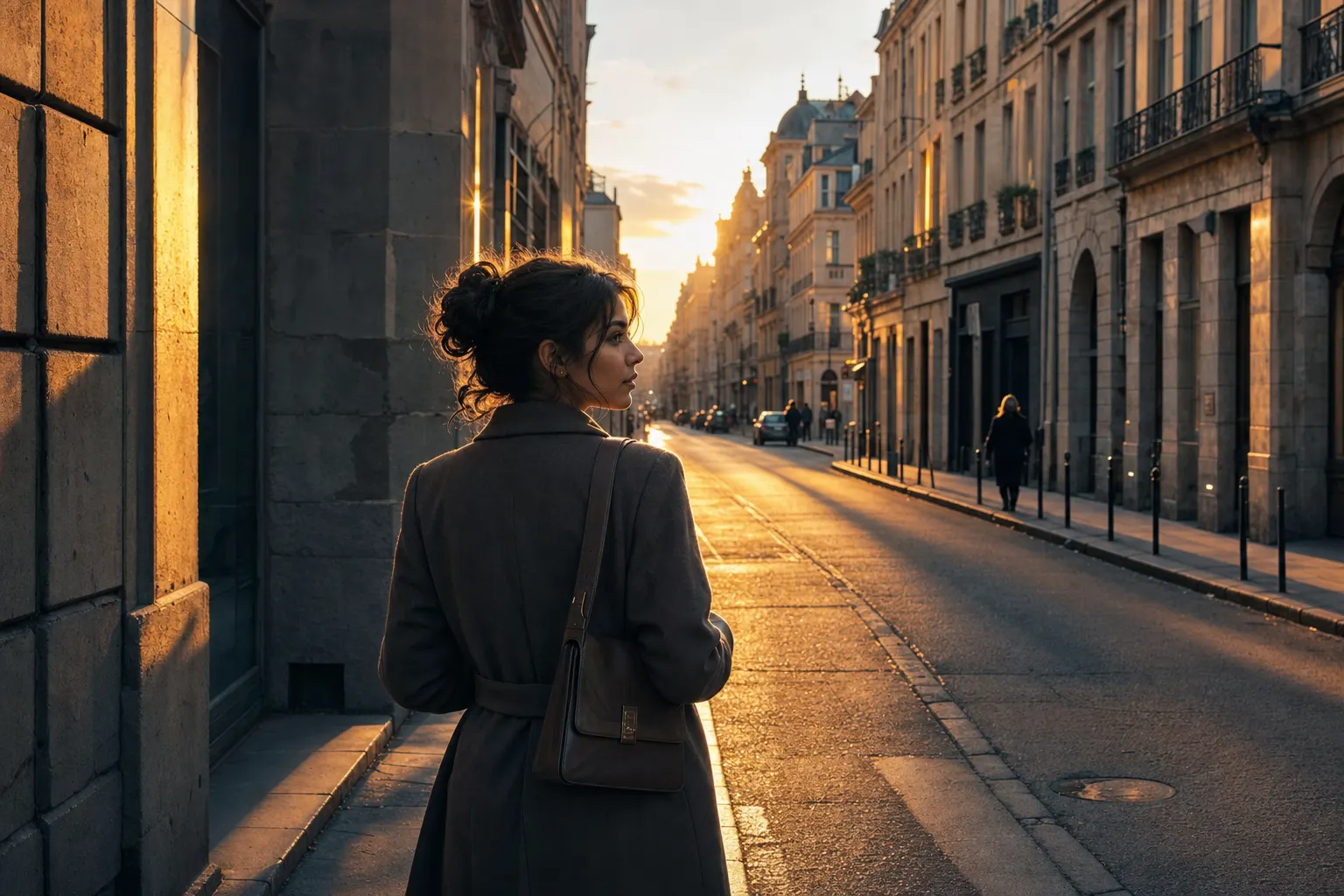
Wygenerowany przez AI
Uchwycenie
Timing first, because nothing downstream can touch it. The peak of a gesture (the stride at full extension, the glance at the moment it lands) lasts a fraction of a second, and human reaction time is longer than that fraction. Press the shutter when you see the peak and the frame records what came after it. So shoot one beat early: read the approach, and fire on the way up. Anticipation, not reflex: reflex is always late by exactly the time it takes to react.
The difference between a snapshot and a street photograph is arithmetic: how many elements align in the same instant. A gesture alone is a snapshot. A gesture against the right background is a photograph. A gesture, a juxtaposition, a shaft of light, and enough context to say where and why, that alignment is what the genre exists for, and it is why the stage-first method wins: every element locked in advance is one less that needs luck.
Zone focus removes the last delay between seeing and recording. A 28 or 35mm lens at f/8 to f/11, pre-focused around three metres, holds everything from roughly two to five metres acceptably sharp, more generous still at 28mm, so there is no autofocus hunt between the moment and the exposure. The camera is focused on the space where the picture will happen before it happens.
Add a silent electronic shutter and the option of shooting from the hip, and your presence shrinks to nearly nothing; candid survives only where the camera goes unannounced. Keep the shutter fast enough to hold a stride and let ISO float: grain is cheap currency, a smeared gesture is not.
And learn the black-background trick, because it is studio isolation with zero setup: find a shaft of low sun with a dark doorway or alley mouth behind it, expose for the lit side of the subject, and let the shadows fall where the meter would rather they didn't. The unlit background drops toward pure black, the subject detaches completely, and a crowded street renders like a set.
Night is the genre's second shift, and it inverts the method rather than ending it. The stage-first logic survives, but the stage is now the light itself: a shop window, a streetlamp's pool, a neon sign throwing one saturated color across three metres of pavement. Stake out the light instead of the background and wait for someone to walk into it. The meter will fight you: left to itself it lifts the whole frame toward gray and drowns the pools that are the picture; expose for the lit side of whoever enters the light and let the dark stay dark. The histogram piling hard left is not an error to fix. It is the scene, reported honestly.
After dark the daytime settings bend but the priorities hold. f/8 costs more light than the night can pay, so the aperture opens and the zone-focus band shrinks with it, which only sharpens the argument for choosing your spot: a narrow zone pre-focused on a lit patch beats hunting autofocus in the dark every time. Hold the shutter at whatever still freezes a stride and pay the difference in ISO without apology: the currency rule from daylight goes double after dark. And treat the mixed colors as the palette they are: sodium orange against window blue is not a white-balance fault to correct; it is the night street's own light plan, already art-directed by the city.
Obróbka
The street edit has one job: finish the exclusion the frame started. Burn down the bright sliver at the edge that leaks the eye out. Deepen the shadow side so the stage stays a stage. Set contrast for the instant read, not for drama. Treat monochrome as a clutter decision rather than a style: color is one more element competing for attention, and when it carries nothing, conversion deletes an entire layer of noise. When the color is the picture, one red coat in a grey crowd, protect it and mute everything else. A modest crop is legitimate finishing here: a trim that seals an edge or removes a half-figure is the same editorial act the framing began.
The honesty clause runs harder in street than in any other genre. Post can darken a distraction; it cannot unmerge a lamppost from a silhouette. It cannot move a gesture to its peak: a gesture caught mid-transition is unrecoverable, because the peak was never recorded; there is nothing in the file to restore. Flat light cannot be re-lit by a slider, and no local adjustment builds a shadow line the hour didn't throw. Those frames are capture-limited, and the fix is the corner again, not the mask. The ceiling is lower here too: heavy processing reads as intervention, and intervention is the one thing this genre cannot absorb. A street photograph's entire currency is the claim that this actually happened: an edit that announces itself spends that claim.
Ocena
Borrow the product's discipline for your own review. The FinalFrame Score is one lane-weighted number, and the critique names ONE bottleneck, the single limit costing the frame the most, rather than a scorecard of sub-grades, because fixing one named thing beats auditing ten. Run the contact sheet the same way: name the one limit, ignore the rest until it moves.
For street frames landing at 6 or 7, the named bottleneck is usually clutter or timing (too much in the frame, or the right thing at the wrong instant) and almost never sharpness, and almost never gear. Above 8 it migrates to micro-polish: a half-merger at an edge, a burn that stepped too far, a crop a few pixels loose.
- The instant read: shown for one second, is the subject unmistakable, or does the eye have to hunt?
- The peak: is the gesture at its apex, or on its way somewhere?
- Edge patrol. Trace all four borders: does anything touch, merge, or half-enter without earning its place?
- The light: does it do any sorting work, or would the frame read identically under overcast?
A frame that passes all four is worth a critique; a frame that fails one just told you what the critique will say.
Dlaczego 6 to nie 8
The 6 documents a scene it does not interpret. Everything is present (a subject somewhere, a street doing street things) but nothing is ranked: too many elements at equal weight, so the eye hunts, and hunting is fatal in a genre judged in its first second. The gesture sits mid-transition, an arm on its way to a meaning it never reaches in-frame. The light is even and sorts nothing. A 6 is proof of presence (it says the photographer stood in an interesting place) but the frame needs its caption, and a street photograph that needs a caption is a document.
The 8 reads instantly: one subject, one gesture, one interaction with light, and nothing else asking for attention. The gesture is at its peak, not near it. Two or three elements align (figure, shadow line, a juxtaposition that comments) and the alignment feels found, not arranged. Most visibly, the 8 shows an editorial decision about what to exclude: the frame is tight because a choice was made, waited for, and kept. The 6 shows what the street looked like. The 8 shows what one frame, cut from that street, could mean.
So shoot it again for the one thing the critique named: the cleaner stage, the earlier press. If the fix is real, the next critique names a different limit, and the FinalFrame Score has room to move. And if the same bottleneck comes back, that is information, not an indictment: street is probabilistic in a way no other genre is (the corner, the light, and the focus are yours to control, and the moment still has to walk in). Timing and clutter yield to repetition, not to one corrected outing; the hit rate climbs with every hour a strong corner is worked. The corner is still there tomorrow. So is the light. Keep standing where the picture is.
Powiązane lekcje
Zobacz to na własnym zdjęciu
Najszybciej zrozumiesz wynik, czytając go na kadrze, który dobrze znasz.
Skrytykuj zdjęcie