Flash
A second light source with its own exposure: judged by the ratio it keeps with the ambient, and by whether the frame reads as lit or as flashed.
FinalFrame ocenjuje svaku fotografiju od 0 do 10: 6 je solidna, 8 je vredna portfolija, a 9 je izložbenog nivoa. Kako funkcioniše ocenjivanje
Šta je zapravo
Flash is not more light. It is a second light source sharing the frame with the one that was already there, and it brings its own exposure. Every flash frame is two photographs occupying one rectangle: the ambient exposure, drawn by the room's own light and governed by shutter, aperture, and ISO; and the flash exposure, drawn by the pulse and governed by power, aperture, and distance. The two are made simultaneously, and the craft, all of it, is the ratio between them. Fill sits the flash a stop or two under the ambient, lifting what the sun dug without leaving a signature. Key inverts the hierarchy: the flash carries the subject and the ambient is demoted to a background wash. Every good flash photograph lives somewhere on that line, and every bad one fell off it: usually at the far end, where the flash is everything and the room is gone.
The map of the knobs is the working half of that sentence, and it is asymmetric on purpose. Shutter speed moves only the ambient: the pulse is finished in a few milliseconds at full power and far less when powered down, complete within any sync-range shutter interval, so you can halve or double the shutter and the flash exposure does not move by a hair. Power and distance move only the flash: the room does not care what the tube is set to. Aperture and ISO move both together. Hold that asymmetry and the whole technique folds open: the shutter is your private negotiation with the room, power and distance your private negotiation with the flash, and the ratio is steered by playing one against the other. Flash photography stops being a mode and becomes ordinary exposure with one extra column.
Hold the borders with the lessons this one leans on. Exposure owns where the key tone lands: this page adds a second source to that arithmetic and changes nothing else about it. Light quality owns size and direction, and flash is the one time in photography you choose them instead of finding them: a bare tube is the smallest, hardest source you will ever use, and the same tube bounced off a ceiling is among the largest and softest (the entire light-quality lesson, purchasable with a thumb on the swivel). And the reputation problem deserves naming at the door: the flash look (flat faces, black rooms, stamped shadows) is not a property of flash. It is the property of the default: small, frontal, on-axis, and overpowering. The critique never scores flash; it scores the light the flash made, under the names of whatever that light did to the frame.
Generisano pomoću AI
Zašto 6 nije 8
A 6 is a frame you can hear the flash in. The light announces its address: dead frontal, so the face flattens into a shape with its form shadows erased, or worse, re-cast as a hard-edged silhouette stamped on the wall a half-meter behind. The background has fallen into the cave, the falloff nobody read, so a warm birthday kitchen renders as a subject floating in black. Skin goes specular where the small source hit it, and in a dim room, with the tube on the lens axis, the eyes come back red. None of these is a metering error (the subject may be exposed to the digit) and all of them trace to one root: the flash was deployed as a rescue, not aimed as a source with a job. The room had a picture in it, and the pulse overwrote it.
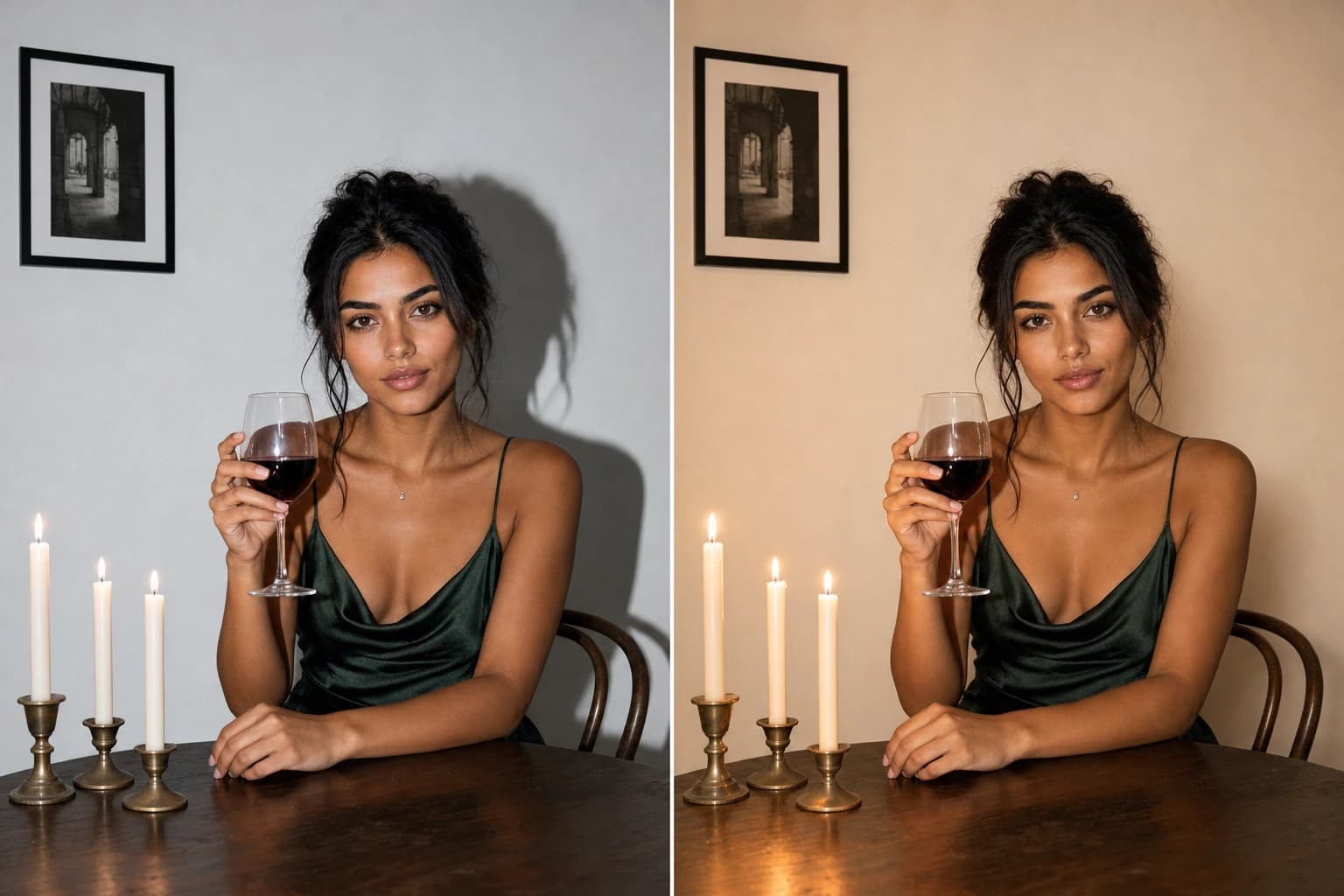
An 8 is a frame you have to deduce the flash in. Cover the catchlights and ask where the light stands: the honest answer reads like a window (size in it, direction across the face, form modeled instead of erased) except the room offers no window where the answer points. The ratio keeps the world in the picture: the background sits perhaps a stop under the subject, present and breathing, the ambient mood not merely surviving the flash but framed by it. The judge's tell is a single question: can you find the flash? In a 6 it is the first thing in the frame: the light is the subject, and not in the way anyone intended. In an 8 it is discoverable only by deduction: a face a stop more luminous than this room can explain, lit from a direction this room does not own. Both frames may have used identical hardware at identical power. The distance between them is three decisions (size, direction, ratio) and none of them costs a stop of anything but attention.
Pre okidanja
Read the ambient first, because it holds a prior claim. Before the flash comes out, meter the room as a photograph in its own right and rule on what the ambient is: the picture, the background, or the problem. When the ambient is the picture (the candle scene, the blue-hour window, the lamp-lit corner whose entire subject is the quality of its own light), flash does not help it; it replaces it, and what it replaces it with is daylight from a tube. Raise the ISO, open the aperture, leave the flash in the bag: declining to fire is a flash decision, and at this kind of scene the correct one. When the ambient is the background, a room worth keeping but not worth trusting with the subject, the frame wants a ratio, and the rest of this lesson is for exactly that. When the ambient is the problem, flash is the cheapest fix in the craft.
Learn the problem cases on sight, because they recur weekly. The backlit face: the rim light you love, the silhouette meter reading you don't (fill returns the face without touching the rim, because the rim belongs to the ambient exposure and the face to the flash). The overhead noon sun: raccoon shadows dug into every eye socket (a whisper of frontal fill, a stop or two under the ambient, opens them without leaving a fingerprint). And note the paradox while you are here, because it dissolves most flash fear: flash does its best work in bright light, where it only has to whisper, and its worst in the dark, where it has to be everything (the exact opposite of the rescue instinct that ships with the camera).
Then survey the room as a modifier catalog, and read the distances. A white ceiling at domestic height is a large soft overhead source, pre-installed; a pale wall at forty-five degrees is a window awaiting an appointment; a black bar ceiling or a banquet-hall vault six meters up returns nothing usable: bounce is a loan, and some rooms decline it. A colored wall repays the loan in its own currency: the light comes back wearing the paint, and skin lit by a green wall will say so. Last, read the geometry the falloff will obey: how far the flash stands from the subject, against how far the subject stands from the background. Those two distances, not the power dial, decide whether the room behind your subject renders present, dim, or gone. Walk them before the first frame, and you have set the background's exposure with your feet.
U kameri
Two ways to set the flash's half of the exposure, each right somewhere. TTL fires a metering pre-flash, reads it through the lens, and sets the power for that frame: a fresh meter reading at every press. Manual is a fraction you chose (full, quarter, sixty-fourth) held until you change it. The rule that sorts them: when the geometry changes frame to frame (events, a moving subject, a bounce angle that shifts as you do), TTL earns its keep, steered with flash-exposure compensation the way you already steer any meter. When the scene holds still (a seated portrait, a setup you built), go manual, because TTL re-decides every frame and can be argued with by a black jacket walking through it: the exposure breathes when nothing changed but the meter's mind. Manual holds the decision; that is the entire feature.
The sync ceiling is mechanics, not policy, and knowing why it exists tells you exactly when it will bite. A focal-plane shutter is two curtains crossing the sensor. At slow speeds the first curtain fully opens before the second sets off: for a moment the whole sensor sees the scene at once, and a pulse fired in that moment lights the entire frame. Above the sync speed, typically around 1/200 to 1/250, the second curtain starts before the first has finished, and the shutter speed becomes a traveling slit: no instant exists in which the whole sensor is uncovered. A single pulse then lights only where the slit happened to be, and the rest of the frame is left holding the curtain's shadow: the black band across a too-fast flash frame is the shutter itself, photographed. That is why sync is a wall and not a suggestion.
High-speed sync buys past the wall by refusing the single pulse: the flash strobes near-continuously while the slit travels, so every strip of the sensor is lit in its turn. The cost is real (commonly two stops or more of the unit's power, worsening as the shutter shortens) because the flash is now behaving as a small continuous light. The trade earns its price in exactly two places: the wide-aperture portrait in full sun, where f/2 demands a shutter far above sync and fill is non-negotiable; and daylight action that needs both the freeze and the fill. Inside the sync range, the single pulse is the stronger, cleaner instrument every time: do not pay the toll on a road you are not on.
Dragging the shutter is the asymmetry from the first section, made into a move. Because shutter touches only the ambient, slowing it is a private negotiation with the room: at the sync speed your birthday kitchen renders black; at 1/30 it comes back; at a quarter-second braced on a tabletop it glows. The flash exposure never moves through any of it, and the pulse freezes the subject even as the slow shutter lets the ambient smear whatever moves, which is why an event frame dragged to 1/15 reads as a crisp figure over living, streaking light rather than a blur. The long-exposure lesson's arithmetic governs the ambient half of that frame verbatim; the flash adds a frozen layer on top of it.
That dragged frame hides one more decision: when, inside the long exposure, the pulse fires, and the factory default is wrong for motion. First-curtain sync fires the flash the instant the shutter opens, so the freeze lands first and the ambient smear draws itself on top of and ahead of it: a dancer dragged at a quarter-second appears to be streaking backwards out of their own body. Rear-curtain sync (second-curtain, in some menus) holds the pulse until just before the shutter closes: the smear lays down first, the freeze arrives at the end of the motion, and the trail falls behind the subject, which is how the eye reads motion as forward. The switch lives in the flash or shutter menu and costs nothing but anticipation: the frame is now sealed at the exposure's end, so you compose for where the subject will be when the shutter closes, not where they are when you press. The choice matters in proportion to the drag: at 1/60 nobody can tell the curtains apart; at a quarter-second it decides whether the figure emerges from its own light or wears it as a veil. Any drag long enough to draw a trail is long enough to care which end of it the flash owns.
Direction and size are where the score is actually decided. Forward-facing on-camera flash is the smallest possible source at the worst possible address, hard light from the lens axis, the one direction guaranteed to model nothing, and, in a dim room, the geometry that finds the retina: red-eye is an on-axis tube meeting dilated pupils, and the fix is geometry too. Bounce is the first exit and the biggest single upgrade in this lesson: tilt or swivel the head so the pulse hits a ceiling or wall, and that surface becomes the source (the light's size, as the subject sees it, is now the surface's size, not the tube's). Give the bounce a direction worth having: over your shoulder, or off a wall at forty-five degrees, so the return crosses the face and models it; straight up off the ceiling directly above the subject is soft but top-heavy, and digs its own polite version of the noon-sun sockets. Off-camera is the full inheritance: a flash on a stand or in a raised hand, fired by a trigger, stops being flash and becomes a light you placed, direction chosen for form, exactly as the light-quality page prescribes for any source, plus one lever no window offers: you can walk it.
Distance is that lever, and the law it obeys is inverse-square: light falls with the square of distance, so each doubling costs two stops. The practical geometry is relative: the two distances from the seeing section. A flash close to the subject makes the subject-to-background gap enormous in stops, and the room plunges; moved close on purpose, that is the black-background-anywhere trick. A flash farther back (or a bounce, whose path is long and whose spread is wide) flattens the falloff and keeps the room. Two finishing disciplines. Gel for the room when the room is warm: the tube speaks daylight, tungsten speaks amber, and an ungelled flash in a lamp-lit scene splits the frame's whites between two masters (a warming gel over the tube marries the sources so one white balance serves both, and no slider fully un-splits them later). And collect the quiet dividend: flash lets the frame sit at base ISO in rooms that were about to charge the noise lesson's full toll (the cleanest file in the building, bought with the same pulse). One modern caveat before leaning on any of this: a fully electronic shutter has no curtains to sync with (many bodies cap flash far below their mechanical sync in silent mode, or refuse to fire it at all) so check how the body treats flash there before an important room.
U obradi
Post can tune a ratio; it cannot conduct one. The honest levers first. A background the flash starved lifts a little at the desk: the shadows hold some room, and the base-ISO file the flash bought can often afford the noise of the lift; a modest rebalance of subject against room is ordinary tonal work. A specular hotspot on skin tames somewhat. Red-eye removes convincingly with any modern tool, and the real fix is geometry next frame, not software this one. And the split-whites frame, when the gel was skipped, reconciles the hard way: one global white balance committed to the dominant source, a local correction walking the other toward it (honest work, tedious, and never as clean as the gel would have been). All of it is adjustment at the margin, and the margin is about a stop wide.
The honesty clause, and it is strict here: post cannot relight. Direction is locked at the pulse: the shadows the light cast, or failed to cast, are geometry written into the file, and no tool moves a source after the fact. Software that paints brightness onto a face does not move the shadow map that says where the light stood, and viewers read shadow maps without knowing they can. A frontal blast cannot be un-blasted: the flattened form, the stamped wall shadow, the erased modeling are not tone errors sitting on top of the image (they are the image). And the ambient mood a flash overpowered cannot be restored, because it was not dimmed, it was outvoted: the candle glow's share of the exposure was driven toward zero at capture, and there is no layer underneath holding it in reserve. A frame flashed past its mood is capture-limited in the strictest sense this curriculum uses.
Which makes the consolation cheap and total: every one of those failures was a decision, and decisions cost nothing to change. A thumb on the swivel, two steps of distance, a stop off the power, a slower shutter: the entire gap between the frame post cannot save and the frame that needs no saving closes before the pulse fires, with choices that travel in any camera bag.
Lestvica
- Beginner: the rescue reflex. The flash fires when the camera calls the room dark: on-axis, full frontal, ambient unread. Every frame announces it (flat faces, black rooms, a shadow stamped on the wall) and the flash made every decision, because nobody else did.
- Competent: the bounce habit. Head tilted at the ceiling by default, TTL trusted, red-eye and the cave mostly gone. Real progress, applied as recipe: the same bounce in rooms with nothing to bounce off, the ratio still whatever the meter felt that frame, the ambient never read before the tube came out.
- Strong (the serious amateur's working level): the ratio chosen per scene. Reads the ambient first and rules picture, background, or problem; sets manual power for the held scene and drags the shutter for the room; walks the flash-to-subject distance for the background it wants; gels when the room is warm, and fills at a whisper in daylight, where flash works best.
- Advanced: light indistinguishable from found light. Off-camera when the frame earns it, sized by the surface, aimed for form, balanced so a stranger reads a window that was never there, and the flash left in the bag when the ambient is the picture. Knowing when not to fire is this rung's real test.
Idi i slikaj
One patient subject, one room with a real ambient mood, a lamp-lit corner, a dusk window, string lights: the kind of room the flash reflex usually destroys. Lock everything the lesson is not about: position, composition, lens, and the pose held roughly steady. Four frames, and the ratio is the only variable, because the ratio is the lesson. Frame one, the baseline: no flash, the ambient's honest claim, at whatever ISO it demands (the mood on record, noise and all). Frame two, the failure, built on purpose: direct flash, straight on, the camera's own judgment (collect the flat face, the stamped shadow, the room gone black, because a failure you have manufactured with your own hands is one you will recognize on sight for the rest of your editing life). Frame three, the bounce: swivel the head at the best surface the room offers and watch the source grow from a tube to a ceiling. Frame four, the balance: power down (flash-exposure compensation or manual) and the shutter dragged until the room returns, tuned until the flash reads as help rather than headline.
Grade it with the only jury that counts: someone who was not there. Show the set and ask one question, which of these used a flash? Frame two they will name before you finish asking. Frame three may pass. And if frame four draws "the one by the window" (a light with size and direction, in a room that kept its mood) that sentence is the grade. Then run your own audit against the two ends: did frame four keep what frame one had (the room, the warmth, the hour) while fixing what frame one lacked: a subject cleanly exposed at base ISO, form intact? A keeper wins both readings; either alone is half the lesson.
Then close the loop. Re-critique the keeper: just that one frame. Flash is not a bottleneck category; the scorecard has no flash line, and this page usually finds you through the damage a flash did under other names: exposure, when the ratio failed (the cave background, the blasted key tone); tonal hierarchy, when the blast re-ranked the frame so a hotspot and a black room finished first and last; color, when two sources split the whites. Flash done well is exactly as anonymous: it surfaces as light the critique simply praises, direction and softness credited in the strengths to a window nobody will know wasn't there. So the prediction is concrete: if the balance is real, the finding that sent you here should retire, and the FinalFrame Score has room to move with it. And if the same finding returns, that is information, not indictment, read where it points: a background still starved wants a longer drag; a key still hot wants power down or distance out; whites still split want the gel you skipped. But if the re-critique names the light itself as a strength, in a room you know had no window: take the win, because it is the whole craft in one sentence. The score is not the reward: the light nobody can find is.
Povezane lekcije
Vidi to na svojoj fotografiji
Najbrži način da razumeš ocenu jeste da je pročitaš na kadru koji dobro poznaješ.
Kritikuj fotografiju