How to shoot a panorama
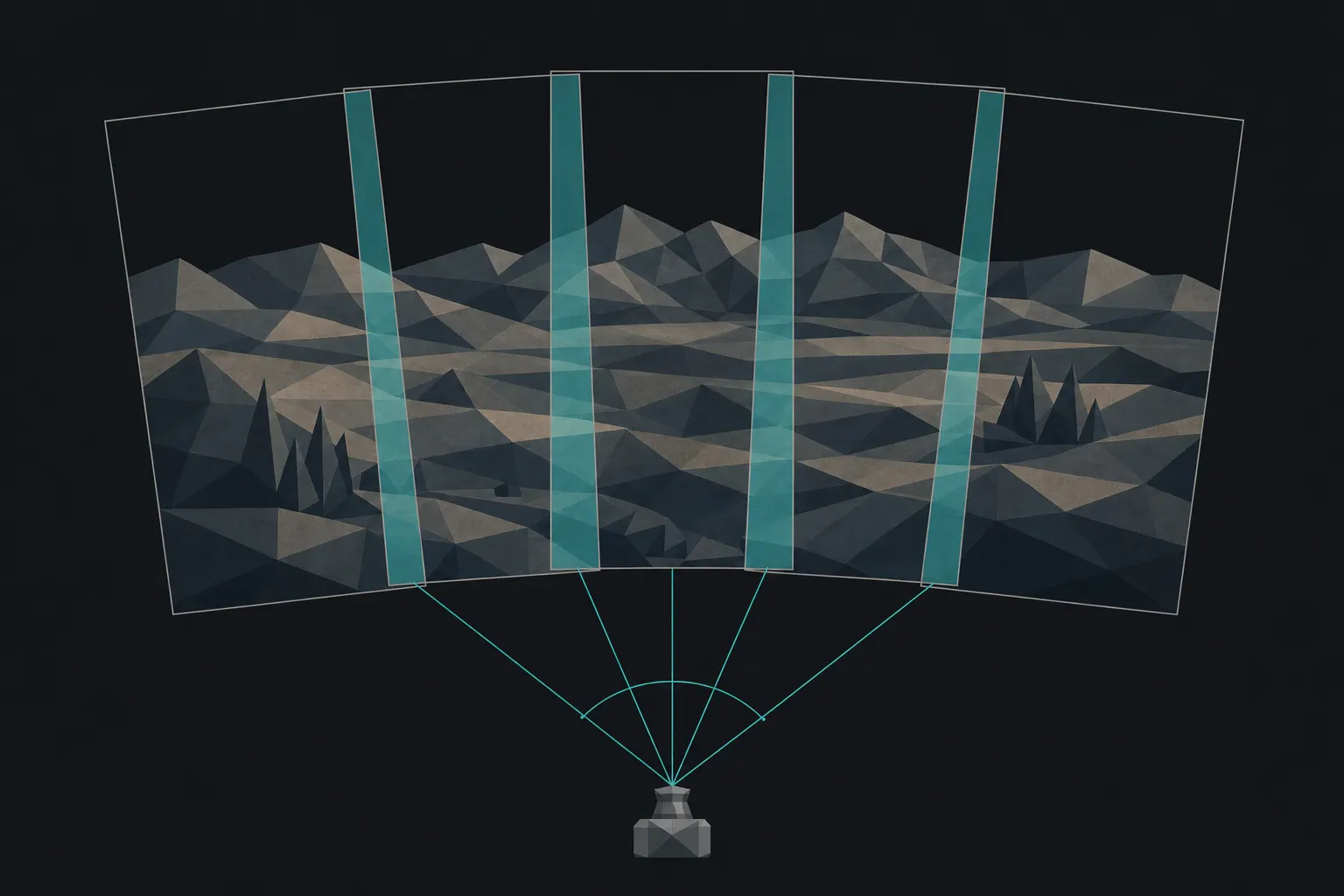
A panorama promises resolution and a sweep no single frame can hold; it fails on the seam that shows. The whole discipline is consistency across frames: a stitcher can align geometry, but it cannot reconcile a frame that metered brighter than its neighbor, refocused mid-sweep, or drifted in colour. So everything the camera would happily automate has to be LOCKED: manual exposure metered once for the whole scene, manual focus set once, a fixed white balance that cannot re-decide per frame. Overlap each frame 30–50% so the stitcher has shared detail to match on. Parallax, the nodal point, matters only when there is near foreground: rotate the camera off the lens's optical centre and near and far objects shift against each other between frames, and the stitch tears at that mismatch; for a distant scene it is negligible, for a foreground rock it is the whole game. A single row covers a horizon; a tall subject wants a multi-row or a vertical sweep. And the honest question comes first (a panorama versus simply using a wider lens: reach for the sweep when you want more resolution than one frame holds, or a composition a wide lens would distort at the edges), a stitched sweep keeps each frame's natural rendering where a wide lens stretches the corners.
Starting points
- Mode
- Manual: the one non-negotiable. Auto anything renegotiates the exposure, focus, or white balance between frames, and every renegotiation is a seam the stitcher cannot hide.
- Exposure
- Meter for the whole span you will sweep across, brightest to darkest, set it manually, and leave it. A frame that brightened mid-sweep leaves a band no stitch can blend.
- Overlap
- 30–50% frame to frame. The stitcher matches on shared detail; give it more overlap across plain sky or water, where there is less for it to grab.
- Focus & white balance
- Both locked manually. Autofocus refocusing between frames shifts the plane and softens the seam; auto white balance repaints the colour across the join. Set each once, then stop touching them.
- Level & pivot
- Level the tripod head so the horizon does not climb or sag across the pan. With near foreground, rotate around the lens's nodal point, not the tripod screw: off-centre rotation shifts near against far and tears the stitch.
- Orientation
- Shoot the frames in portrait for more vertical coverage per sweep. One row for a horizon; a multi-row or a vertical sweep for a tall subject.
In the field
- Plan the sweep first: where it starts, where it ends, and the brightest and darkest parts it will cross.
- Level the head so the horizon holds its line across the whole pan.
- Meter once, focus once, set white balance once, all manual, then leave all three alone.
- Overlap each frame 30–50% with the last; add overlap in featureless sky or water.
- For near foreground rotate around the nodal point; for a distant scene, ordinary rotation is fine.
- Shoot faster than the light changes: a moving sun or a drifting cloud shifts the exposure out from under a slow sweep.
When it fails
- A bright or dark band across the join
- The exposure changed mid-sweep, which is exactly why the mode is manual. An auto exposure re-meters each frame, and the stitcher cannot blend two different brightnesses into one continuous sky. Meter once for the whole scene, set the exposure manually, and shoot faster than the light moves.
- A ghosted, half-there figure at a seam
- Something moved between the two frames that overlap there: a walker, a car, a branch in wind. The stitcher had the subject in one frame and not the other, so it blends a ghost. Sweep quickly, wait for the overlap zones to clear, or time the pan so moving subjects fall inside a single frame rather than across a join.
- Banding or a hard step in a clear sky
- A smooth gradient with no detail gives the stitcher nothing to align on, so small exposure or white-balance drift shows as a visible step. Increase the overlap across the sky, lock white balance to a fixed preset so the colour cannot drift, and shoot RAW so the gradient survives editing without posterising.
Stitched or compressed: get the honest read.
A technique assembles the frames; a critique reads the result. Upload your finished panorama or a standout single frame and FinalFrame returns the full diagnosis: what works, what limits the frame, and whether the fix lives at the desk or back in the field.
Kritikuj fotografiju