Podvodna
Veština iza snažnog kadra, i ono što razdvaja 6 od 8.
FinalFrame ocenjuje svaku fotografiju od 0 do 10: 6 je solidna, 8 je vredna portfolija, a 9 je izložbenog nivoa. Kako funkcioniše ocenjivanje
Viđenje
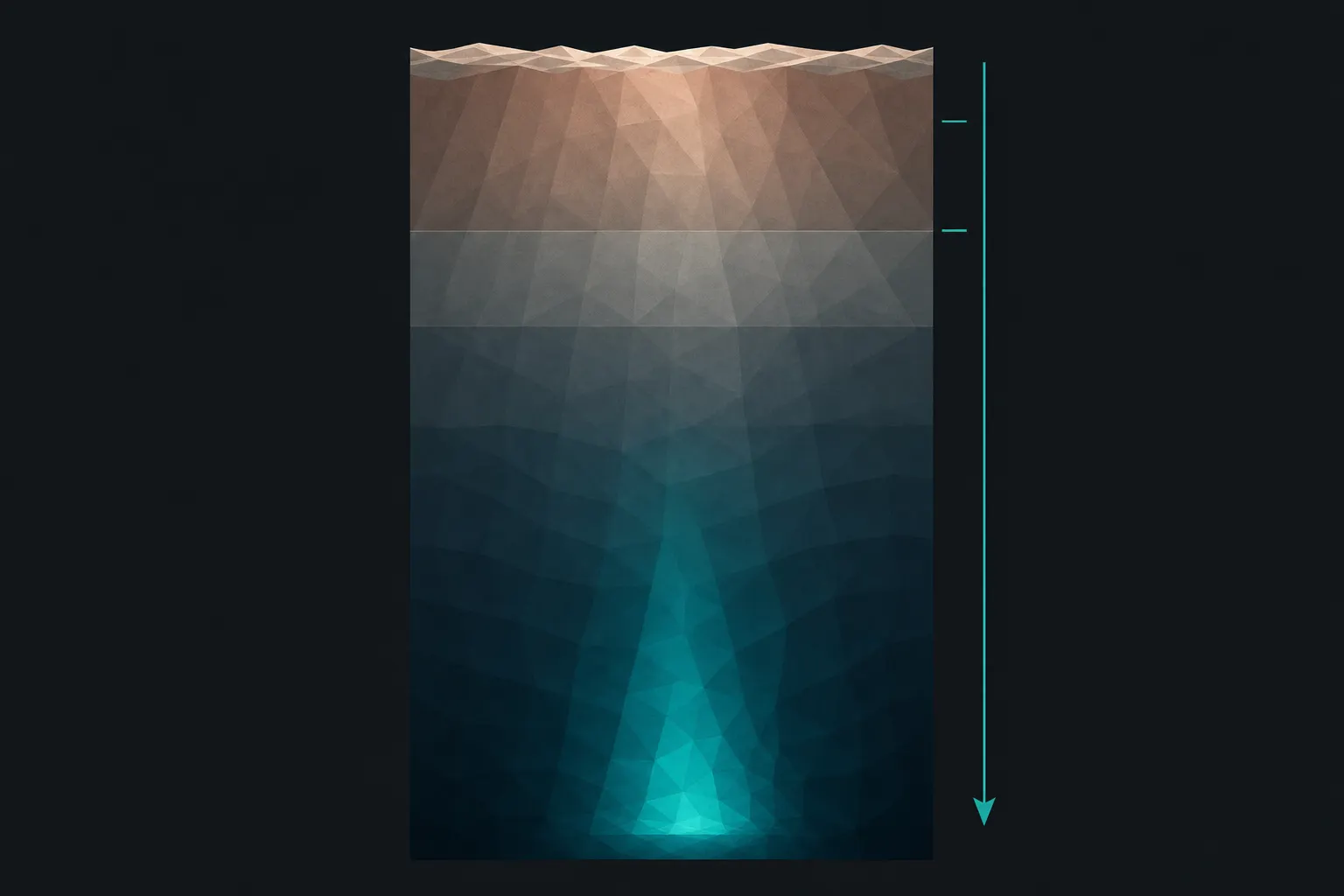
Underwater photography begins with a fact no other genre has to negotiate: the medium itself is the enemy of the image. Water absorbs light selectively by wavelength (red goes first, most of it gone within the first several meters, then orange, then yellow) until what remains is the blue-green the ocean is famous for. And the absorption is charged on the entire path the light travels: down through the water to the subject, then across the gap from the subject to the lens. A subject three meters away at ten meters of depth is being seen through thirteen meters of filtration. That arithmetic drives every decision in this genre, and it produces the first commandment: get close, and then get closer. Every meter of water removed from between the port and the subject returns color, contrast, and sharpness that no other choice can buy back. Water also scatters light far more than air, so distance doesn't just shift color: it hazes the frame, softening edges and flattening tone the way fog does on land, except here the fog is everywhere and permanent.
The second read is angle, and it runs opposite to instinct. A diver hangs above the reef, so the natural framing is downward, and downward is where underwater photographs go to die, because the subject lands against the visual clutter of the bottom, same tones, same texture, no separation. The working angle is level or upward: a subject shot slightly from below stands against open blue water or the bright ceiling of the surface, and the frame gains the separation the reef refused. Look up often enough and the surface itself becomes a subject (the bright circular window directly overhead through which the sky is visible, ringed by the mirror of the water), one of the few compositional gifts the medium hands over for free.
The third read is behavior, because most subjects here are alive and none of them are directed. A fish approached fast shows its tail; approached slow, low, and obliquely, it often holds. The frames come from patience and stillness: settling into position near a cleaning station or a coral head and letting the scene resume around a photographer who has become furniture. Which is why the least glamorous skill in the genre is the one that decides it: buoyancy. Neutral, motionless, fins quiet. It is the underwater tripod, it is what allows an approach measured in centimeters, and it is what keeps the bottom undisturbed: one careless fin kick raises a cloud of silt that ruins the visibility for the shot, the dive, and the reef itself.
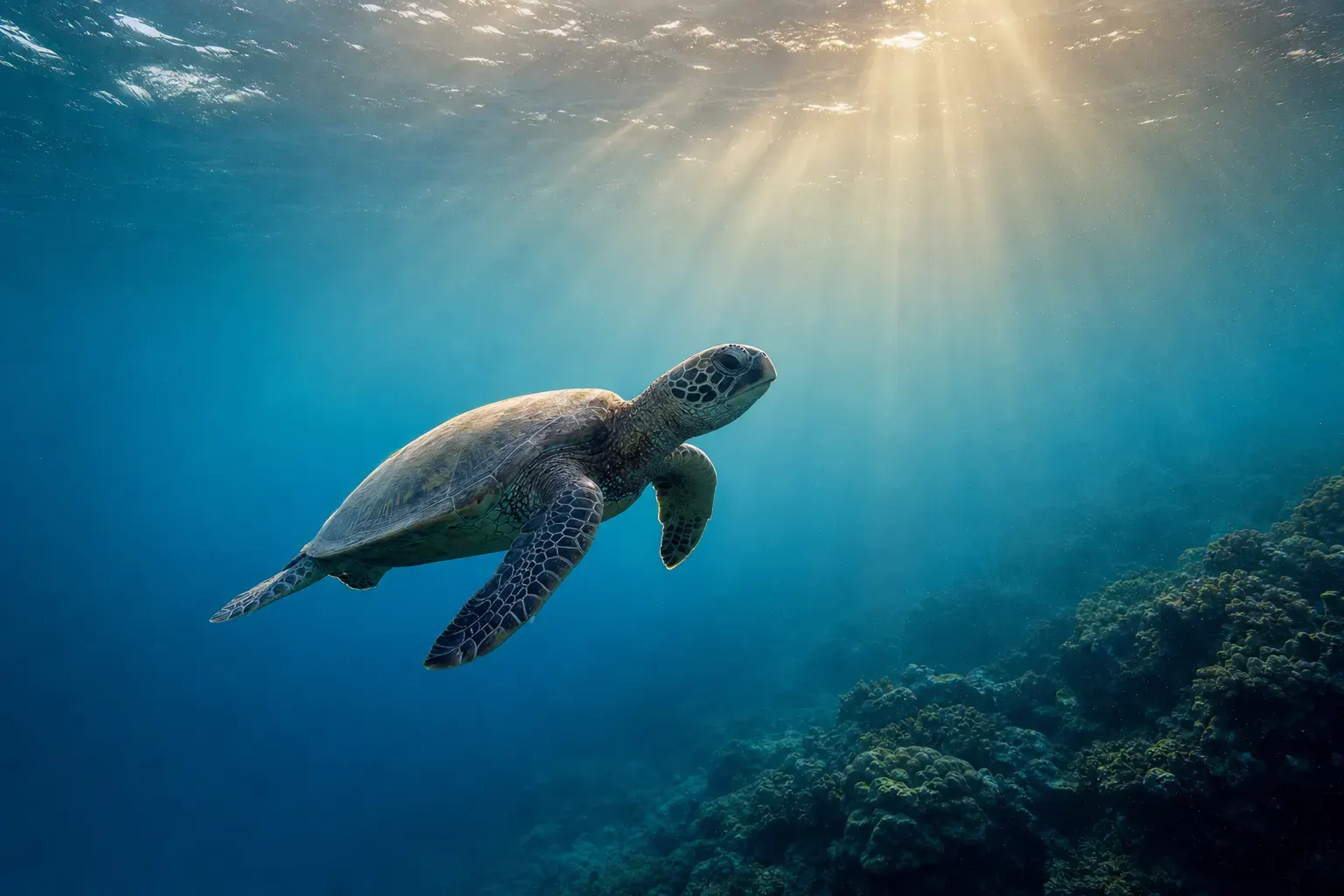
Generisano pomoću AI
Snimanje
The core problem of the genre, the water ate the color, has two capture-time answers, and every underwater photograph uses one of them. The first is the strobe. Artificial light travels only a short distance through water before the same absorption bleeds it, but within that short range it restores the full spectrum: reds that haven't existed at depth since the surface reappear the instant the strobe fires. This is the second reason proximity is everything: the strobe's useful reach is measured in a meter or two, so the light only works on subjects close enough to receive it.
The second answer is deliberate white balance for ambient-light shooting: manual white balance set at depth off a grey slate or clean sand, re-set as the depth changes, sometimes helped by a color-correcting filter in shallower water, always in RAW. It works where enough of the spectrum still survives to rebalance. It has a floor: below the depths where red has been fully absorbed, there is nothing left in the red channel to amplify but noise (no white balance recovers a wavelength the water never delivered to the sensor).
Strobe position is its own craft, because the strobe creates the genre's signature failure: backscatter (the constellation of bright specks that appears when strobe light bounces off particles suspended in the water between lens and subject). The particles are always there; the mistake is illuminating them. A strobe mounted close to the lens and aimed straight ahead lights the entire column of water in front of the port, and every mote in it fires back at the sensor.
The correction is geometry: pull the strobes out wide and slightly back, angle them so the edges of their beams feather across the subject rather than pointing down the lens axis (lighting the subject while leaving the water directly in front of the port dark). Get closer and the problem shrinks again, because there is simply less water in the frame to light. In genuinely thick particulate, no angle fully wins; the answer that remains is proximity and framing tighter.
Exposure underwater is really two exposures made in the same frame, and separating them mentally is the step that unlocks the genre's look. The strobe exposes the foreground subject, governed by aperture and strobe power: shutter speed barely touches it, because the flash duration is far shorter than the shutter. The ambient light exposes the background water, governed by shutter speed and ISO. That split hands over independent control: aperture and strobe power set the subject; shutter speed, held within the camera's sync limit, dials the blue behind it from bright mid-water to deep twilight without changing the subject at all.
A balanced frame (full-color subject against a rich, deliberate blue) is those two exposures agreeing. And as in every genre with a living subject, focus goes on the eye; in dim water a small focus light earns its place by giving the autofocus something to grip.
The equipment layer is unusually load-bearing here, and one piece of physics explains most of it. Light bends when it crosses from water to air, so behind a flat port everything appears roughly a third larger and closer than it is: acceptable for macro, where the magnification is a gift, but ruinous for wide lenses, where it narrows the field of view and smears the corners. The dome port is the fix: it restores the lens's in-air angle of view, but it does so by forming a virtual image close behind the dome, which the lens must be able to focus on (the reason wide-angle underwater work is close-focus work by construction). Port choice follows lens choice: dome for wide, flat for macro.
And beneath all of it, the unglamorous discipline of the housing: o-rings inspected, groomed, and seated before every dive, because in this genre a maintenance lapse doesn't cost a frame (it costs the camera).
- First commandment
- get close, then closer: every meter of water removed returns color, contrast, and sharpness
- Color
- a strobe (restores the full spectrum, ~1–2 m reach) OR manual WB at depth, in raw: neither reaches below where red ran out
- Backscatter
- pull the strobes wide and back, feather the beams: don't light the water in front of the port
- Two exposures
- strobe = the subject (aperture + power) · ambient = the blue behind it (shutter + ISO)
- Focus
- on the eye; a small focus light helps the AF grip in dim water
- Ports
- a dome for wide (close-focus by construction) · a flat port for macro
Obrada
RAW is not optional underwater; it is the difference between adjusting white balance and inventing it. The standard pass is white balance and tint correction toward what the strobe or the manual reading preserved, a contrast and dehaze lift to claw back some of what the water column scattered away, and careful per-channel work: the blue channel usually arrived healthy, the red channel arrived starved, and the edit should respect how much signal each actually recorded. Pushing a starved channel hard doesn't produce color; it produces red noise wearing color's clothes.
Backscatter clean-up is legitimate and routine at small scale: a handful of lit particles in open blue removes cleanly and invisibly, the underwater equivalent of dust-spotting a sky. It stops being routine when the specks number in the hundreds or drift across the subject itself: that frame is not a clean-up job, it is a strobe-angle lesson filed for the next dive. The same restraint applies to saturation: a reef under strobe light is already vivid, and pushing it further tips the frame into colors no reef has. The edit should end with water that still reads as water.
And the honest truth, which underwater is closer to a law of physics than a convention: the color and light the water absorbed are gone, not hidden. A slider can approximate what red might have looked like; it cannot recover data the sensor never received. No dehaze setting removes three meters of water from between the lens and the subject, no edit repositions a strobe after the fact, and no white balance reaches below the depth where the spectrum ran out. Those failures are capture-limited: the strobe and proximity decisions are made on the dive, at depth, before the shutter fires, and editing polishes what the water allowed through. The fix is at capture, next time: closer, strobes out and feathered, angle up, white balance set where the subject actually swims.
Procena
Self-critique with the same lens the product uses. The FinalFrame Score is a lane-weighted blend, and the critique names ONE bottleneck, the single highest-leverage weakness in the frame, not a per-category report card. Read it as the answer to "what do I change on the next dive," because that is exactly what it is.
For underwater frames in the 6–7 band, the bottleneck is most often the water column itself: the subject sits a meter or two too far away, so the frame carries a blue-green cast the edit couldn't fully lift, contrast gone soft, a scatter of lit particles in the dark areas, or the angle is downward and the subject melts into the reef behind it. At 8 and above, the bottlenecks shift to fine margins: the balance between strobe foreground and ambient background a half-stop off, a hot spot where a strobe edge caught a white flank, the eye a hair behind the plane of focus, a single bright speck in an otherwise clean blue.
- Zoom to 100% on the eye: is the sharpest pixel there?
- Sweep the open water at 100%: is the blue clean, or peppered?
- Is the color on the subject real (strobe-lit or properly balanced) or is it a cast pushed around in post?
- How much water is actually in this frame: could one kick closer have removed most of what's wrong with it?
Zašto 6 nije 8
The 6 is correct, and correctness is its ceiling. The subject is identifiable, exposure holds, focus probably landed. But the frame was made through too much water: a veil of blue-green sits over everything, the blacks are grey, the reds are approximations, and the fine texture (scales, coral polyps, the surface of things) has been scattered soft. The angle is slightly down, so the subject shares its background's tones and clutter. A faint field of backscatter waits in the shadows for anyone who looks. Nothing is broken. Everything is distant. The diagnostic tell: the frame reads as proof of an encounter, evidence that a diver and a turtle were once in the same water, rather than as a photograph of the turtle.
An 8 was made close. The water between port and subject has been reduced to almost nothing, so the colors are full-spectrum and the edges bite: strobe light putting reds back where the ocean removed them, feathered wide so the blue behind stays clean and dark and empty. The angle is level or up, the subject standing off open water instead of dissolving into reef. The eye is tack-sharp. The two exposures agree: a lit, dimensional subject against an ambient blue somebody chose. And underneath the visible frame sits the invisible craft that permitted it: the buoyancy that held position at arm's length without touching anything, the approach slow enough that the animal stayed. The distance between the 6 and the 8 is measured in meters of water removed, and every one of them was removed before the shutter fired.
So dive it again, for the one thing the critique named. If it was color and contrast, close the distance until it feels too close, then close it again, or set the white balance at the subject's depth instead of the surface's; if it was backscatter, pull the strobes out and back and feather the beams until the water in front of the port goes dark; if it was separation, drop below the subject and shoot up into the blue. If the fix is real, you'll see it on the camera's screen before the score shows it: the next critique names a different limit, and the FinalFrame Score has room to move, because the frame has stopped paying the water's tax. And if the same bottleneck is named again, that is information, not indictment. Underwater is the one genre where the medium votes on every frame and the session ends on a clock that doesn't negotiate: visibility, particulate, surge, and the animals' patience are set by the ocean on the day, and air and bottom time run out whether or not the shot has happened. Some dives never hand over clear water or a subject that holds, and the buoyancy that lets a photographer hover motionless an arm's length from a wild animal is built across many dives, not found in a menu. Read the repeat as a description of what that water gave the camera. Then go back down: the ocean resets every day, and the reef will still be there, running its own light, waiting for the dive where you arrive close enough to photograph it instead of the water in front of it.
Povezane lekcije
Vidi to na svojoj fotografiji
Najbrži način da razumeš ocenu jeste da je pročitaš na kadru koji dobro poznaješ.
Kritikuj fotografiju