Portrait
Das Handwerk hinter einem starken Bild – und was eine 6 von einer 8 unterscheidet.
FinalFrame bewertet jedes Foto von 0–10: eine 6 ist solide, eine 8 ist portfoliowürdig und eine 9 ist ausstellungsreif. So funktioniert die Bewertung
Sehen
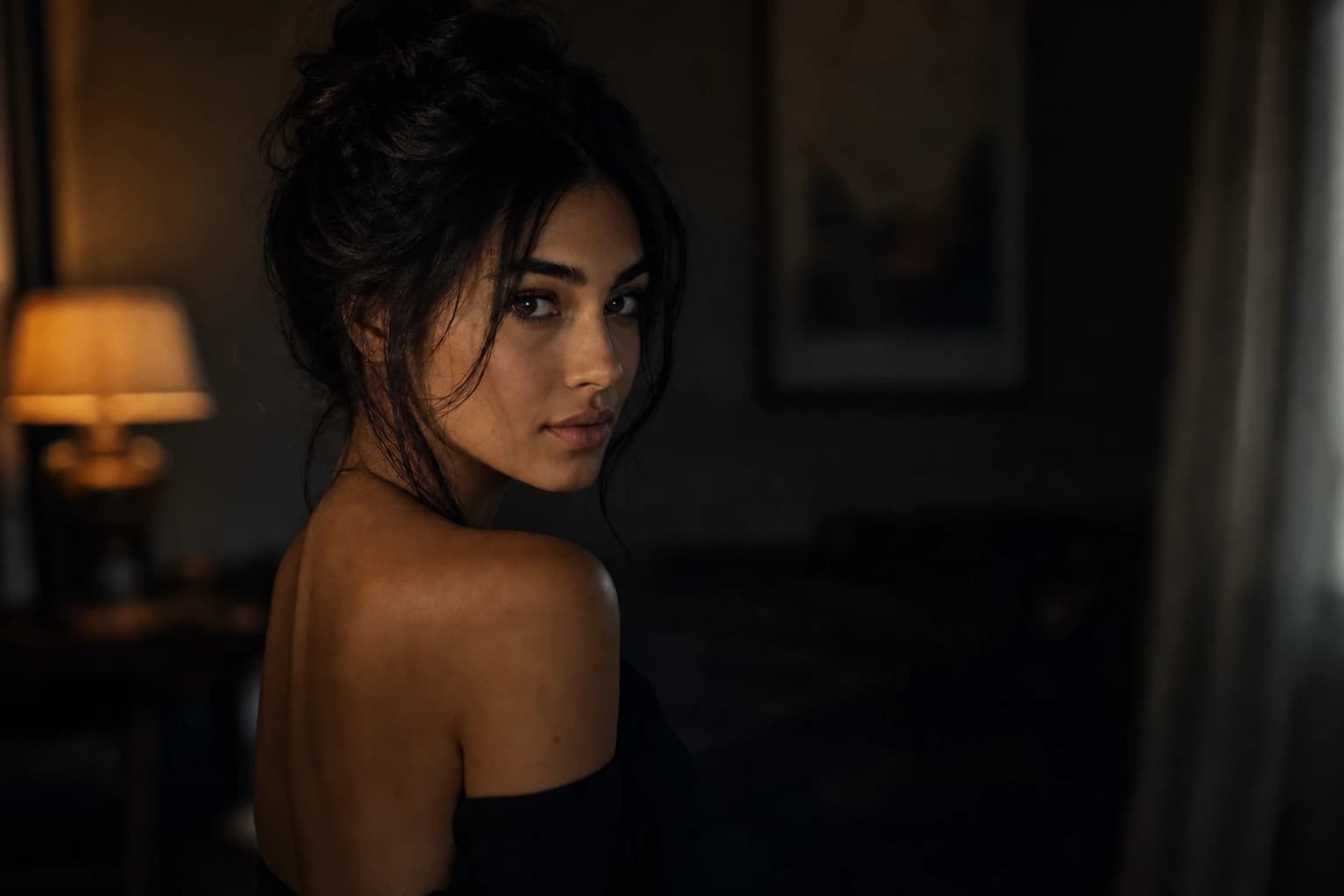
A portrait is decided before the camera comes up. The first discipline is reading light on a face the way you'd read a histogram: quality first, direction second. Quality lives in the shadow edge: look at the line where the nose shadow meets lit skin. A crisp, hard edge means small or distant light: drama, texture, every pore announced. A gradual, feathered edge means a large source close in: forgiveness, softness, calm. Direction is even simpler to see and more often ignored: walk your subject in a slow half-circle relative to the window and watch the cheekbone. Light skimming across the face carves dimension; light arriving flat from the camera's position erases it. The most reliable classroom in portraiture costs nothing: one north-facing window and a white reflector. Master that pairing before you buy a single light, because it teaches the only two variables that matter, and it never changes on you mid-lesson.
The second discipline is the moment. "Smile" produces a mask: the social face, deployed on command, and the camera records exactly how deployed it is. The real frames live in conversation and in the gaps: the half-second after a laugh, the settling between poses, the glance away and back. Keep shooting through those gaps. The pose is the rehearsal; the frame after the pose is often the photograph.
The third is distance, and it is where most portraits quietly fail. Conversational distance feels polite, so that's where amateurs stand, and the resulting frame reads as a record of a person standing in a place, not a portrait. Fill the frame with the face and shoulders: either step in with a normal or short telephoto (not a wide lens up close, which balloons the nose), or step back and let a longer lens do the framing (the greater camera-to-subject distance flattens perspective and flatters features). Uncomfortably close, by social standards, is usually photographically correct.
KI-generiert
Aufnehmen
Focus goes on the near eye. Not the face, not the nearest eyelash-adjacent brow, not whichever eye the autofocus preferred: the eye closest to the camera, every frame. If the near eye is soft, the portrait fails regardless of everything else in it, because the eye is where every viewer lands first and where the entire contract of sharpness is judged.
Now the depth-of-field reality that makes this hard. On a fast 50 or 85 at f/1.4, focused from about five feet, the total zone of acceptable sharpness is an inch or two: closer to one inch on the 85. On a three-quarter view, the far eye sits further from the camera than that zone is deep, so it will not be sharp. That is a choice, not a defect, but it must be chosen.
When the face is angled and you want both eyes to hold, stop down to f/2–f/2.8 and buy the margin. Reserve f/1.4 for a face square to the camera, or for the frame where you're deliberately releasing everything but that one eye. Knowing which situation you're in is the difference between a razor-thin plane that serves the image and one that gambles it.
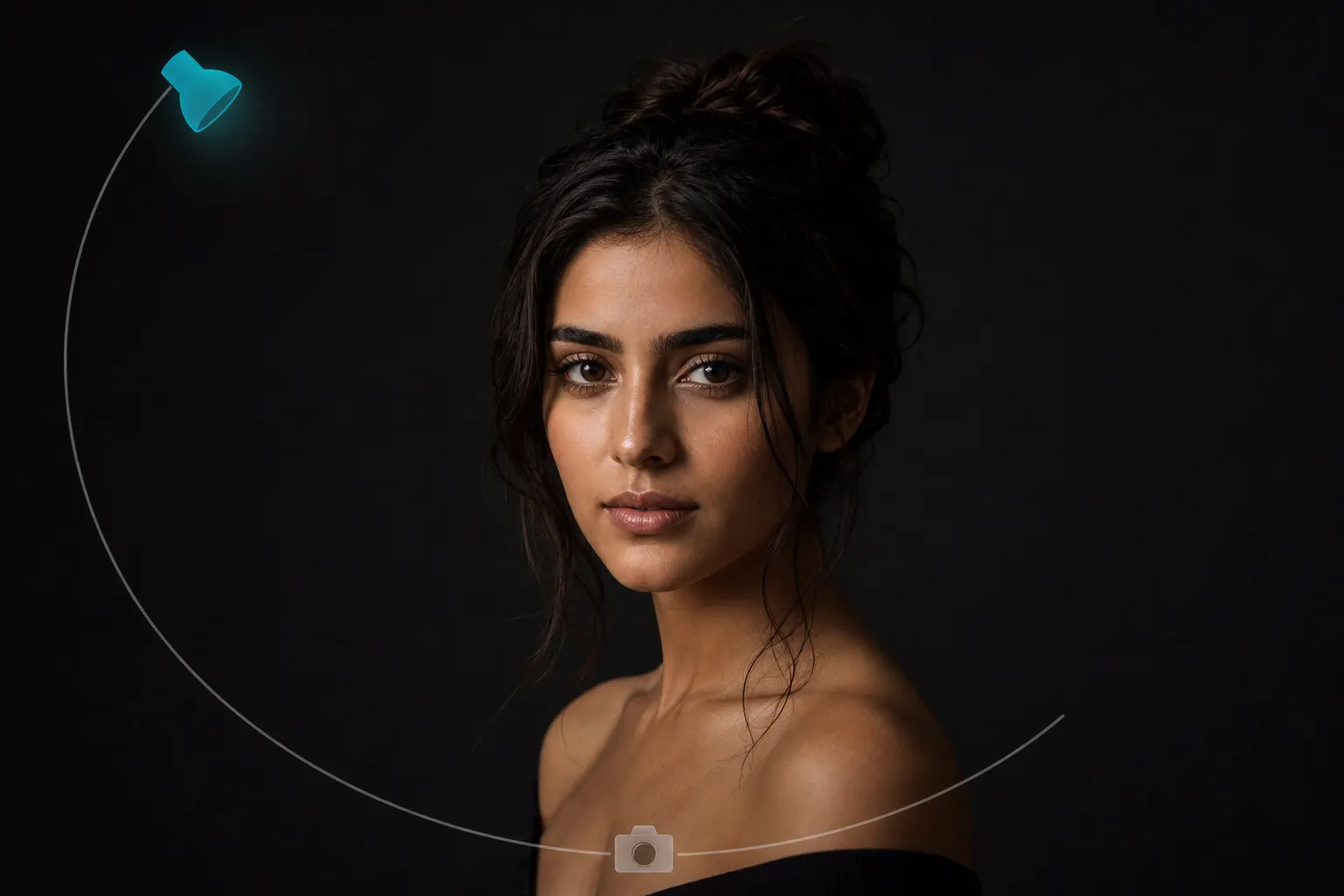
Light patterns are worth learning by name because naming them lets you build them on demand. Window light with a white reflector on the shadow side is the foundational setup: the window shapes, the reflector decides how deep the shadows fall. Rembrandt, light roughly forty-five degrees to the side and above, leaves a small triangle of light on the shadow-side cheek: dimensional, painterly. Split, light at ninety degrees, lights half the face and commits the other half to shadow: severe, graphic. Butterfly, light high and frontal, drops a small symmetrical shadow under the nose: the classic beauty-and-cheekbone pattern.
And under all of them sits the inverse-square law: illumination falls with the square of distance, so a light moved closer doesn't just get softer as its relative size grows (its falloff steepens, the shadow side deepens faster, and the background drops toward black). Move it away and everything evens out and flattens. Distance to the light is an exposure control, a softness control, and a mood control simultaneously.
Separation has two levers, and aperture is only one of them. The other is subject-to-background distance. An 85mm at f/2 with the subject ten feet off the background melts that background into tone; the same lens at the same aperture with the subject's shoulders against the wall renders every brick. Before you reach for a wider aperture, walk your subject forward.
Shooting the garment rather than the person: editorial, beauty, or lookbook work? The fashion guide (/learn/fashion) is this page's companion, it assumes every discipline here and re-aims it at the garment: silhouette, fabric, the gesture line, and the editorial-versus-commercial split.
- Focus
- the near eye, every frame: a soft near eye fails the frame
- Aperture
- f/2–f/2.8 holds both eyes on an angled face · f/1.4 only for a face square to camera
- Depth of field
- f/1.4 from ~5 ft ≈ a 1–2 inch sharp zone (≈1 inch on an 85)
- Lens
- a fast 50 or 85mm
- Light patterns
- Rembrandt (45° to the side + above) · Split (90°) · Butterfly (high + frontal)
- Separation
- aperture and subject-to-background distance both: walk them off the wall first
KI-generiert
Bearbeiten
Skin should look like skin. That sentence is the entire retouching brief, and most portrait edits fail it in one of three familiar ways: over-smoothing that turns pores into plastic, whitened eyes and teeth pushed past what scleras and enamel actually are (they are not paper-white, and the eye detects the lie instantly), and frequency-separation work driven until the skin reads waxy (a texture no living face has). The corrective posture is subtraction: remove the temporary (a blemish, a stray flake), keep the permanent (texture, lines, the geography of the face), and stop the moment the edit becomes visible.
Dodge and burn is the portrait tool that earns its keep: used gently. Lift the planes the light already favors, deepen the transition on the shadow side a touch, brighten the iris slightly (the iris, never the whites). You are finishing the sculpting the light started, not redrawing the face.
The honest truth, and in portraiture it is absolute: post cannot rescue a soft near eye. No sharpening tool creates detail the sensor never recorded: that frame is a reshoot, full stop. Post also cannot manufacture a genuine expression; there is no slider between "aware of camera" and "unguarded." And it cannot add the connection that wasn't in the room. Those three failures are capture-limited: the session is where the portrait is won. Editing polishes what the session gave you: it cannot go back and be in the room.
Bewerten
When you self-critique, use the same lens the product does. The FinalFrame Score is a lane-weighted blend, and the critique hands you ONE named bottleneck, the single highest-leverage weakness, not a per-category report card. Read the bottleneck as the answer to "what do I fix first," because that is exactly what it is.
For portraits scoring in the 6–7 band, the bottleneck is most often subject-separation or composition: the subject doesn't pop from the background because it sits in the same tonal register, or the framing works against the face (a cavern of headroom above the head, limbs cut at the joints instead of mid-bone). At 8 and above, the bottlenecks shift to micro-polish: skin handling, a stray hair crossing the face, a missing catchlight leaving the eyes flat. That progression is the curriculum.
- Zoom to 100% on the near eye: is the sharpest pixel there?
- Shrink to thumbnail: does the subject still separate?
- The harder question: does the expression read present, or posed?
Warum eine 6 keine 8 ist
The 6 is correct, and correctness is its ceiling. Exposure is right, the subject is recognizable, the near eye probably held. But the light is available, not shaped: it landed on the face rather than being placed there, so the face reads flat, without a deliberate shadow side. The expression reads aware-of-camera: composed, cooperative, closed. And the subject sits in the background rather than in front of it: same sharpness register, same tonal register, nothing pops. Nothing is wrong. Nothing is chosen. The diagnostic tell: describe the frame aloud, and you'll describe a person, not a moment.
An 8 is a moment with a person in it. The light sculpts: there is an intentional shadow side, and the face has dimension because someone decided where the dark would fall. The eyes are tack-sharp and carry a catchlight. The expression is unguarded: caught between poses, not delivered on request. The background complements instead of competing: softened by distance and aperture, or quiet by design. The skin looks like skin. Cover any one of these and the frame drops; that interdependence is what a judge reads as a portrait made, not taken. The 6 shows what the person looks like. The 8 shows what it was like to be in the room with them, and that difference is built at capture, in the light, the distance, and the ten seconds of patience after the pose collapsed.
So shoot it again, for the one thing the critique named. If the bottleneck was separation, place the light so the dark falls behind the subject and walk them off the wall; if it was the eyes, hold the near eye and stop down until it can't miss; if it was the expression, put the camera down for a minute, talk, and lift it again for the frame after the pose collapses. If the fix is real, you'll see it before the score does: the next critique names a different limit, and the FinalFrame Score has room to move, because you've stopped fighting the thing that was holding it down. And if the same bottleneck is named again, that is information, not indictment. A portrait needs two things to arrive at once (a person and a moment) and some sessions simply never offer the unguarded frame, no matter how right the light. That's not a verdict on your craft; it's a reading of what the room gave you. The fix may not be another f-stop. It may be a longer conversation, a different subject, or the plain patience to keep shooting past the pose until the face forgets the camera is there. The score follows the moment. Go find the moment.
Verwandte Lektionen
Sieh es an deinem eigenen Foto
Am schnellsten verstehst du den Score, wenn du ihn an einem Bild liest, das du gut kennst.
Foto kritisieren lassen