Color Cast
An unintended color tint across the image, where tones you know are neutral no longer read neutral.
FinalFrame हर फ़ोटो को 0–10 पर स्कोर करता है: 6 सक्षम है, 8 पोर्टफ़ोलियो-योग्य है, और 9 प्रदर्शनी स्तर का है। स्कोरिंग कैसे काम करती है
यह असल में क्या है
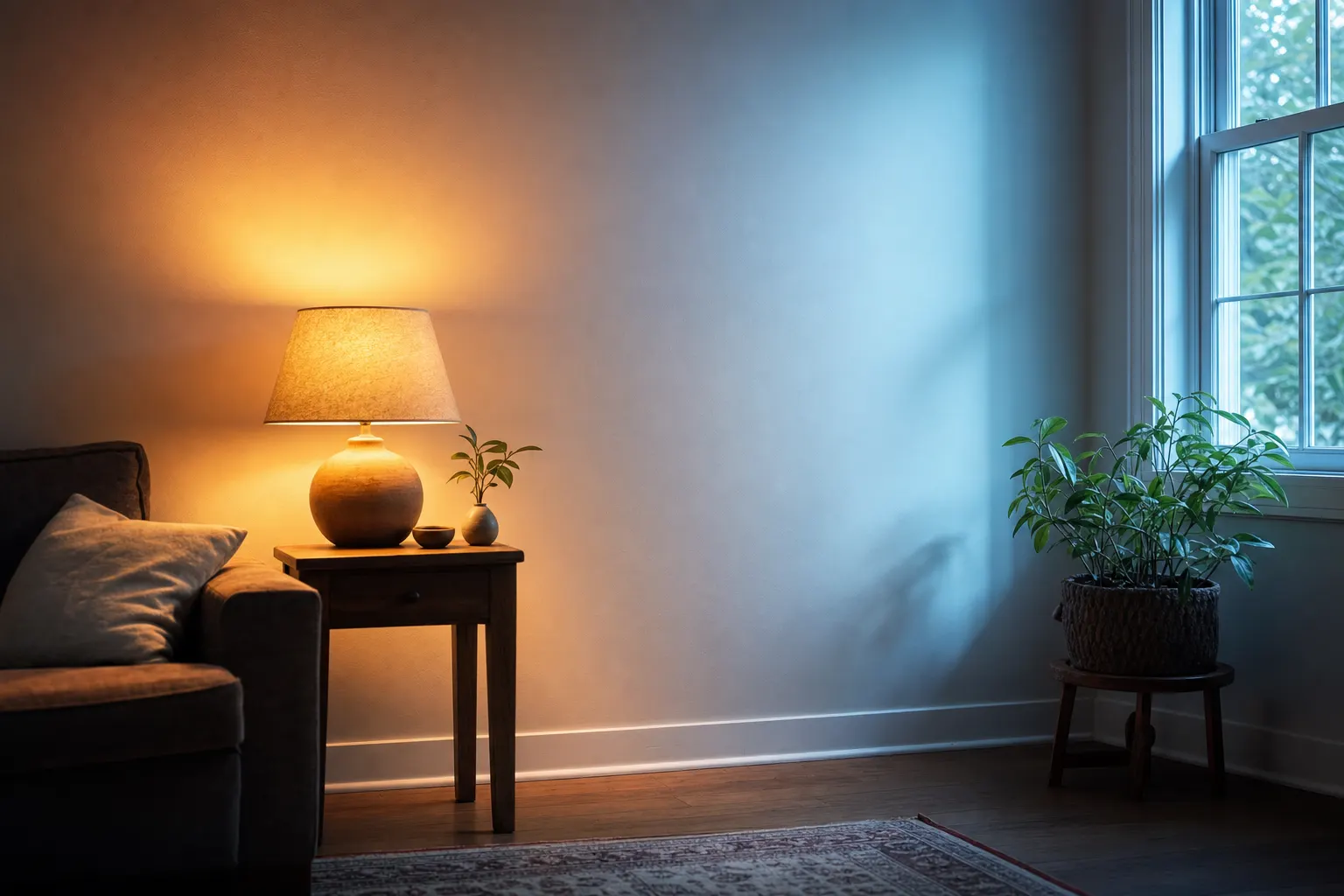
A color cast is the tint that survives your white balance. That one sentence is the whole reason this page exists apart from its neighbor: white balance is a single, global act (one temperature-and-tint decision, one eyedropper click, that swings the entire rectangle until neutrals read neutral). It corrects the dominant light, and when the frame held only one light, it finishes the job. A cast is what remains when the frame held more than one story: the green that still clings to skin after the eyedropper has done its best, the warmth a red wall keeps breathing onto the near cheek, the blue that lives only in the shadows while the highlights already read clean. The global move handled the room; the cast is the part of the room the global move was never shaped to reach.
That is the structural fact the whole lesson stands on: a cast is almost always partial. It occupies one region, one light source's territory, or one slice of the tonal range, and a slider that moves every pixel by the same amount cannot, by construction, fix an error that only some pixels have. So the craft splits cleanly in two. Half of it is diagnosis: proving, with a known neutral and the actual numbers, where the tint lives before any tool comes off the shelf. The other half is delivery: matching the correction to that address (the hue band, the tonal range, the masked region), rather than reaching for the temperature slider again and hoping harder.
One level up sits the color lesson, which asks whether the hues you chose sit well together. This page asks the prior, humbler question: whether the hues you never chose are quietly lying about what was neutral. And on the far side sits color-grading: deliberate, consistent non-neutrality, signed by its author. A cast is the same shift with no signature.
AI से बनाई गई
6 क्यों 8 नहीं
A 6 carries a cast nobody chose, and at this level, usually a cast somebody believed they had corrected. The white balance was set, the eyedropper found something that looked grey, the frame warmed into plausibility, and the edit moved on, while a tint stayed behind. Skin still runs faintly green under the office light the global move only half-neutralized; a face reads warm against a room the white balance cooled for the window behind it; the shadows hold a blue the temperature slider never touched, because it was busy being right about the highlights. The frame looks corrected. It is not neutral. That gap, between corrected and neutral, is where a great deal of competent color quietly sits, because the one move that was made was reasonable, and the second look that would have caught the leftover never happened.
An 8 is clean wherever the eye thinks to check. Sample any tone that should be neutral (the grey concrete, the white shirt out of direct sun) and it reads neutral; skin reads as skin; and every color that is NOT neutral is so plainly deliberate and consistent that no one could mistake it for an accident. That last clause is the entire border with grading: in a thumbnail, a cast and a grade can look identical. The difference is a signature. A grade owns its non-neutrality (warm highlights over cool shadows, applied evenly and in proportion) while a cast is non-neutrality nobody signed for, and it betrays itself by drifting: it strengthens toward the light source it answers to, because it obeys physics, not intent. The judge's reflex here is one glance at the neutrals and the skin, asking a single question: was this color chosen or inherited? On a 6, a neutral betrays an accident its maker never saw. On an 8 there are no accidents in the neutrals, and that reads instantly as control: the same way a stray cast reads as an edit that stopped looking one move too early.
शटर से पहले
The seeing happens in two places, and the one at the scene is cheaper by an order of magnitude. Before the shutter, count the colors of the light. One source (one color of light on everything) and the global white balance will handle it; the cast problem barely exists. Two differently-colored sources in the same frame (a warm lamp on one side of a face, a cool window on the other) and the single-slider fix is already lost before anything is pressed: two whites in one frame, and no setting can honor both. Reading that split at the scene costs a second. Discovering it at the desk costs an hour, and sometimes the frame.
Then hunt the bounces, because reflected light carries the color of whatever it bounced off. Any large, strongly-colored surface near the subject is a second light source in disguise: a red wall warms the cheek beside it, grass throws green up under a chin, a blue awning cools everything beneath it. Open shade is where bounces bite hardest: with no direct light to overpower them, the colored reflection becomes the light.
At the screen, the instrument changes, because the eye is the one tool that cannot be trusted here: it adapts. Stare at a faintly green frame for a minute and the brain cancels the green, files it under neutral, and lets it ship. The RGB readout under the cursor does not adapt. Find something in the frame that is neutral in reality (grey concrete, a white wall in even light, asphalt, an untinted cloud) and hover it: a true neutral reads its three channels equal, within a point or two. Avoid anything clipped: a blown white reads equal by definition and tells the read nothing. One channel standing proud IS the cast, and it names itself: green high says fluorescent-family light, blue high says shade or a mismatched setting, red and green high together say warm tungsten.
Then make the read that decides everything downstream. Sample a known neutral in the shadows, another in the midtones, another in the highlights. If the offset is the same in all three, the cast is global and white balance owns it. If the three reads disagree (green in the shadows, clean in the highlights), the cast lives in only part of the tonal range, and it is now a proven fact, not a suspicion, that no global slider will zero it. That is the diagnosis that chooses the tool.
To calibrate the eye these reads depend on, two short setups, far from any real edit. For the split: a plain white mug or card, half-lit by a warm lamp, half by window light (one frame, then the eyedropper clicked on each side in turn). The other side swings orange, then blue; neither click fixes both, and the tint that survives each attempt is this whole lesson made visible. For the bounce: the same reference in open shade, hard beside a strongly colored wall, and the RGB read on the wall-facing side (the wall's hue sitting in the numbers, on a surface known to be white).
कैमरे में
Every cast is cheaper to prevent than to chase, and prevention is a capture act. The mixed-light cast has three clean kills at the scene, in order of preference. REMOVE a source: switch the lamp off and let the window rule alone, and the frame drops back to one color of light that a single white balance finishes. MATCH the sources: gel the flash or the lamp to the ambient (a warming gel under tungsten, a green gel under fluorescent) so both lights speak the same color. Or MOVE the subject fully into one light, so the second source still burns but no longer lands. The failure mode is half-committing (both lights left on the face) which is precisely the split that survives every slider later.
The bounce cast is beaten by overpowering or escaping it. A white reflector on the shaded side throws neutral light back at the subject and drowns the red wall's contribution; failing that, one step re-seats the subject beside a neutral surface instead of a colored one. And one habit makes the eventual edit honest: a grey card (better, a color-reference target) photographed once under the exact light. The card is a known neutral to click. The target builds a camera profile, and the profile matters most under exactly the light that causes the worst casts: fluorescent and cheap LED have spiky, gap-toothed spectra (whole slices of the spectrum simply missing) and a profile's per-color corrections untangle that far better than any two-axis slider moved by eye, because a spiky spectrum shifts each color by a different amount, and one uniform tilt cannot answer a distortion that varies color by color.
Shoot RAW, always, but be precise about what RAW buys here. It carries white balance as metadata, so the GLOBAL decision is free to redo forever. It does nothing for the partial cast: the mixed split and the local bounce are baked into the relationships between pixels, not into the render settings. RAW protects white balance. It does not dissolve a cast that white balance was never able to reach.
एडिटिंग में
The repair is a matter of address: find where the tint lives, then use the tool that delivers to that address, never the global slider by reflex. Start global anyway, because it is free and it clears the ground: set white balance on the most trustworthy neutral in the frame, so the dominant light is handled and whatever remains is the true residual rather than an uncorrected room. Re-read the neutrals. If they all come back clean, this was a white-balance problem wearing a cast's clothes, and the work is done. If a tint survives, its behavior names one of three tools.
A cast living in one HUE, evenly across the frame, the green still clinging to skin under corrected fluorescent, comes out on the axis most editors forget: tint. White balance has two axes, and the green-to-magenta one is the counter for exactly this; a fluorescent green lifts straight out with a push toward magenta. When a global tint move would cost the rest of the palette more than the cast is worth, the color mixer does the same job with a scalpel: drop the saturation or shift the hue of the ONE offending band and leave every other color untouched.
A cast living in one TONAL RANGE, the blue that sits in the shadows under highlights that already read clean, is what color-balance-by-range exists for: the grading wheels, pointed at correction instead of style. Pull the affected range toward the cast's opposite (magenta against green, warm against blue) while the other ranges hold still. This is the fix the temperature slider physically cannot perform: it moves every tone together, so correcting the shadows with it un-corrects the highlights that were already right.
A cast living in one REGION (the red wall's warmth on the near cheek, one face in a group lit by a different bulb) is a masking job. Mask the skin, or the subject, and re-balance only inside the line, so the bounce comes off the face while the wall stays honestly red. The wall was never the failure; only its light on the skin was. Whatever the tool, the finish line is the one the diagnosis set: the known neutrals read equal again, and the memory colors (skin, grey, foliage) stop lying.
Then the honesty clause. A correction can only redistribute color the file recorded; it cannot invent a channel the light never delivered. The hard wall is near-monochromatic light: an old sodium streetlamp is a sliver of amber and almost nothing else, so the blue, and much of the green, was never captured, and there is no neutral hiding in the file to recover. Drag such a frame toward grey and it does not become corrected; it becomes mud, because the information being asked for does not exist. The soft wall is mixed light entangled at every boundary: each frontier between the two sources CAN be masked, but past a certain density the correction is surgery, and surgery shows at every soft edge. Both walls carry the same verdict (capture-limited) and the same honest fix, priced at the scene: a gel, a killed lamp, a step into single-colored light. Next frame, not another hour of sliders.
सीढ़ी
- Beginner: corrects white balance globally, clicks the eyedropper on anything grey-ish, and calls color done; no neutral is ever checked by the numbers, so the residual green on skin and the warm/cool split across the frame ship unseen.
- Competent: notices a frame reads "off" and chases it by re-doing the global white balance; every cast is treated as one more global move, so a mixed-light split or a tonal-range cast defeats the slider and survives into the final file.
- Strong (the working level of a serious editor) (diagnoses before correcting: RGB numbers on a known neutral, the read split across shadows, midtones and highlights, and the tool matched to the address), the tint axis for a hue, the wheels for a range, a mask for a bounce.
- Advanced (a late rung: plenty of otherwise-fluent editors never stop trusting their adapted eye): reads color by instrument as a reflex, sees the second source and the bounce at the scene and kills them before the shutter, corrects a residual exactly where it lives without disturbing the rest of the palette, and knows the one wall no tool crosses: near-monochromatic light left no neutral to find.
जाइए और खींचिए
Start with the frame that sent you here: the fix is the point, and the drills above only train the eye for it. Open the RAW whose critique named color, and diagnose before touching a slider. Find two or three tones that should be neutral (one in the shadows, one in the midtones, one in the highlights) and write down the RGB read on each. Equal channels: neutral. One channel proud: a cast, and the high channel names its source. Now compare the three reads, because the comparison is the entire diagnosis: the same offset top to bottom means a global cast, and one white-balance move will clear it; disagreeing reads mean a partial cast, and the proof is now on paper that the global slider cannot finish this job.
One gate before the work. If the file is lit by a single near-monochromatic source (the amber wash of an old sodium lamp, a frame where one channel is essentially absent), do not fight it. There is no neutral in that file to recover; it is capture-limited, and the next frame wants a gel or a different light, not another hour of sliders.
Then correct at the diagnosed address. Global white balance first, on the most trustworthy neutral; re-read the samples; and for whatever survives, the tool the numbers pointed at: magenta on the tint axis or a one-band move in the mixer for a hue that clings, the wheels for a cast trapped in one tonal range, a mask for a bounce or a mismatched light. Stop the moment the known neutrals read equal and the skin stops lying. Upload that version as a NEW VERSION of the image and let the re-critique read it against the original: the same frame, its neutrals now honest.
You reached this page because a critique named color as the bottleneck, and accuracy is that verdict's foundation: a cast is a lie in the foundation, so removing it should let the next critique move up to whatever the palette itself is doing, with the FinalFrame Score recovering what the lie was costing (most visibly on the Technical sub-score, since a clean neutral is a technical virtue before it is an artistic one). And if color is named again, that is a reading, not a rejection, and the answer is already sitting in the numbers you wrote down. A sampled neutral that still reads unequal means the residual outlived the correction and wants a more local tool than the one you reached for. A neutral that now reads perfectly clean while the critique still catches color means the cast was never this frame's real color problem: the palette is, and that is the parent color lesson, one level up. Either way, the reads decide, not the mood: the same numbers that diagnosed the cast tell you which door to walk through next.
संबंधित पाठ
इसे अपनी फ़ोटो पर देखें
स्कोर समझने का सबसे तेज़ तरीका है उसे किसी ऐसे फ़्रेम पर पढ़ना जिसे आप अच्छी तरह जानते हैं।
किसी फ़ोटो की समीक्षा कराएँ