Fashion
Shoot the garment, not the face, and know FinalFrame files fashion under Portrait (runway can read as Event), so pick your lane before the shutter.
FinalFrame는 모든 사진을 0–10으로 채점해요. 6은 탄탄한 수준, 8은 포트폴리오에 어울리는 수준, 9는 전시 등급이에요. 채점 방식
진짜 정체
Start with what the product will say, so it doesn't surprise you: FinalFrame has no separate fashion genre, and the classifier will label your work Portrait almost without exception (beauty, editorial, and commercial alike, averted gaze or not) while runway and backstage frames can read as Event coverage. That is not a misread; it is the rubric. Fashion photography is judged as the craft family it borrows from, which means your one real decision at upload is the lane. The mood-led lanes (Cinematic Mood, Print Ready) read averted eyes, deadpan faces, and stylized light as vocabulary, because they weight the artistic axis of the FinalFrame Score more heavily. Beauty work runs on the opposite contract: eye-to-lens connection, clean rendering, a face open to the viewer, and the cleaner lanes, Portfolio Clean and Client Delivery, read a face the way that contract expects. Upload an averted-gaze editorial into a delivery-facing lane and the critique will honestly report a connection that was never supposed to be there. Pick the lane for the job the frame is doing, and the critique becomes your ally instead of a misunderstanding.
Then the reframe that defines the genre. A portrait asks who this person is. A fashion photograph asks what this garment is, and what world it belongs to. The face in a fashion frame is cast, not confessed: chosen the way a location is chosen, for what it does for the clothes. The garment is the subject: its silhouette is the frame's primary line, its fabric is the frame's primary texture, its drape is the frame's primary gesture. Most fashion photographs fail as fashion photographs for one reason, they were taken by the portrait reflex, all attention on the face, while the actual subject hung off the shoulders unexamined: bunched at the waist where nobody smoothed it, dissolved against a background the same tone, rendered in light chosen for skin instead of cloth. The clothes were present. They were never photographed.
And underneath every decision in this genre runs one split: editorial or commercial. Commercial serves the garment as merchandise: legible, color-true, desirable; the viewer must see what the clothes are, because the clothes are what's for sale. Editorial serves the garment as character: it can bury a hem in shadow, crop the sleeve, let mood eat information, because it sells the world, and the world sells the clothes. Neither is superior, and the same photograph cannot fully do both jobs. Every fault in fashion is a fault relative to the job: the light, the pose, the retouch, the grade (all of them are arbitrated by which side of the split the frame stands on, which is why knowing your side before the first frame is the genre's first professional act).
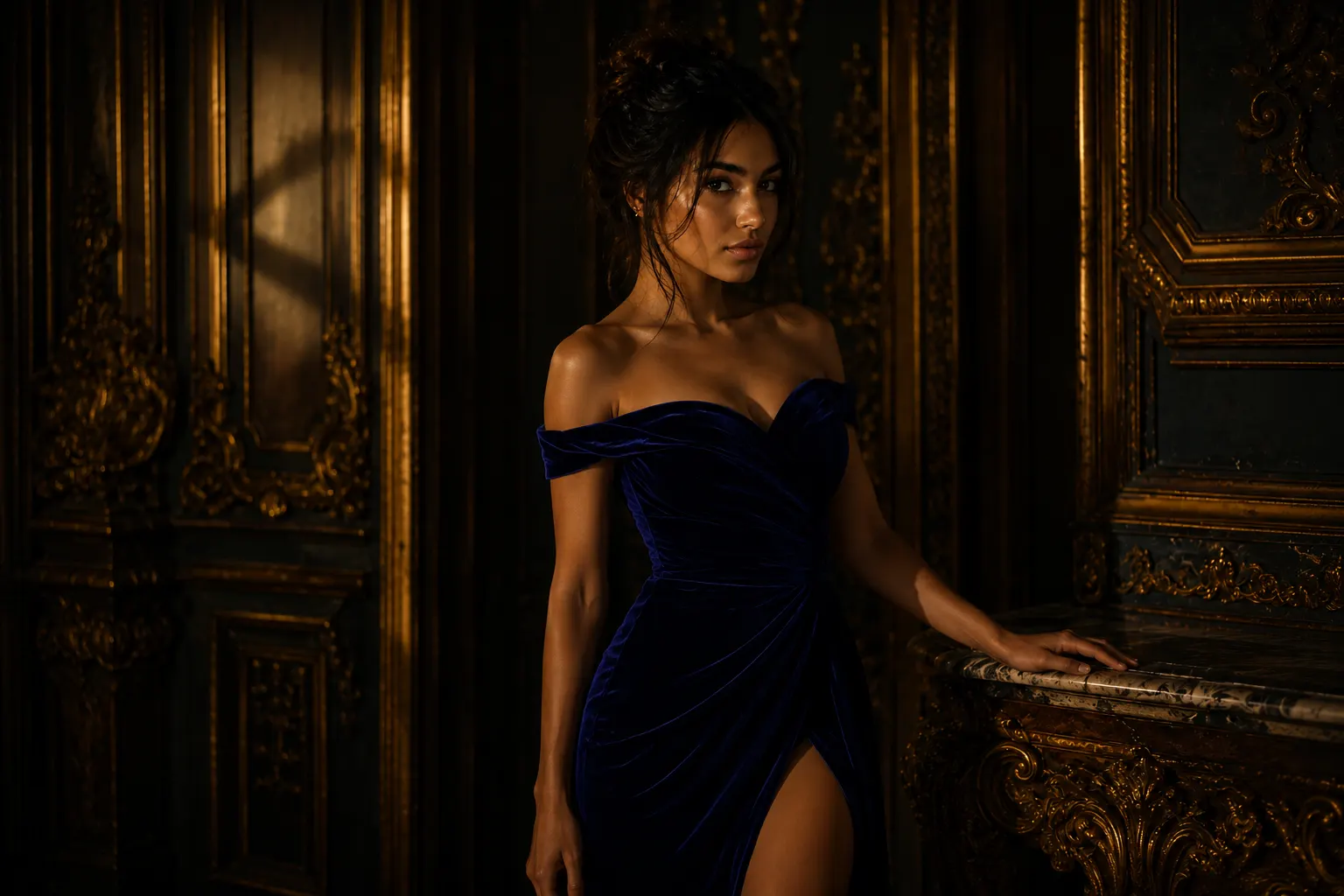
AI 생성
6과 8을 가르는 것
The 6 is a portrait of a person wearing clothes. The light is competent and lands on the face, the near eye probably holds, the pose is a person standing, and the garment is incidental. The drape fell where it fell. The silhouette melts into a background nobody cleared for it. The fabric is exposed, not rendered: the tweed has no weave, the silk has no gradient, the structure of the tailoring reads as a dark shape. The styling is an outfit, things worn at the same time, rather than a statement. Scored as the portrait it accidentally is, the frame holds up. But run the judge's test: could this garment be swapped for another and the photograph not notice? In a 6, yes, every time, which is the proof that the frame's actual subject was never in charge of it.
The 8 is built from the garment out. The silhouette is drawn: held against negative space, the outline legible from across the room. The fabric is rendered, because the light was chosen for the textile and not the skin: raking light dragging up the weave, a big soft source laying a long gradient down the satin. The body is articulate (the gesture line runs clean from crown to toe, hands deliberate, neck extended) and the face does exactly what the job requires, which in editorial may be nothing at all: deadpan is fashion vocabulary, not a connection failure. The styling holds one nameable world, and every element in the frame belongs to it. The light is a statement the whole frame commits to. Swap the garment now and the photograph collapses, because everything in it (the line, the light, the world) was reasoned from that garment. A 6 shows someone wearing the clothes. An 8 shows why the clothes exist. The distance between the scores is which one was the subject.
셔터를 누르기 전에
Three reads before the shutter, and not one of them is the face.
First, the garment read. Every garment does one thing best, and the frame must know what it is before anything else can be decided. Structure (a tailored shoulder, an architectural coat) is a silhouette garment: it asks for clean negative space and light that draws the outline. Drape (bias-cut silk, anything that moves) is a gesture garment: it asks for movement and a soft source that lets the folds carry long gradients. Texture (tweed, knit, sequins, leather) asks for raking light that makes the surface speak. Color and graphic pattern ask for a committed palette and a background that argues with nothing. Name the garment's one thing in a sentence. If you cannot, the camera cannot show it, and the shoot is a portrait session in borrowed clothes.
Second, the gesture line. Pose is not expression, and fashion grades them separately. Trace the line of the body from crown to toe in the viewfinder: does it curve (the S through hip and shoulder that gives a static figure motion) or does it stack, straight and inert? Check the hands, because hands are where poses die: edge-on and half-relaxed they read as grace; a flat palm, a fist, or a starfish splay reads as panic. Check the neck: extended, it lengthens the whole line; compressed, it shortens the person and the clothes. And release the face from the portrait contract: a deadpan face over an articulate body is fashion working exactly as designed. A warm smile over a slack body is a snapshot of someone at a party.
Third, the styling audit, because art direction is a scored axis in this genre, not a garnish on it. Name the world the frame claims (desert brutalist, nineties minimal, wet London night) in five words or fewer, and audit every element against it: garment, hair, makeup, location, props, light. Each one either belongs to that world or argues with it, and anything arguing is clutter wearing a stylist's excuse. A frame whose elements come from three different worlds has no concept, however beautiful each element is alone, and the critique's artistic reading will say so in its own words.
촬영에서
Light in fashion is a statement or an accident, and the entire craft of the genre's lighting is knowing which one you are making. Hard frontal flash that flattens the features and prints a crisp shadow on the wall behind; ring-light flatness that erases every direction at once; high-key blowout that surrenders the background and half the tonal scale: each is a legitimate dialect of fashion, and each is also a common fault, and the same physics produces both. The difference is commitment. A statement light is total and repeatable: it runs through the whole set the same way, the exposure is built around it, the styling agrees with it, and the frame carries no evidence of wishing it were something else. An accident shows up once, argues with the makeup, and reads as the compromise it was. Before adopting a hard dialect, ask the frame's own question: if this flatness were removed, would the picture improve? If yes, it was never a statement. Commit or correct: the middle is where fashion lighting goes to die.
Then light the fabric, because fabric is rendered by light or not at all. Raking sidelight drags out weave, knit, and every constructed seam: the texture answer. A large soft source stretches speculars into the long, smooth gradients that make satin and silk read as liquid: sheen is nothing but a soft highlight given room to travel. Backlight turns translucent fabrics into glass: chiffon and organza glow with transmitted light the way leaves do, and no reflected light produces that color. And put the garment in motion, because fabric photographs best doing something: a static garment shows its construction, a moving one shows its drape. The walk, the turn, the fan, the toss of a hem: motion is what separates cloth from upholstery, and it costs nothing but frames.
Direct the pose; don't request the mood. Build the line from the feet up (weight settled on one leg, hip answering, shoulders countering, neck long) then place the hands somewhere with a reason: a lapel, a pocket, the air mid-gesture. Shoot the transitions, not just the arrivals; the half-second between two directed positions often holds a line no instruction produces. And let the split govern every lever. Commercial: the garment legible from collar to hem, color held true, detail crisp (light for information, pose for the silhouette the designer drew). Editorial: mood first, world first (light for the story, pose for the tension). The levers point in opposite directions, which is why the frame must know its job before the first one is pulled.
보정에서
Skin first, because fashion post lives and dies there. Fashion tolerates more polish than portraiture (the face is cast, the standard is stylized) but the ceiling is the same and it is texture: skin without pores is not skin, it is rendering, and the eye knows in a quarter of a second. Frequency separation exists to make restraint possible, not to abolish it: the technique splits texture from tone precisely so tone can be evened without erasing the surface; used as designed it is invisible, and pushed past that it manufactures the plastic face that reads as a defect from across the room. The working ethic is the portrait lesson's, tightened: remove the temporary (the blemish, the lint, the stray hair crossing the face) and keep the permanent, the pores and the geography. And know where finishing ends: reshaping the body underneath the garment is not retouching the photograph, it is falsifying the garment's fit, and fit is the one thing a fashion photograph exists to report.
Garment cleanup, by contrast, is legitimate and expected: this is the genre where the clone tool earns honest wages. The stray thread, the lint, the visible clip pinning the sample at the back, the wrinkle the steamer missed: professional practice, remove them all. What post cannot do is re-drape. Fabric that fell wrong fell wrong in three dimensions, and the warp tool that drags a fold into place bends the stripes and the seams along with it: the pattern testifies, every time. Drape is decided by the stylist's hands and the model's motion in the second before the shutter, which makes it capture-limited in the fullest sense: the fix is a steamer, a fan, and another pass down the studio, not a slider.
Then the color story, because fashion is judged in sets (the lookbook, the spread, the campaign) and the grade is a contract that runs across frames. Commercially the contract is literal: the client's red must be the same red in every frame, because the red is the product. Editorially it is tonal: the story's palette must hold from first frame to last, and one frame graded warm in a cool set breaks the spell at thumbnail size. Grade an anchor frame, sync the set, then fix locally, and review the whole set small, as a contact sheet, where any frame whose color announces itself has already failed. The honesty clause underneath: consistency cannot be manufactured across captures that mixed their light. A set shot half in tungsten and half in daylight will fight the sync forever, because the contract post must keep was signed, or broken, at capture. FinalFrame critiques one frame at a time; the set discipline still pays, because the frame that belongs to a coherent story carries its coherence with it.
실력의 사다리
- Beginner: shoots a portrait of an outfit. The face gets all the attention, the garment hangs unexamined, the pose is a person standing, and the light was chosen for skin. The clothes are present in the frame and absent from the photograph.
- Competent: the garment is lit but not spoken for. Clean light, sharp fabric, a tidy background, and no decision anywhere: silhouette unmanaged, hands unposed, styling an outfit rather than a world, the flatness accidental instead of committed. Fashion hygiene without fashion intent.
- Strong (where the genre actually starts): the garment is the subject. The light is chosen for the textile, the gesture line is directed from the feet up, the styling audits to one nameable world, and the frame knows which job it is doing (editorial or commercial) and does that one.
- Advanced: builds the world first. The light is a statement carried across an entire set, deadpan and hard flash deployed as vocabulary rather than risk, the color story holding at contact-sheet size, and every frame could run without a caption, because the styling names the world by itself.
찍으러 가세요
One look, one model, one location, one light. Shoot the same garment two ways, and change the job, not the clothes. Version one is the beauty frame: eyes to the lens, face open to the light, garment legible from collar to hem, background clean (the commercial contract, honored in full). Version two is the editorial frame: gaze averted or dead level past the camera, the body articulated into a real gesture line, the light pushed into a statement (mood ahead of information, the world ahead of the sale). Keep everything else identical, because the job is the only variable, and the job is the lesson.
Now run both through a critique, and match the lane to the job: the beauty frame in Portfolio Clean or Client Delivery, the editorial frame in Cinematic Mood or Print Ready. Read the two reports side by side. The classifier will likely call both frames Portrait, and then the verdicts will diverge: the beauty frame judged on connection, the near eye, the skin; the editorial frame judged on concept, composition, the commitment of its light. The named bottleneck will land in different places, and the worth-it read may flip outright between them: the same garment, the same day, two different photographs by the product's own honest reckoning. That divergence is not noise. It is the split made visible: fashion is portrait craft pointed at two different jobs, and the score follows the job you told the critique you were doing.
And if both reports name the same bottleneck: that is information, not indictment, and it is the most useful sentence in either one. A limit that survives the framing change lives upstream of the split: the garment was never spoken for in either frame, and no amount of gaze direction rescues a subject the light never rendered. Then the next shoot starts where this lesson started (at the garment read, naming the one thing the clothes do best) and the frame after that is built from it. The score is not the reward. The moved bottleneck is.