정물
강한 사진 뒤에 있는 기술, 그리고 6과 8을 가르는 것.
FinalFrame는 모든 사진을 0–10으로 채점해요. 6은 탄탄한 수준, 8은 포트폴리오에 어울리는 수준, 9는 전시 등급이에요. 채점 방식
보기
Still life inverts the usual arrangement between light and subject. In most genres, light serves the thing being photographed; here, the objects serve the light. The genre grew out of painting (the Dutch masters, Chardin, Morandi) and it kept painting's central conviction: a picture is a construction of tone, and the objects are the excuse. The classic instrument is a single soft source, most famously a north-facing window, because one source draws one coherent set of shadows, and coherent shadows are what make a flat rectangle read as a world with depth in it. Read that light the way a painter would: the shadow edge tells you the source's size and distance (a feathered edge means large and close, a crisp edge means small or far) and the rate at which the light dies across the table sets the mood of the whole frame. When the source sits close, falloff is steep and the far side of the arrangement sinks toward black: that is chiaroscuro, the painterly key, and it is built with geometry, not sliders.
The second discipline has no equivalent anywhere else in photography: the composition is made with hands. Every other genre finds its arrangement in the world; still life builds it, one object at a time, and that freedom is exactly why the genre is unforgiving: nothing in the frame arrived by accident, so everything in the frame is a decision, visible as such. Build slowly. Place the anchor object first, then add one piece at a time, looking through the camera between each addition, because the camera's fixed viewpoint collapses the table into shapes the standing eye doesn't see. Vary heights so the silhouettes stagger rather than line up; let objects overlap so the frame gains layers and depth; leave negative space that gives the eye somewhere to rest. Loose triangles and odd-numbered groupings recur across four centuries of this genre for a plain reason: they keep the eye moving inside the frame instead of ticking down a row.
The third discipline is choosing the objects at all, and this is where still life separates itself from product photography: its commercial cousin. Product serves the object: clean, literal, flattering, built to sell. Still life serves the image: the objects are vocabulary, and the picture is the sentence. Objects with history speak (patina, wear, a chipped rim, fruit a day past perfect) where gloss and newness tend to sit mute. The old vanitas painters composed with cut flowers, guttered candles, and hourglasses because those things carried time inside them; the modern table has its own versions: the worn tool, the emptied cup, the letter half-written. Hold the set to a harmony: a limited palette, tones that belong to one key, objects that plausibly share a world. Then apply the remove-one test: take any object away, and if the picture doesn't miss it, it was clutter wearing a costume.
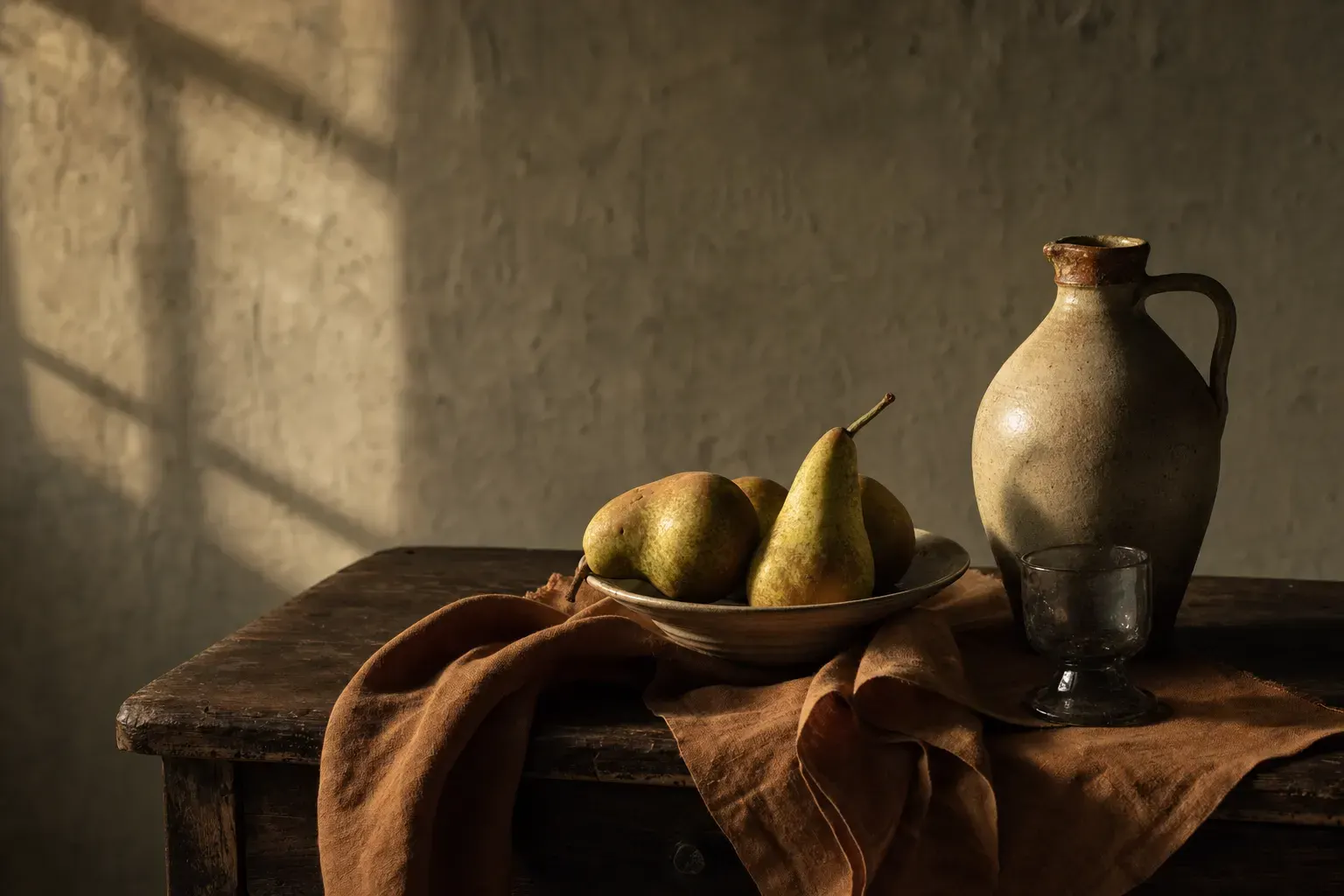
AI 생성
촬영
The genre's quiet superpower is that nothing moves. That single fact should reorganize the technique: the camera goes on a tripod, ISO goes to base, and the shutter takes as long as it takes (a second, ten seconds, it makes no difference to a pear). With motion off the table, aperture becomes a purely creative choice instead of a payment, and the working rhythm changes too.
Still life is not shot; it is worked. Make a frame, study it on the screen, change exactly one thing (an object an inch left, the light a hand-width lower, one prop removed) and make the next. The set holds still while the picture improves, and the discipline of one-change-at-a-time is what teaches which variable did what.
Light control runs on a few honest mechanics. Distance to the source is the master control: by the inverse-square relationship, illumination falls with the square of distance, so a source moved close in doesn't just grow softer as its relative size increases (its falloff steepens, the shadow side and the background drop away faster, and the frame moves toward the painterly dark ground). Move it back and everything evens out and quiets down.
A white card on the shadow side opens the darks; a black flag deepens them and carves the shadow edge: negative fill is half the chiaroscuro recipe and the cheaper half. Guard the source's purity: room lights and a window disagree on color, and the mixture muddies every tone in the set, so shoot with one source live and the rest of the room dark. And mind the background as a lit surface in its own right: its distance from the arrangement, and the falloff across it, decide whether the objects sit against a tone or dissolve into one.
Depth of field is the genuine technical problem, because tabletop distances are close and close focus means a shallow zone of sharpness. An arrangement with real front-to-back depth usually wants the middle apertures, f/8 to f/11 territory, with focus placed on the hero object, the one the composition leads to. Stopping down further buys depth at a price: past a point, diffraction begins to soften the very fine texture the smaller aperture was meant to protect, so buy only the depth the frame needs.
Focus stacking will render an entire set sharp front to back when the picture calls for it, but treat the plane of focus as an expressive tool before an obstacle: a still life that melts softly toward its edges, one object held sharp, is a legitimate and old idea. Focus deliberately: magnified live view on the hero's texture, and a remote release or short self-timer so the tripod's stillness isn't spent by the pressing finger.
보정
Still life earns a fuller edit than most genres, because the finish line is painterly rather than documentary. The work is tonal: deepen the ground, dodge the planes the light already favors, burn the corners and the passages the eye should pass through quickly, and guide the viewer along the path the arrangement built. A restrained vignette belongs to this tradition; so does color grading that pulls the palette into one key: warming the lit side, cooling the shadows, quieting a stray hue that argues with the harmony. Cleanup is expected craft, not cheating: dust on a dark ground, a lint thread, a distracting speck of glare (the set was built by hand and the frame may carry the hand's residue).
The restraint that governs it all: the edit finishes the sculpting the light started; it does not attempt sculpture of its own. When dodge and burn start inventing a falloff the source never produced, the frame acquires the airbrushed look of light that obeys no geometry, and the eye, trained on four hundred years of pictures where it did, reads the lie without knowing why.
And the honest truth: post cannot move an object. It cannot swing the shadows to the other side of the set, cannot steepen falloff that the source's distance never created, cannot subtract the clutter object whose overlap tangles three silhouettes, and cannot supply a focal point to an arrangement that never chose one. Flat, directionless light and an inventory-style layout are capture-limited: decided at the table, before the shutter. In this genre that verdict is unusually kind: the table is still there. The set can be rebuilt tomorrow, one decision better.
평가
Self-critique with the same lens the product uses. The FinalFrame Score is a lane-weighted blend, and the critique names ONE bottleneck, the single highest-leverage weakness in the frame, not a per-category report card. Read it as the answer to "what do I change on the next build," because in still life, uniquely, the next build can be this exact set with one variable moved.
For still-life frames in the 6–7 band, the bottleneck is most often the light or the arrangement: the illumination is even and directionless, so the objects render without modeling and the frame has no tonal key, or the objects sit side by side at similar heights, placed rather than composed, with no path for the eye and no reason for the count. At 8 and above, the bottlenecks shift to fine margins: a tangent where two silhouettes kiss at the frame's reading height, one prop breaking the palette, a background tone that neither separates nor recedes, a highlight on glass or ceramic left unshaped.
- Shrink to a thumbnail and squint: do the tonal masses read as a design, with one clear place the eye lands first?
- Walk the outline of every object: any tangents, any merges, any silhouette cut awkwardly by the frame edge?
- Apply the remove-one test to each prop.
- Zoom to 100% on the hero object: is the sharpest, most textured pixel exactly there?
6과 8을 가르는 것
The 6 is correct, and correctness is its ceiling. Exposure holds, focus landed, the objects are attractive and identifiable. But the light is even: it describes the objects without modeling them, arriving from everywhere and therefore from nowhere, so there is no shadow side, no falloff, no key. The arrangement is a lineup: similar heights, no overlap, no negative space doing work, objects that share a table but not a world. The palette is whatever the objects happened to be. Nothing is wrong. Nothing is composed. The diagnostic tell: the frame reads as a record of things (objects on a surface) and in a genre where every element was chosen, a frame that looks unchosen has already answered the only question a judge asks it.
An 8 is a picture the light made. One source with intention; shadows that model form and pool into a dark ground the eye accepts as depth; a tonal key held from corner to corner. The arrangement has architecture (an anchor, a path, layers of overlap, air where the design needs air) and every object survives the remove-one test. The palette is a decision: a limited harmony with, at most, one deliberate accent. The frame reads as built, the way a painting reads as painted, and every one of those differences was settled at the table, in the placing and the light, before the exposure began.
So build it again, for the one thing the critique named. If the bottleneck was the light, kill the room lights, commit to one source, and walk it closer until the falloff appears; if it was the arrangement, strip the set to the anchor object and rebuild one piece at a time through the camera; if it was harmony, pull every prop that argues with the key. If the fix is real, you'll see it on the screen before the score shows it: the next critique names a different limit, and the FinalFrame Score has room to move, because the frame has stopped being a record and started being a construction. And if the same bottleneck is named again, that is information, not indictment. Still life is the slowest craft in photography to ripen, for a structural reason: with no decisive moment, no weather, and no luck in the frame, every variable is a choice, and the repeat is usually pointing at the one variable that hasn't changed between builds, the same window, the same table height, the same working distance quietly reproducing the same geometry. Painters spent apprenticeships learning arrangement before anyone handed them color; tonal seeing accrues by iteration, not epiphany. And this genre grants what no other does: the set is not a moment, it waits. Rebuild the exact frame tomorrow with one constant changed, and the picture will tell you (patiently, repeatably) what it needed all along.