Tonal Hierarchy
How brightness contrast directs the viewer's eye to the subject.
FinalFrame는 모든 사진을 0–10으로 채점해요. 6은 탄탄한 수준, 8은 포트폴리오에 어울리는 수준, 9는 전시 등급이에요. 채점 방식
진짜 정체
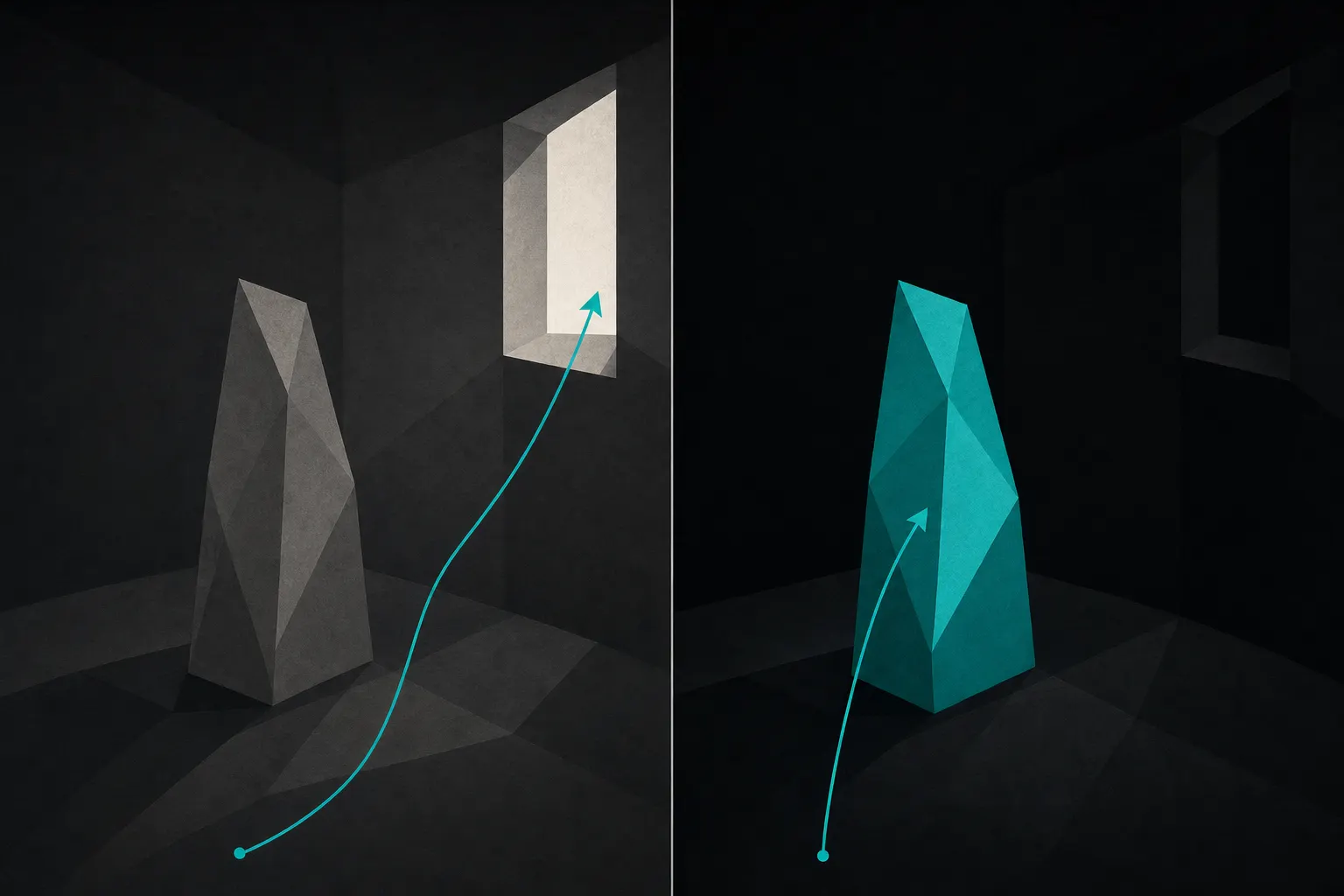
Every photograph already has a tonal hierarchy. The only question is whether you built it or inherited it. Tonal hierarchy is the luminance ranking of the frame (which mass reads brightest against its surround, which reads second, which recedes into ground) and what the score weighs is whether that ranking matches the order of importance you intended. The eye goes first to the strongest luminance contrast in the picture. It does not ask permission, it does not read captions, and it does not care what the subject is: brightest-against-dark usually takes the first look, but a dark shape on a bright field seizes it just as hard, which is why a silhouette has ferocious hierarchy and a grey-on-grey frame has none. Contrast of either polarity is the currency; the ranking is what it buys.
Hold on to the word ranking, because it is not the word contrast. Global contrast is a span: the distance between your darkest tone and your brightest. Hierarchy is an order: who is first, who is second, who is crowd. A frame can own a full histogram, true blacks, and crisp whites, and still be hierarchically flat, because six patches are all shouting at the same volume and no one has the floor.
The failure wears two opposite disguises, and both end here. Flat light hands every surface the same tone: the subject sits at the surround's volume, and the frame has no first place at all. Harsh light mints accidental winners (a blown window, a wedge of white sky, a specular flare on metal) and hands the first look to one of them. Different weather, same diagnosis: the ranking does not favor the subject.
This is the oldest attention technology in pictures (painters ran it for centuries as chiaroscuro before the first photograph existed) and in this curriculum it is the enforcement arm of everything the composition lesson promises: leading lines and placement PROPOSE an eye-path; luminance is what makes the eye actually take it. It is also figure-ground's engine: when the subject-separation lesson lists tonal contrast first among its four channels, this lesson is that channel at full length.

AI 생성
6과 8을 가르는 것
A 6 has contrast; an 8 has a ranking. The 6 comes out of the editor with a healthy histogram and a confident global move (blacks anchored, whites bright, midtones alive) and every tone still sitting exactly where the scene happened to drop it. The subject shares its luminance with the wall behind it, and somewhere in the frame a brighter patch is quietly winning: the blown window, the pale wedge of sky in a corner, the white shirt at the frame edge, the glint on a parked car. That patch is the eye-thief. It takes the viewer's first look (the most valuable thing a photograph is ever given) and spends it on nothing.
An 8 is ranked like a cast list. The subject holds the lead: the strongest contrast against its own surround. Supporting elements sit a legible step down. Everything else is the crowd, compressed into quiet midtones and shadow that give the eye nowhere else to go, so it goes where it was sent, and stays. The judge's tell is a single question: where does the eye land FIRST, and did the photographer choose that spot? The answer arrives before analysis does: the drift toward a bright corner is physical, felt in the first beat of looking, and no caption argues it back. A 6 asks the viewer to find the subject. An 8 has already decided for them, and a frame that decides reads as intended, which is the thing a score can actually reward.
셔터를 누르기 전에
Color hides luminance, so strip it. Most cameras will show you a monochrome preview (set a black-and-white picture style in the EVF) or simply squint until the scene collapses into masses: the composition lesson's squint test, now asked one sharper question. Then rank out loud: brightest, second, third. If the subject is not first (or a deliberate, unmistakable inversion, darkest against bright), the frame has an eye-thief, and it will out-rank anything you meant to say.
Learn the repeat offenders by name: sky wedges at the frame edges. Windows and doorways in interiors. White clothing behind the subject. Bright pavement at the bottom of the frame. Specular hotspots on metal, glass, and anything wet. None of them look like problems in color at capture: your attention is on the subject, and attention supplies the hierarchy the frame doesn't have. All of them read as beacons the moment the color is gone. The check costs a few seconds, and no other habit in this lesson pays better.
촬영에서
The ranking is set by where the light falls, and where the light falls is a position-and-patience decision long before it is a slider. Put the subject in light and the ground in shade and the hierarchy is built before you have chosen an exposure. Every shadow edge is a ranking machine, a doorway, a window, a break in the trees, the hard shade line of a building: one step moves the subject between lit and shaded, between first place and no place. Run it backwards on purpose and you have the silhouette: subject darkest against a bright field, hierarchy just as strong with the polarity reversed. What flat, even light hands you is the hardest version of the job: a frame whose ranking must come from the tones of the things themselves (dark clothing against a pale wall, a white cup on dark wood). Possible, slow, and the reason flat-light frames fail this lesson more than any other kind.
Then expose FOR the ranking, not merely for the meter: place the subject at the tonal position you chose and let the rest of the frame fall around it (the budget mechanics live in the exposure lesson). And treat moving light as the timing problem it is: the sun clearing a roofline, a cloud gap crossing a field, a shaft finding one plane in a dim room. The moment the light ranks the scene for you is a decisive moment as real as any gesture, and it lasts about as long.
보정에서
Of everything this curriculum teaches, tonal hierarchy is the concept post can do the most for: dodge and burn exists for exactly this, and has since the darkroom. Order of operations: set the global span first (black point, white point, overall contrast) then rank locally. Lift the subject a touch. Burn the thieves down. Walk the frame edges and take every bright border patch back a step, so it stops leaking the eye out of the picture. A vignette is the blunt version of that last move: it darkens the entire perimeter when usually only two or three patches deserve it; prefer the targeted burn. The discipline throughout is invisibility: the viewer should feel the pull toward the subject and never see the hand doing the pulling. A glowing subject in a dirty-haloed surround has traded a hierarchy failure for an edit-discipline one: a worse trade than it looks, because the first reads as unlucky and the second reads as dishonest.
The honesty clause has two walls. A blown eye-thief cannot be recovered: pure white holds no data, and burning it down produces a flat grey patch, not a window (that scar belongs to the exposure lesson, and no local tool heals it). And a subject that never received distinct light can only be pushed so far: when subject and ground sit at the same luminance under flat light, a mask strong enough to force the separation reads as pasted (light-that-never-was is among the easiest fakes for a judge to smell, because real light ranks everything it touches and a mask ranks only what it covers). That frame is capture-limited. The fix costs nothing in software because it is not sold there: light, position, or patience, next time. One exception runs the other way: an astro file's hierarchy is built almost entirely in post (a flat, unstretched Milky Way is not capture-limited); the structure is in the RAW, and the stretch is the fix. And a second, for monochrome-bound frames: hue contrast recorded at capture is a banked tonal lever (the channel mixer pulls apart a subject and ground that match in luminance but differ in color, cleanly and without a mask) so flat luminance over distinct hues is a conversion decision, not a capture limit; only same hue AND same luminance stays capture-limited.
실력의 사다리
- Beginner: thinks in global contrast. One slider for the whole frame; the ranking is whatever the scene handed over. Contrast goes up, order does not.
- Competent: catches the obvious thieves. Notices the blown window or the bright corner in review, crops or burns it down after the fact. The defense is real; it just arrives after the frame is made.
- Strong (a late rung: plenty of otherwise-advanced photographers never reach it): ranks on purpose. Reads the scene in grayscale before the shutter, positions and times so the light puts the subject first, and dodges and burns to enforce the ranking invisibly.
- Advanced: orchestrates the whole scale. Places every zone deliberately; runs hierarchy as mood as well as attention: high-key with one dark anchor, low-key with one lit plane; can build a ranking in flat light from the tones of things alone, or reads a scene that offers no ranking, and knows to walk away.
찍으러 가세요
Take one movable subject (a person who will step where you ask, a chair you can carry, a mug) into a dim room with one window, or out to the hard shade line of a building. Frame the pool of light and the shadow around it, lock the framing, and let the subject do all the moving. Frame one: subject in the shadow, dim ground behind it (everything at one volume, the flat frame). Frame two: the subject takes one step into the light, lit against that same dim ground (the ranked frame). Frame three, the one permitted re-aim: turn until the light source itself sits behind the subject and shoot the deliberate silhouette (dark against bright, the same ranking run in reverse). One subject, one step at a time, one variable: where it stands against the light.
Import all three and strip the color: grayscale conversions, side by side. Rank each frame out loud: brightest, second, third. In the flat frame, name the eye-thief; there is almost always one, and finding it yourself, before a critique does, is the skill this assignment exists to build. In the ranked frames, verify the subject actually holds first place (or last, in the silhouette), and that nothing else (a slice of the window, a bright scrap of ground) is quietly taking the first look on the way in.
Then close the loop. Put your strongest ranked frame back through the machine, one re-critique, one question: is tonal hierarchy still the named bottleneck? It is the reason you are reading this, and if one step into the light fixed the ranking, the diagnosis should move on to whatever is genuinely next, and the FinalFrame Score has room to move with it. And if tonal hierarchy is named again, that is information, not indictment: usually a rival patch the grayscale will show you on a second look, or a ranking that exists but is too shallow to read as a decision rather than an accident. Either way you now know exactly what the first look costs, and who has been stealing yours. The score is not the reward; the moved bottleneck is.