Motion blur on purpose: pan, zoom burst, flash
Panning, a zoom burst and rear-curtain flash all fail the same way: nothing in the frame stayed sharp enough to prove the blur was meant. Each moves something while the shutter is open (the camera, the zoom ring, or the moment the flash fires) so that one element, the anchor, stays sharp while the rest draws into streaks. A pan holds the subject crisp against a streaked background; a failed freeze is the reverse, a smeared subject against a still scene. A zoom burst holds the center and streaks everything outward from it. Rear-curtain flash fires at the end of a slow exposure, so the flash freezes the subject and the ambient light trails behind it. The smear reads as a decision only because something beside it did not. FinalFrame's critique applies the same test. Its rules file unintentional motion blur on the subject as a major technical failure and exempt a motion look that is clearly a deliberate choice, a pan with a sharp subject and a streaked background among the named examples. A motion look the frame plainly chose is not recorded as a capture ceiling. The other side holds too: subject softness the critique puts down to motion is recorded as a capture ceiling. (Intentional camera movement, where the whole frame is meant to blur, is a different technique, and the same rules treat it as a choice too; these three promise a sharp element, so the anchor is what proves them.) The long-exposure lesson states the same contract from the other end: a chosen duration reads as intent, and an arbitrary in-between smear reads as accident and surfaces under sharpness or timing. So the craft is two jobs at once. Pick a shutter long enough that the moving part draws a real streak, not a faint shiver (a background that barely moved reads as an ordinary frame, not a pan), and then protect the anchor with everything you have: a smooth pan, a locked center, a flash bright enough to own the subject. Expect a low hit rate; that is what the burst and the follow-through are for.
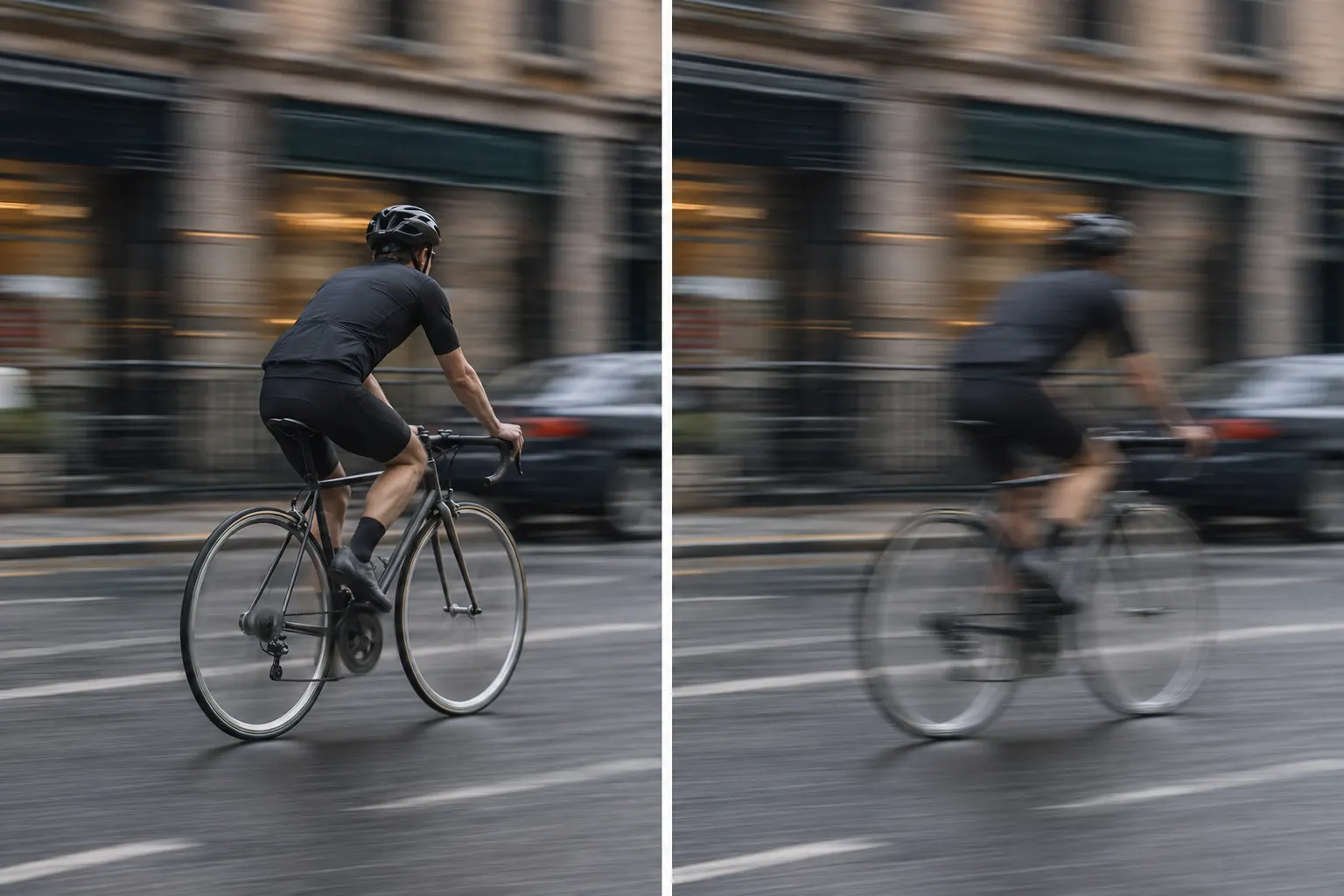
AI-generated
Starting points
- Which one
- Panning when the subject crosses your view (a cyclist, a runner, a car). A zoom burst when the subject can sit dead center against light and contrast to streak (a lit building at night). Rear-curtain flash when the subject is close enough to light with a flash and the ambient is dim (a dancer, a cyclist under street lights).
- Pan shutter
- Start around 1/30s and read the result. Walkers and slow cyclists want 1/8s to 1/15s; fast cyclists, runners and road traffic 1/30s to 1/60s; motorsport 1/60s to 1/250s, still slow enough to streak the ground and spin the wheels; birds in flight 1/30s to 1/125s against water or trees, where the wing blur is part of the look. A faster shutter means a shorter background streak and a higher hit rate; pick the slowest you can land.
- Pan motion
- Feet planted, elbows in, rotate from the hips, not the arms. Pick the subject up early, match its speed before the press, and keep turning through the exposure and past it. Continuous autofocus with a tracking point on the subject, or a single point pre-focused on the line it will cross. Burst mode. If the lens has a panning stabilization mode, use it; if it only has the normal mode and it fights the pan, switch it off.
- Zoom burst
- A manual zoom ring (a power zoom is too slow and too coarse). Tripod, stabilization off, focus set first and autofocus then switched off, a remote or the timer. Shutter 1/4s to 1s, slower in darker scenes. Subject at the optical center of the frame: the hold records a sharp layer of the whole scene, and the center is the one place the turn adds no smear on top of it, since the radial streak is zero there and grows toward the corners. Hold the zoom still for roughly the first half of the exposure, then turn it smoothly through the rest.
- Rear-curtain flash
- Shutter 1/4s to 1/30s (flash shooters call this dragging the shutter), sync set to rear (second) curtain in the camera's flash menu or on the flash unit, so the flash freezes the subject at the end of the exposure and the ambient trail falls behind it. Meter the ambient on the subject at that shutter, then set the flash 1 to 2 stops brighter on the subject, or the ambient smears a ghost through the frozen figure. Shutter moves only the ambient; flash power and distance move only the flash; aperture and ISO move both. Many bodies cap or refuse flash under a fully electronic shutter: use the mechanical shutter where the body has one, and check how yours treats flash first.
- Light
- A slow shutter in daylight needs the light cut: base ISO and f/8 to f/11 first, then a polarizer (about 1.5 to 2 stops) or a 3-stop ND for a pan, and about a 6-stop ND for a daylight zoom burst (sunny at base ISO and f/11 is near 1/200s, and 1/4s is about six stops away). Stopping down past about f/11 starts to soften the very anchor the frame depends on. A busy, textured, contrasty background gives a visible streak; a plain sky or a blank wall gives no evidence that you panned at all.
In the field
- Name the anchor before the first frame (the one thing that must be sharp), set the shutter for the streak you want, then protect the anchor with technique.
- Panning: pick the subject up early, match its speed, fire in a burst, follow through after the last frame.
- Zoom burst: tripod, subject on the optical center, hold then turn, one smooth motion through the exposure.
- Rear-curtain flash: rear-curtain sync confirmed on the body or the flash, a shutter mode the flash actually fires in, flash 1 to 2 stops over the ambient on the subject.
- Cut the daylight (base ISO, f/8 to f/11, then a polarizer or ND) so the slow shutter exposes correctly.
- Check the anchor at magnification on the first frames (a part that does not rotate: a helmet edge, a frame tube, a number board), not the wheels and not the background, and keep shooting: a one-in-five hit rate on a pan is normal, and the keeper is the frame whose anchor is sharp, not the one with the longest streak.
When it fails
- A streaked background and a soft subject
- The camera moved with the subject but not at its speed, or it stopped at the press, so the subject blurred along with the scene and nothing in the frame is sharp. With nothing sharp, the frame cannot read as a pan: the critique's own definition of one is a sharp subject against a streaked background, and subject softness it puts down to motion is recorded as a capture ceiling, not a creative choice. Fix the motion first: match speed earlier, follow through, burst. If the subject still will not hold, shorten the shutter one stop at a time until the anchor lands, then creep back toward the longer streak, and stop before the wheels freeze: in motorsport, frozen wheels are themselves a miss in the critique's sports guidance. A pan at 1/125s with a crisp rider beats one at 1/15s with a crisp nothing.
- Rays with no sharp center
- The zoom turned for the whole exposure, or the subject sat off-center, so the streaks have no sharp origin and the frame reads as an accident of a slow shutter. Put the subject at the center, hold the zoom for the first half of the exposure so a crisp layer of the scene is recorded, then turn. This is the one failure a reader can legitimately dispute: a soft center with radial rays reads as a deliberate abstract to one viewer and a shaken slow shutter to another. The critique keeps no separate motion-blur category; when the smear is the problem it surfaces under sharpness or timing, or as a capture ceiling when it is read as a miss no edit can fix. Give it a center and the dispute ends.
- A trail ahead of the subject, or a ghost through it
- Two errors with one cause: the ambient and the flash were not sequenced or balanced. A trail running ahead of the frozen figure means the flash fired on the first curtain, at the start of the exposure, and the subject then walked through its own trail; set rear-curtain sync so the flash closes the exposure and the trail sits behind. A translucent second copy of the subject over the sharp one means the ambient on the subject was within a stop of the flash, bright enough to show through the flashed copy; drop the ambient on the subject (a smaller aperture plus more flash power, or a darker spot) until the flash leads by 1 to 2 stops. The flash lesson's frame is the useful one: a flash frame is two exposures sharing one rectangle, and the shutter is the one lever that moves the ambient without touching the flash. The night portraits guide in the field guides runs the same move with rear-curtain sync in its recipe.
Finished the sequence? Get the honest read.
A technique assembles the frames; a critique reads the result. Upload the finished image (for a timelapse, a standout frame) and FinalFrame returns the full diagnosis: what works, what limits the frame, and whether the fix lives at the desk or back in the field.
Critique a photo