Long Exposure
The shutter held open long enough that motion renders as accumulated form (silked water, cloud streaks, light trails, thinned crowds) anchored by still elements kept tack-sharp. In our scoring, a chosen duration reads as intent; an arbitrary smear or a shaken anchor surfaces as a sharpness flaw.
FinalFrame valuta ogni foto da 0 a 10: un 6 è competente, un 8 è degno di un portfolio e un 9 è di livello espositivo. Come funziona il punteggio
Cos'è davvero
Every photograph is a long exposure; the only question is how long. The shutter never captures an instant: it captures an interval, and an ordinary frame keeps that interval so short the world cannot move inside it, which is why photographs read as frozen time. The technique called long exposure begins the moment the interval is chosen for what it does to motion (the shutter used as a time control, not just a light valve) held open until the world moves while the camera watches, so the frame stops recording how the scene looked and starts recording how it behaved. A moving element stops being an object and becomes the sum of everywhere it went: water renders as every position it held, laid one over another; a walking crowd thins toward transparency; headlights write out their route as a line of light. The still elements, meanwhile, stay exactly what they were. One frame, two renderings (the held and the dissolved) and the picture is the relationship between them.
Which is why the technique's real law has nothing to do with blur. A long exposure divides every scene into two populations (what will move during the interval and what will hold still) and it lives or dies on the second one. The dissolved elements only read as intent when something in the frame proves the camera never moved: a rock rendered tack-sharp against silked water, a building crisp under streaked cloud. Lose the still population (a trembling tripod, wind, a handheld attempt) and the frame does not read as a long exposure at all; it reads as a mistake. The moving elements are the show. The still ones are the evidence.
An unchosen smear, motion blur that merely happened to a frame that meant to freeze, is a sharpness verdict, not a technique; the critique files it there because accident has no category of its own. Exposure, by contrast, owns where the key tone lands, and hands this lesson its arithmetic: a longer shutter is more light, and the whole apparatus of dense filters below exists to pay that bill. Timing owns the decisive instant, and a long exposure is its deliberate inverse: replacing the instant with an interval, trading the peak of the action for the shape of it; strong photographers hold both. This page is about the chosen interval: how long to leave the shutter open, and what that duration does to the scene in front of it.
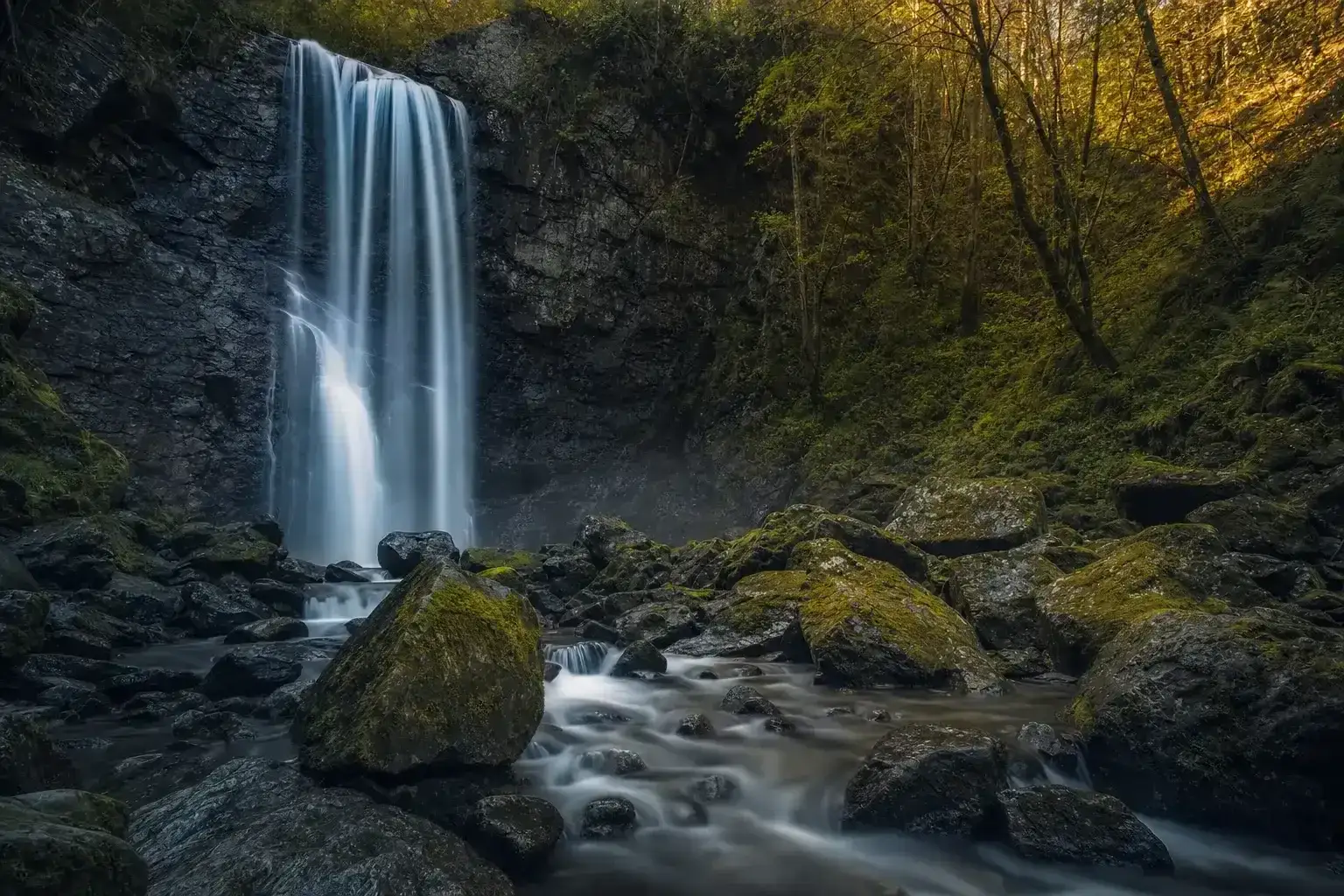
Generata dall'AI
Perché un 6 non è un 8
A 6 used a slow shutter and the water went blurry, and that sentence is the entire decision record. The duration was whatever the light or the tutorial handed over, and it shows in two tells a judge reads in seconds. First, the moving element sits between renderings: the water neither holds the strands of silk nor flattens into mist (an in-between smear that any duration would have produced, the drift that is the one illegitimate choice on the whole shutter spectrum). Second, the still population is not honestly still: punch to 100% and the rocks carry a faint double edge, the skyline a soft shiver of shake, so nothing in the frame testifies that the blur was chosen. Both tells trace to the same root: the duration was inherited, not decided.
An 8 chose its duration for this scene, and the choice is legible in the frame. The water sits at two seconds because that is where these strands survive at this flow, or at a full minute because the frame wanted the water gone, an empty silver plane under one dark rock. The cloud streaks run along the composition's existing lines, not across them. The crowd is thinned to exactly the density that leaves the still figure alone. And everything that held still is tack-sharp: the anchor that converts blur from a symptom into a signature, because the sharp rock is what proves the soft water was a decision. The judge's tell is a single question: make the exposure four times longer or four times shorter (is it a different photograph)? In an 8, yes, and a worse one, because the duration was load-bearing. In a 6 it is the same photograph, because there was no decision in it to break. A duration that cannot be changed without cost is the whole distance between the two scores.
Prima dello scatto
Split the scene into its two populations before you touch the tripod: what will move during the interval, and what will hold still. No moving element and the long exposure has no subject: you are paying minutes for a photograph a fast shutter takes for free. No still element and it has no anchor: the frame dissolves into mush (full-frame dissolution is a real move, but it belongs to the abstract and creative genres; the working shape here is anchored). Then audit the still population with suspicion, because membership changes with duration: foliage is a still element at 1/125 and a moving one at thirty seconds, when every leaf in wind becomes smoke and grass becomes fog; a wooden footbridge under your tripod is itself a moving element, trembling with every footstep. The classic ruined long exposure is not the water going wrong, the water almost cannot go wrong, it is a tree at the frame's edge quietly dissolving, or the whole frame inheriting a bridge's shiver.
Then read displacement, not speed. What decides the rendering is not how fast the element moves but how far it travels across the frame during the interval, which makes it a function of distance and focal length as much as of motion. Rapids a step away go to silk at half a second; a waterfall across the valley needs seconds for the same rendering; clouds overhead streak at thirty seconds while the same clouds near the horizon barely crawl. So there is no recipe duration. Thirty seconds is not a property of waterfalls; it is a property of one waterfall, at one distance, through one lens. The mapping from duration to rendering is read from your own frames, which is exactly what the assignment below is for.
Last, the arithmetic read, done bare, before any filter goes on. Meter the scene at your working aperture and base ISO and note the shutter it offers; the gap in stops between that reading and the duration the motion wants is exactly the density you need. The trade underneath is reciprocity (halve the light and the time doubles, stop for stop) and a digital sensor holds that trade linearly at any duration you will use; the compensation tables film shooters kept for reciprocity failure are a historical footnote here. Three stops multiply the metered time by eight, six stops by sixty-four, ten by a little over a thousand: the 10-stop that turns a metered 1/125 into eight full seconds of open shutter. After the frame, trust only the instruments: the LCD's pretty render lies in the dark, so read the histogram for the exposure, then punch to 100% on the still anchor and judge it on texture, not shine, before you strike the tripod.
In fase di scatto
Everything in this technique flows through one non-negotiable: for the whole interval, the camera must be the stillest thing in the scene. A real tripod, legs spread and low, center column down, weight hung from the hook when wind is any part of the forecast, and your own body as a windbreak when it is. Fire with a remote release or the two-second timer, because a finger on the shutter is a motion event. Switch image stabilization off once the camera is mounted: on a stable platform the mechanism can hunt for motion that is not there and manufacture the very smear it exists to prevent (some current bodies detect the tripod themselves, but trust that only after you have tested it). On an SLR, cover the viewfinder eyepiece: light leaks in through it across a long exposure and fogs the frame from behind, a back door mirrorless bodies simply do not have. And know when the shutter's own tremor matters. Mirror slap and shutter shock live in the first fraction of a second, so on a two-minute frame they are a negligible sliver, but in the silk band, the half-second-to-two-second exposures, that tremor is a real fraction of the total. Electronic first curtain or mirror-up earns its keep exactly there.
The dense filter then changes the order of operations, because you cannot see through it. A 10-stop is opaque to the eye and unreliable for autofocus; even a 6-stop is dusk in a ring. So the sequence is fixed: compose bare, focus bare, switch the lens to manual so nothing re-focuses at the press, then mount the glass. Meter bare too, count the filter's stops onto the metered time, and dial it in; past thirty seconds you are in bulb mode, with a locking release or an intervalometer counting instead of your thumb. Strong NDs are rarely neutral in anything but name (most throw a cast, a 10-stop's often cool-blue) so shoot RAW and settle white balance at the desk. And borrow the trick that saves the most field time: rehearse the exposure at high ISO. Six stops above base, ISO 6400 from a base of 100, turns the two-minute frame into a two-second test: get the histogram right in seconds, then drop back to base and multiply the time by sixty-four. Iterate in seconds; spend the minutes once.
Each duration family is its own afternoon.
Moving water is the entry point and the spectrum-teacher: fast shutters hold texture and spray; a half-second to a couple of seconds silks it while the strands and structure survive; many seconds flatten it toward mist. All three are legitimate: each chosen, none drifted into.
Clouds need wind and patience: fifteen to thirty seconds and up before the streaks read. Treat the streaks as compositional lines and aim them along the frame's structure, not across it.
Traffic writes light trails in ten to thirty seconds, and the hour matters more than the shutter: at blue hour the ambient still draws the city and the dynamic range still fits the sensor; in full dark the trails ride alone on black, accumulating toward clip while everything else starves.
Crowds are the quiet miracle: at multi-second durations walkers thin to ghosts, and at a minute they are gone (whoever keeps moving never accumulates enough presence to register, while whoever holds still stays). That one fact empties a plaza, or isolates the single patient figure standing in it.
Star trails invert the astro discipline (the trailing its shutter ceiling exists to prevent becomes the subject) though the modern practice is stacking an hour of thirty-second frames rather than cooking the sensor through one heroic exposure.
Light painting flips the contract: in darkness, shutter locked open, you become the light source, and the frame accumulates wherever you walk the torch (the painter, moving and unlit, never registers).
Two costs round out the craft. Buy duration with density and base ISO, never with the aperture's far end: stopping to f/22 does add stops, but past the middle apertures diffraction begins softening the entire frame (your tack-sharp anchor included) and a long exposure that trades its anchor's crispness for time has sold the wrong asset. The aperture stays a depth of field decision, made on its own merits; the sharpness lesson owns that wall. And minutes of open shutter levy a heat tax: the sensor warms, thermal noise builds, and hot pixels appear that no ISO caused (the noise lesson names this texture and its family). In-camera long-exposure noise reduction removes it honestly, by shooting a second, equal-length dark frame and subtracting it, at the price of doubling every wait: budget the four-minute frame as eight. When the light is racing at dusk, that doubled wait can cost the frame, which is why many shooters switch it off and clean the hot pixels at the desk instead.
In post-produzione
A long exposure usually arrives at the desk as the best-fed file you own: base ISO, generously exposed, its moving surfaces averaged into gradients smoother than any single instant of the scene ever was. Work it accordingly: the silk and the streaks take a tone curve beautifully, and the usual finishing moves (the filter's cast corrected at white balance, a burn to keep a bright sky seated, a black point set so the frame has an anchor in tone as well as in geometry) are all honest business. So is the cleanup this technique specifically earns: hot pixels heal legally everywhere, in any genre, because they are sensor artifacts rather than scene content (the same class as dust and fringing, nothing that ever stood in front of the lens). A dark frame subtracted at the desk does the same work in bulk. And when a star-trail stack or a bracketed blend builds the image from several frames, the assembly is the craft working as designed: the same honest arithmetic as the exposure lesson's bracket.
Now the clause, and here it cuts in both directions at once. Post cannot add time. The motion-blur filters (path blur, radial blur, the one-click long-exposure looks) smear a single instant in a single direction, and a real long exposure is not a smear: it is an accumulation, thousands of positions summed with their changing light. That is why the fake reads flat the moment anyone looks: a uniform drag with hard edges where real accumulation would bloom and vary. The render encodes information the capture never contained. A frame that needed the interval and got an instant cannot be edited into having waited.
And post cannot subtract time either. The still anchor that shook (wind leaning on the tripod through a two-minute frame, the footbridge bouncing underfoot) was smeared by the same physics that silked the water, and it is exactly as unrecoverable: deconvolution tools claw back a hair of handshake on an instant frame; they do not unwind a minute of sway. A soft anchor voids the whole technique, because it destroys the evidence that anything else was chosen. The rendering itself is just as locked: the water you carried to mist holds no strands to bring back (that texture was averaged out of existence on the sensor, not hidden in the file) and a highlight that accumulated past the ceiling for sixty seconds is a blown highlight like any other, and highlight recovery meets the same wall here it meets everywhere. Duration is decided once, while the shutter is open. When the anchor shook, when the rendering overshot, when the whole frame was handheld hope, that is capture-limited, and the honest fix comes with this technique's one standing consolation: almost every long-exposure subject waits. The waterfall holds its schedule, the traffic repeats tomorrow night, the tide comes back. Reshoot it: with the ladder below, this time.
La scala
- Beginner: the effect for its own sake. Found the slow shutter (a tutorial, a phone's night mode) and pointed it at water; everything blurred, moving and still alike, because nothing held the camera. The blur is the subject, and nobody chose it.
- Competent: the rig works, the recipe rules. Tripod, remote, ND arithmetic right, the anchor honestly sharp, and the same thirty seconds on every waterfall because the tutorial said thirty. Clean, repeatable, interchangeable. The hygiene is complete; the choosing hasn't started.
- Strong (the serious amateur's working level): duration per scene. Reads displacement (how far this water, this cloud, this crowd travels the frame), not folklore, and picks texture, silk, or mist for the picture; brackets when unsure; patrols the wind, the foliage, and the ground so the still population holds.
- Advanced: time as authorship. The interval composed with everything else: streaks aligned to the frame's structure, the crowd thinned to the density the picture wants, the trail scheduled for the hour the ambient balances it, and the technique declined outright when the scene's truth is an instant. Knowing when the shutter should not stay open is this rung's real test.
Vai a scattare
One scene, one moving element, one still anchor. Moving water is ideal: a stream, a fountain, surf against rock; a busy crossing or an avenue at dusk works as well. Lock everything: tripod planted, composition fixed, focus set and switched to manual, aperture mid-ring, base ISO, white balance fixed. Then shoot the duration ladder, letting a dense filter, or the failing light, buy the long end: one fast reference frame that freezes the motion outright, then a quarter-second, one second, two, eight, thirty. Adjust the rungs to what your light and your glass allow, but change nothing else between frames. Duration is the only variable, because duration is the lesson.
Import the ladder and read it twice. First pass, the moving element: watch it travel the spectrum (texture, then silk with strands and structure, then mist); solid figures, then ghosts, then empty pavement, and mark the rung where it does the most for this frame. Not the most extreme rung: the longest exposure is only automatically the longest, never automatically the best, and the strongest rendering usually sits somewhere inside the ladder, where structure survives. Second pass, the still anchor at 100%, judged on texture and without mercy: at which durations did it stay honestly sharp, and where did the wind, the ground, or your own hands rob it? The keeper must win both readings, the rendering chosen and the anchor clean, because either one alone is half a photograph.
Then close the loop. Re-critique the keeper: just that one frame. A critique named sharpness as this work's bottleneck; that is usually how this page finds you, because an unchosen smear and a shaken anchor both land under sharpness: accident doesn't get a category of its own. The re-critique is the experiment: if the smear was the accident, a duration chosen on purpose and anchored tack-sharp should retire sharpness as the named limit, and the FinalFrame Score has room to move with it. And if sharpness is named again, that is information, not indictment: punch to 100% and read where it points. On the still anchor: the idea was fine and the rig betrayed it (the tripod, the wind, the release, the stabilization left on); the fix is hardware discipline, not vision, and it lives in the in-camera section above. On the moving element: the frame never committed (the rendering still sits between texture and silk, or the scene never had a still population to anchor it) and the fix is a braver rung on the same ladder, or the honest concession that this scene wanted the instant rather than the interval, which is the timing lesson's territory and no lesser choice. Either way, the ladder you shot is the diagnosis in physical form. The score is not the reward: the moved bottleneck is.
Lezioni correlate
Vedilo sulla tua foto
Il modo più rapido per capire il punteggio è leggerne uno su uno scatto che conosci bene.
Critica una foto