イベント
強い一枚を支える技術、そして6と8を分けるもの。
FinalFrame はすべての写真を0〜10で採点します。6 は堅実な一枚、8 はポートフォリオに値する一枚、9 は展示クラスです。 採点の仕組み
見る
Event photography is the genre where the subject cannot be asked to do it again, and where the storytelling is the deliverable. A wedding, a concert, a graduation, a birthday: each runs on a script of unrepeatable beats, and the working discipline is knowing that script better than the people living it. The first kiss, the ring exchange, the drop into the chorus, the cake, the toast: these are scheduled moments, and a scheduled moment is a gift, because the camera can be in position before it happens. Get the order of the day, the setlist, the run sheet (whatever the event calls its plan) and treat it as a shot list with timestamps. The frames that look like luck were standing in the right place two minutes early.
The second read is that the moment is usually not where the announcement is. During the vows, the couple is the obvious frame, but the mother's hand going to her mouth is the photograph. During the speech, the room watches the speaker; the camera should be watching the person the speech is about. Every event beat has an action and a reaction, and the reaction is where the emotion lives undefended, because nobody performs for a camera they've forgotten is pointed the other way. The strongest single habit in this genre is turning around.
Third is coverage, because an event is judged as a story, not a frame. The working set has three registers: wide frames that establish the room (the scale, the light, the décor someone spent months on); medium frames of people interacting: the hug, the laugh across the table, the dance floor at full boil; and tight details: the rings, the place cards, the setlist taped to the stage, the shoes kicked off under a chair. A take that lives entirely in one register reads as incomplete no matter how strong each frame is. Think in beats and registers together: every major beat of the event deserves its wide, its moment, and its detail.
And under all of it, unobtrusiveness: the craft of not changing the thing being photographed. The moment a guest becomes aware of the lens, the candid dies and the pose begins. Move during applause and music swells, not during silence. Learn the sightlines before the event starts: where the aisle resolves, where the stage lights land, which doorway the light falls through. A long lens from the back of the room and a small camera at conversational distance are two different kinds of invisible; the event decides which one each beat needs. Being unnoticed is not timidity: it is the precondition for every honest frame in the take.
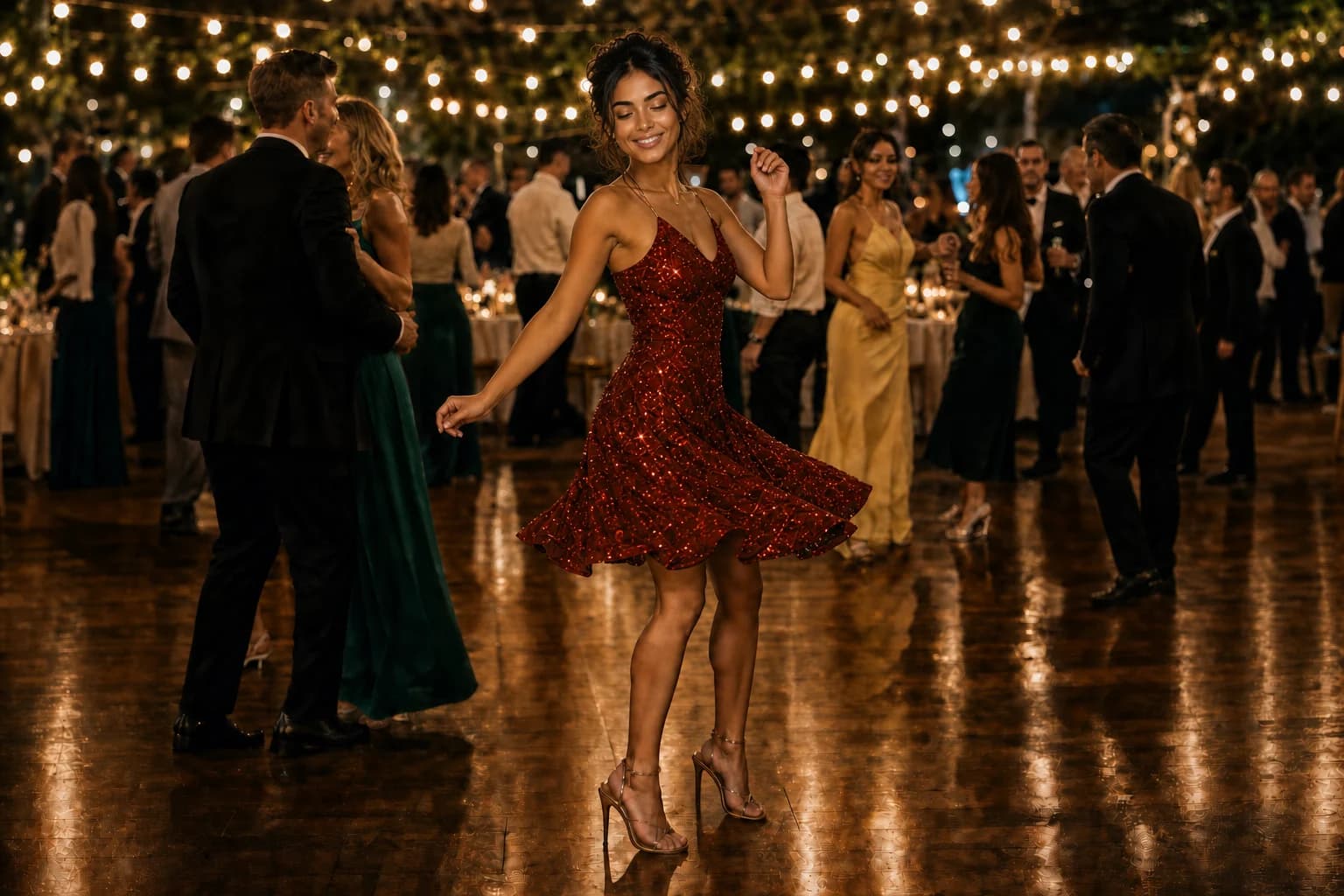
AI生成
撮る
The technical spine of this genre is mixed, low, uncontrollable light, and the first answer to it is fast glass. A lens at f/1.4 passes two stops more light than one at f/2.8: that is the difference between a usable shutter speed and a smeared one in a candlelit room, and it buys the subject separation that pulls one face out of a crowded reception. The cost is a thin plane of focus, so the discipline from portraiture carries over: focus lands on the near eye of the person the frame is about, and when two people share the moment (the couple, the parent and child) stopping down a little is what keeps them both inside the story.
Shutter speed follows the motion, and event motion comes in two speeds. A still face during the vows or a speech survives modest speeds; hands mid-gesture, a hug landing, and anything on the dance floor want something around 1/250s to hold. When the light won't fund that, the ledger reads the same as everywhere else: raise the ISO and accept the grain, because noise is a processing problem and blur at the peak of the hug is forever.
The exception is deliberate: on a dance floor, a slow shutter with flash (dragging the shutter) freezes the subject with the flash pop while the ambient exposure smears the room's lights into energy. That frame is a choice; drifting into blur because the ISO felt too high is not.
Flash itself is a judgment call the event makes for you. Ceremonies often prohibit it, and a flash firing during the vows changes the room: the opposite of unobtrusive. Concerts make it useless as well as unwelcome: light falls off with the square of distance, so a small on-camera flash at stage distance illuminates the backs of heads in front of the lens and nothing on stage.
Where flash is welcome (receptions, parties) bounce it. A ceiling or wall turns the small source into a large one, and soft light with direction replaces the flat, hard, red-eyed look of direct on-camera flash. Watch the bounce surface's color, because the light takes it: a white ceiling is a softbox, a wooden one is an orange gel. And when silence matters, the electronic shutter earns its place, with one textbook caveat: under LED and some fluorescent lighting, its rolling readout can catch the light's flicker cycle as dark bands across the frame. Test a frame in the actual light before the processional starts, and fall back to the mechanical shutter if the banding shows.
Stage and dance-floor lighting deserve their own paragraph because they cycle. Concert light runs a program (saturated washes, strobes, a bright white look somewhere in the rotation) and the saturated washes are the trap: a deep red wash drives skin into a single clipped channel where texture simply ceases to exist. The craft is patience inside the song: meter for the performer's face, hold the frame, and take it when the cycle swings bright or white. On the dance floor the same logic applies gentler, the DJ's colors can be fought or used, and used is better: let the magenta be magenta, and reserve the clean-skin frames for the pockets of neutral light the room still holds.
Finally, the housekeeping that this genre elevates to craft: continuous autofocus for anything walking toward the lens (an aisle processional is head-on motion, gentle on shutter speed but relentless on focus) and, where the body has them, both card slots writing every frame. In a genre where the subject cannot be re-shot, redundancy is not caution; it is part of the craft.
編集
The first edit is the cull, and in this genre the cull is composition at the level of the story. An event take is long, and its worth is decided by which frames survive: one frame at the peak of each beat outranks five frames on either side of it. Sequence the survivors the way the day ran: the set should read like the event felt. Inside each frame, the crop finishes what a crowded room started: tighten to the emotion, and clear the edges of the half-guests and raised phones that the moment left no time to clear at capture.
Then the two taxes this genre always pays. High ISO is the first, and the handling is selective: quiet the grain in the shadows and the flat walls, protect the faces, and stop before skin turns plastic (an even grain on a sharp, true moment reads as honest); smearing reads as damage. Mixed white balance is the second, and the referee is skin. A frame lit by tungsten uplights, an LED dance floor, and window light cannot be made neutral everywhere at once: neutralize for the light on the faces that matter and let the room's other sources keep their color, which is, after all, what the room looked like. Keep the choice consistent across each scene: a reception that changes color frame to frame reads as an error even when every individual frame is defensible. And when a color cast is truly irreconcilable (the deep red wash, the green fluorescent corner), a monochrome conversion can dissolve the color problem entirely, provided it is chosen for the frame's tonal strength and not deployed as a bandage; black and white rescues color, never content.
The honest truth, and in this genre it is the whole truth: post cannot restore the moment. The first kiss happened once. No edit recovers the frame where the veil lift was a back of a head, where the hug had already loosened, where the flash didn't recycle in time or the focus tracked the officiant instead of the bride. No crop manufactures the reaction that was behind the camera, and no slider re-lights the toast that happened in the darkest corner of the room. Those failures are capture-limited: the event is where the frame is won, and it does not run twice. Editing polishes what the coverage brought home; the fix for what it didn't is at the next event: earlier in position, script read closer, one more glance over the shoulder at the reaction side of the room.
評価
Self-critique with the same lens the product uses. The FinalFrame Score is a lane-weighted blend, and the critique names ONE bottleneck, the single highest-leverage weakness in the frame, not a per-category report card. Read it as the answer to "what do I watch for at the next event," because in this genre that is exactly what it is: the beats repeat across events even though no single moment ever does.
For event frames in the 6–7 band, the bottleneck is most often the moment or the clutter: the frame lands beside the beat (the laugh already fading, the hands an inch from touching, the applause instead of the line that caused it) or the moment is real but drowning in the room: exit signs, raised phones, a stranger's shoulder, a bright doorway pulling the eye out of the frame, because the shot was taken from where standing was possible rather than where the frame was right. At 8 and above, the bottlenecks shift to fine margins: highlight control on a white dress under mixed light, a layered frame where the foreground reaction almost lines up with the background action, skin tone drifting under a colored wash, a crop that pinches the gesture.
- Zoom to 100% on the face the frame is about: sharpest pixel there, eyes open?
- Walk the frame's edges: anything bright, half-cut, or phone-shaped that the eye snags on?
- Shrink to a thumbnail: does the emotion still read at a glance?
- The harder question, the one that decides the band: would someone who wasn't there feel this, or does the frame only work as a reminder for someone who was?
6と8を分けるもの
The 6 is correct, and correctness is its ceiling. The exposure holds in difficult light, the faces are sharp enough, the occasion is unmistakable. But the frame lands between beats (the hug loosening, the toast glasses already lowered) so it proves the event happened without showing a moment being lived. The room is recorded rather than organized: the moment sits in the middle distance with the venue's clutter at full volume around it, and the light is whatever the spot offered, not a pocket that was found. The diagnostic tell: the caption that fits is the name of the occasion ("the reception," "the show"), not the name of a moment.
An 8 is the beat itself, at its peak, with the room bent around it. The gesture is at full extension: the kiss, not the lean-in; the laugh at its crest, not its decay. The frame is layered like the event actually felt: a reaction in the foreground, the action behind it, both reading. The background was bought with feet before the moment arrived (a dark wall, a clean doorway, ten steps to the side of the exit sign) and the light was found, not accepted: the window in the prep room, the white swing of the stage cycle, the bounce off the one white ceiling in the building. Faces are sharp, eyes open, skin still skin under mixed sources. It reads the way the day felt to the people inside it, and that is the whole assignment of this genre: not what the event looked like, but what it was like to be there.
So shoot the next event for the one thing the critique named. If it was the moment, read the script closer and be in position a beat early: the peak stops surprising a camera that knew it was coming; if it was clutter, spend the empty minutes before each beat choosing the background the moment will happen against; if it was the light, walk the venue first and map its pockets, so the important beats get steered, or the camera gets carried, toward them. If the fix is real, you'll see it in the take before the score shows it: the next critique names a different limit, and the FinalFrame Score has room to move, because the frames have stopped losing to the same missing beat. And if the same bottleneck is named again, that is information, not indictment. Events have a truth no other genre states so plainly: the moment happens exactly once, where and when it happens (sometimes facing away, sometimes behind a raised phone, sometimes in the worst light in the building) and no craft compels a room full of people to stage their feelings in front of a clean background. Some nights the reaction is on the wrong side of the aisle, and no anticipation retrieves a beat the day never played toward the lens. Read the repeat as a description of what that room gave the camera, then go to the next event, because the beats of this genre recur even though its moments never do. There will be another toast, another first dance, another crowd surging at the chorus, and every one of them is a fresh chance to stand two minutes early in the right place. The score follows the moment. Be there before it.