Light quality
The size and direction of the light source: what the light does to the subject, not just whether there is enough of it.
FinalFrame her fotoğrafı 0–10 arası puanlar: 6 sağlam, 8 portföye değer, 9 sergi düzeyindedir. Puanlama nasıl çalışır
Aslında ne olduğu
Light is taught as a supply problem: is there enough of it? That framing produces exposed, empty pictures, because a photograph does not record the subject; it records the light coming off the subject. Form, texture, depth, mood: none of these are properties of things. They are properties of light falling on things, and two words describe everything the light can do: quality and direction.
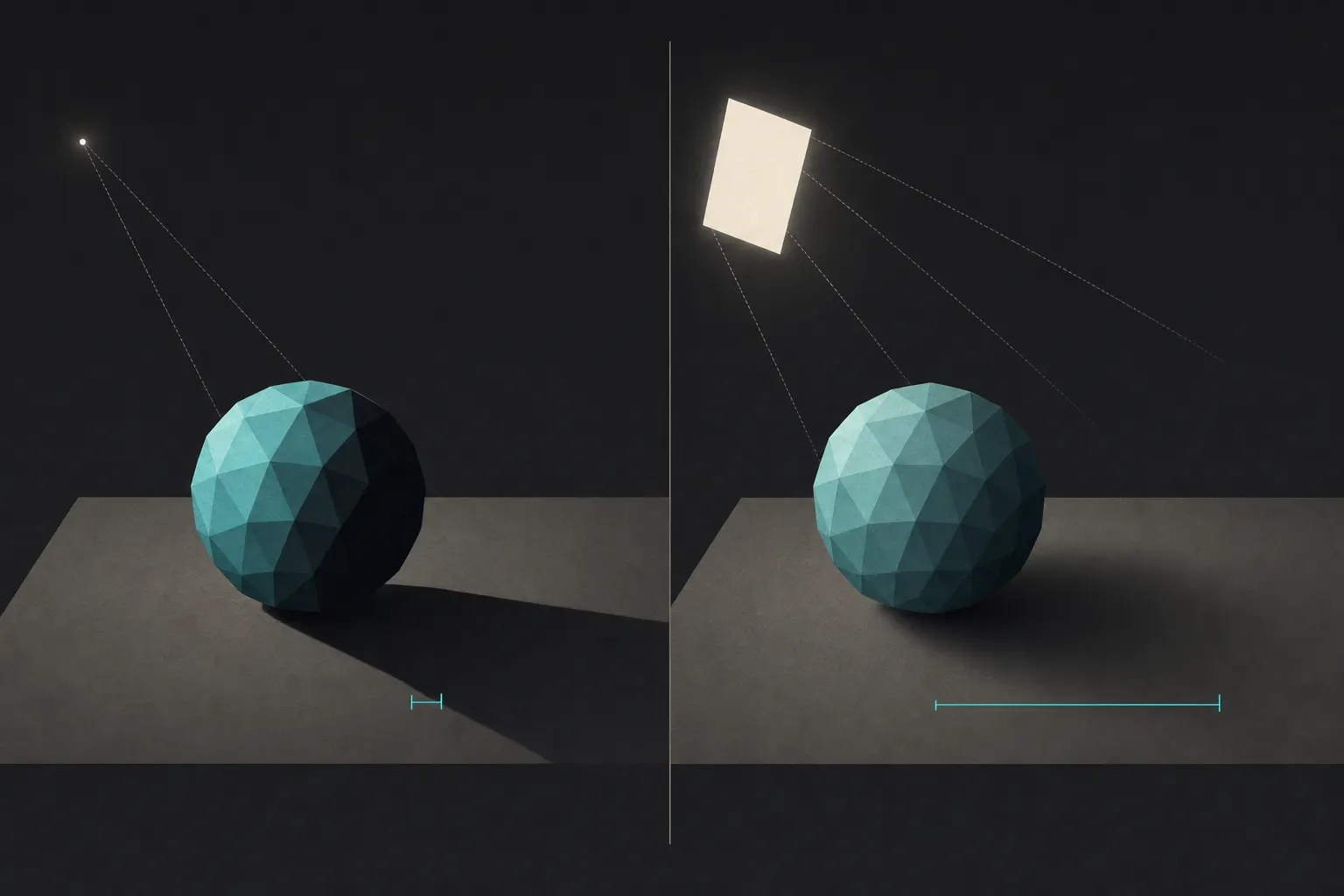
Quality is the size of the source, not its brightness, its size as seen from the subject. A small source sends every ray from nearly the same point, so edges cast crisp, dark-cored shadows and contrast runs high: the bare sun, for all its enormity, is a hard source, because at that distance it is a disc small enough to blot out with a thumbtip. A large source sends rays from everywhere at once, so light wraps around edges, shadow lines dissolve into gradients, and surfaces calm down: a cloud does not dim the sun so much as replace it (the whole sky becomes the source). Soft light is not weak hard light. It is a different instrument, and the size of the source relative to the subject is the only thing that chooses between them.
Direction is where that source sits relative to the line between camera and subject, and it decides whether form and texture exist in the frame at all. Light from behind the camera, front light, drops every shadow behind the subject, where the lens cannot see it: no visible shadow, no modelling, and a three-dimensional thing flattens into a shape. Light from the side rakes across the surface, and every ridge, fold, and pore casts a shadow the camera can see: texture and volume switch on. Light from behind the subject traces a bright rim along the outline and lifts it off the ground, or gives up the surface entirely and hands you a silhouette. Same subject, same lens, same hour: three different photographs. The light that sculpts and the light that flattens can be one quarter-circle of walking apart.

Yapay zeka üretimi
6 neden 8 değil
A 6 has adequate light. The frame is exposed, nothing important clips, the subject is plainly visible: illumination did its job, and that was the only job it was given. The light is a condition the frame accepted: it fell out of the sky at whatever hour the shoot happened, from wherever it happened to come. The judge's tell is a question: what is the light DOING here? In a 6 the honest answer is "it's on." The frame could be remade at almost any hour of any day and lose nothing, because nothing in it was built from this particular light.
An 8's light has a verb. It rakes the surface and drags the texture up. It rims the outline and cuts the subject off the ground. It wraps a form in one long gradient, or hammers it into graphic black-and-white geometry. Cover the subject with your hand and the light still tells you something (the hour, the weather, where the source stood) because the light is load-bearing: move the same frame to noon-overhead and the picture collapses. And it can be described without mentioning the subject at all: low, hard, from the left, warm. A 6 was lit; an 8 was lit BY something the photograph committed to. Light as an instrument chosen, against light as a condition endured: that is the whole distance between the two scores.
Deklanşörden önce
Read the shadows. They are the light's sworn testimony, and they answer every question about a light before the camera comes up. Direction: a shadow points directly away from its source (find any shadow and you have found the light). Height: long shadows mean a low source; puddles of shadow directly beneath things mean it is overhead. And size, the most trained read of the three, lives in the shadow's EDGE: a knife-edged shadow means a small, hard source; an edge that dissolves over a hand's width means a big, soft one. One glance at the ground reports all three before the scene has said anything.
Then run the hand test. Hold one hand up in the light and turn it slowly: watch the shadow side rotate around it, watch the skin's texture appear as the light rakes it and vanish as it faces the light head-on. Everything this light will do to the subject, it is already doing to your hand: for free, in two seconds.
Last, remember that direction is camera-relative. The sun does not move when you do, but the light in the photograph does. The flat front light you are standing in is side light a quarter-orbit to your left, and backlight from the far side of the subject. So before the shutter, name the verb: is this light sculpting the subject, flattening it, separating it, or merely illuminating it? If the honest answer is merely illuminating, the picture is running on subject alone, and the fix is a walk, not a slider.
Kamerada
You cannot move the sun. You hold three levers anyway: where you stand, when you shoot, and, at close range, how big the source is allowed to be.
Position first, because it is free. Orbit the subject and the direction changes with every step: the quarter-circle from front light to side light is the cheapest lighting change in photography, and it switches texture and form on. Keep walking and side becomes back: the rim appears, the surface goes quiet, flare wants managing. The orbit costs nothing, and half the time it is the whole fix.
Then choose the hour like a lens: the named lights are not grades of "good"; they are different instruments. Golden hour: the sun low, so the world is side-lit at ground level and every surface rakes; the light arrives warm because its long, low path through the atmosphere scatters the blue away; shadows run long and carry the frame's geometry. Blue hour: the sun below the horizon and the sky itself the only source (soft, cool, nearly shadowless, and quiet). Overcast: the cloud layer becomes the source, the largest soft light there is; shadows thin toward nothing, glare stops burning color off surfaces, and a subject that needs calm, even description gets it, while a subject that needed form goes hungry. Open shade: out of the sun, lit by the open sky (soft, gently directional from the sky's opening, and cool). Clear midday: hard and overhead, shadows pooled beneath everything (the least chosen light because it is the default one, though its brutal geometry is exactly right when a frame is about shape and nothing else). None of these is good light. Each is right for one picture and wrong for a different picture, and the 8 knows which it is holding.
At close range, resize the source. Anything translucent between a hard source and the subject becomes the new source, at the size of the fabric: a curtain, a scrim, the cloud you waited for. A reflector opens the shadow side without inviting a second set of shadows. A window is a large directional source whose contrast is set with distance: light thins quickly close to a source and slowly far from one, so a subject beside the window sits bright against a room that plunges toward dark, and the same subject deep in the room sits in a near-even wash. And when the light is one cloud away from right: wait. A cloud crossing the sun resizes the source in seconds, and every shadow edge in the scene softens at once. The tonal-hierarchy lesson treats moving light as a ranking machine; it is also a quality machine, and patience operates both.
Düzenlemede
Post can amplify the light that was there. The render can be warmed or cooled toward the hour the light actually felt like. Contrast can push a hard light harder or ease a soft one flatter. And dodge and burn can extend the light's own work: deepen the shadow side a touch, lift the lit side, stretch the gradient the light already laid across a curved surface. Done along the light's existing axis, these edits read as natural for a precise reason: they agree with every other cue in the frame. (Dodge and burn in service of the frame's RANKING, who gets the first look, is the tonal-hierarchy lesson's business. Here the tool has one master: the direction the real light already declared.)
What post cannot do is move the source. Direction is recorded in a thousand agreeing witnesses: the position of every shadow, the gradient across every curved surface, the placement of every glint, each one a small mirror or fingerprint of where the light stood. A front-lit face cannot be relit into side light at the desk: the shadow the nose never cast is not hiding in the file, and painting it in is drawing, not developing (the painted shadow will disagree with every surface the real light touched, and the frame will feel wrong to a viewer who could never say why). Quality is just as baked in: texture in a photograph IS shadow at millimetre scale, so the texture slider can only amplify micro-shadows the light actually cast (under frontal light it finds nothing to amplify, and pushed anyway it manufactures crunch, not surface). A hard shadow edge does not soften honestly, and a soft one does not sharpen at all.
So when the diagnosis is the light itself (wrong direction, wrong size, wrong hour), the frame is capture-limited, and the honest fix is not sold in software: the same subject with the light a quarter-orbit different, an hour earlier or later, a cloud awaited, a scrim raised, one step into open shade. Decided on the shoot, where the light still takes direction.
Merdiven
- Beginner: light as quantity. Enough or not enough; the shoot happens when the schedule says, under whatever falls out of the sky. Light gets noticed only when it fails.
- Competent: follows the folklore. Noon avoided, golden hour booked, subjects walked into open shade. The habits are sound and secondhand: rules applied to the clock, while the specific light (its size, its direction, its shadow) goes unread.
- Strong (where light starts being chosen): reads shadows before the shutter. The source's size and position get named from a shadow's edge and direction; the orbit gets walked for direction, the hour picked for quality, and the light in the keeper has a verb.
- Advanced: chooses subjects for the light. The hour is scouted before the subject is; "bad" light gets used on purpose: hard noon for graphic shape, dead overcast for quiet color; at close range the source gets resized rather than tolerated. At this rung light is not what falls on the picture. It is what the picture is made of.
Hadi, çek
One small subject with both form and texture: a carved stone, a crumpled paper bag, a weathered fence post, a loaf with a torn crust. Then one hard source whose geometry you control: a single bare lamp in a dark room is ideal, because unlike the sun it takes direction; direct sun works if you orbit instead. Camera on the same framing throughout: light is the only variable, because light is the lesson.
Movement one: direction, three frames. Lamp beside the camera: front light. Lamp at ninety degrees: side light. Lamp behind the subject: rim, or silhouette. Move nothing else.
Movement two: quality, two frames. Return the lamp to the side position and change only the size of the source: one frame bare, one frame with anything translucent hung between lamp and subject (tracing paper, a white pillowcase, baking parchment). (Under the sun: the bare frame in direct light, the soft frame when a cloud crosses, or behind a held-up scrim.)
Five frames. Read them like a judge. Start at the shadow edges: between the two side-lit frames, watch the edge go from knife to gradient (that edge is the source's size, written onto the scene, and it is the read this whole lesson trains). Then hunt the texture: front-lit, it barely exists; under hard side light, it shouts; under soft side light, it is modelled and calm; backlit, the surface is gone and only the outline speaks. Then say each frame's verb out loud (sculpting, flattening, separating) and notice it can now be diagnosed from the shadow alone, before the subject is even looked at.
Then close the loop. Light quality is not a bottleneck category of its own: it is upstream of the ones that are. When the light itself is the limit (the wrong hour, harsh overhead noon, a directionless overcast no tonal edit can sculpt around), a critique routes it to timing: the capture-time lever that names the light the scene needed and when to return for it. Flat light whose information is still in the file, present but unranked, surfaces instead as a tonal-hierarchy finding, because that is the flatness post can genuinely rescue; the unread harsh hour surfaces as an exposure finding, because a brutal contrast ratio forces a sacrifice somewhere; and light that merely illuminates shows up as an artistic reading with no reason to move. So take the strongest of the five (usually one of the side-lit pair) and put the reading to work in the world: reshoot a real subject in that light, on purpose, and re-critique the result. If the light is now doing work, the downstream symptom should stop being named: the next critique has to reach for something genuinely different, and the FinalFrame Score has room to move with it. And if the same bottleneck comes back, that is information, not indictment, and the commonest cause is timing, the clock and not the eye: the reshoot happened at the hour the day allowed, and at that hour the light was the same flat overhead it always is. The tabletop lamp already proved the seeing works; what needs to move is the shoot, to an hour when the light is worth reading. Both outcomes are worth five frames to know. The score is not the reward: the moved bottleneck is.
İlgili dersler
Kendi fotoğrafında gör
Puanı anlamanın en hızlı yolu, iyi tanıdığın bir kare üzerinde bir puan okumaktır.
Bir fotoğrafı eleştir