Macro
Le savoir-faire derrière une image forte, et ce qui sépare un 6 d'un 8.
FinalFrame note chaque photo de 0 à 10 : un 6 est solide, un 8 est digne d'un portfolio et un 9 est de qualité d'exposition. Comment fonctionne la notation
Voir
Macro begins with a number most photographers have never consciously chosen: the reproduction ratio. At 1:1, the subject is rendered life-size on the sensor, a full-frame sensor is 36×24mm, so at 1:1 a 36mm beetle fills the frame edge to edge. That number is a creative decision, not a spec to max out. Not everything needs 1:1: an insect at 1:3, standing in its architecture of stems and dew, often tells a better story than the tight crop that deletes its world. Decide before the shutter what the frame is about (one eye, one wing's venation, one droplet) because at these distances there is no room for "and also." The chosen detail is where the sharpest pixel will live; everything else is support.
Then read the surroundings at macro scale, because the frame will. A twig two inches behind the subject becomes a blob the size of the subject itself; a flower two feet back becomes a clean wash of color. The background is decided by where you kneel, and it costs nothing to shift six inches before committing.
Finally, read the light for direction the way the lens will magnify it. Side-light rakes across scales, wing veins, and petal edges and turns them into topography. Back-light does something no other angle can: leaves and wings go translucent, stained glass against a foreground that falls naturally dark and clean. And know that at working distances of inches, moving the light two inches is a lighting change: the whole shadow pattern reorganizes. That is not a nuisance; it is the fastest lighting studio you will ever own.
One more pre-shutter permission: at extreme magnification, familiar things stop being things and become pattern (ridges, tessellation, color fields). When the frame goes abstract, let it. Abstraction is a legitimate destination, not a failure to identify the subject.

Générée par IA
Capturer
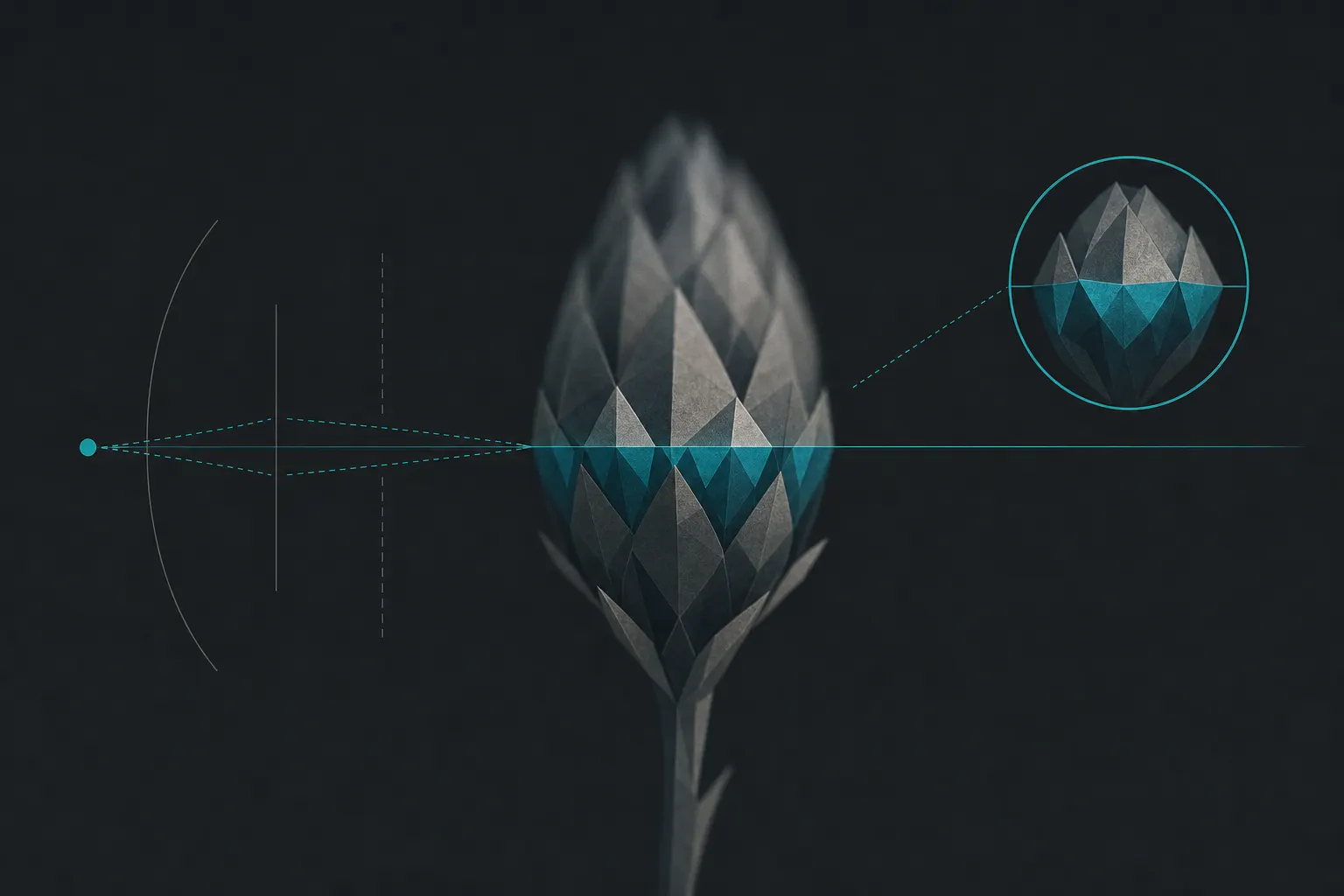
The defining problem of macro is depth of field, and it is worse than intuition says. At 1:1, the sharp zone is a razor even stopped down (a few tenths of a millimetre at wide apertures, still only a couple of millimetres by f/16). Natural light at f/2.8 gives a hair of sharpness and a beautiful melt around it; that can be the picture, if the hair lands exactly where you chose. When you need more depth, the working answer is diffused flash: it buys f/11–f/16 at low ISO, and the flash burst is brief enough to freeze both subject motion and your own sway. Diffusion is not optional: bare flash at close range produces hard speculars and black shadows, and shadows are magnified along with everything else.
One honest caveat: stopping down past f/16 at high magnification pays diminishing returns, because effective aperture grows with magnification and diffraction begins softening the whole frame, focus plane included.
When no single frame can hold the depth, focus stacking can: ten to thirty frames with tiny focus shifts, merged in post, delivering front-to-back sharpness that no aperture at 1:1 can produce. It demands a static subject and a stable rig, which is why it belongs to dew, frost, minerals, and cold-morning insects that have not yet warmed up enough to leave.
Stability is its own discipline, because camera shake is magnified at exactly the same ratio as the subject. For static work: tripod, and a focusing rail, at 1:1 you focus by moving the camera, not turning the ring. For live insects, the field technique is older and simpler: elbows braced on the ground, focus pre-set to a fixed distance, and your body swaying forward and back by millimetres until the plane crosses the eye (fire in that instant). It feels crude. It is how the sharp ones are made.
- Reproduction ratio
- a creative choice, not a max, 1:1 is life-size (a 36 mm subject fills a full frame)
- Aperture
- f/2.8 = a hair of sharpness and melt · diffused flash buys f/11–f/16 at low ISO
- Diffusion
- not optional: bare close flash gives hard speculars and magnified black shadows
- Focus stacking
- 10–30 frames, tiny focus shifts: a static subject and stable rig only
- Stability
- at 1:1, focus by moving the camera (a rail); for live insects, brace and sway the plane onto the eye
Traiter
The macro edit starts at the background, because that is where magnification did its damage. Clean the bright out-of-focus slivers, darken the bokeh edges that pull the eye, and give the subject a half-step of tonal separation from the wash behind it. Then sharpen the plane, not the frame: mask the sharpening to the in-focus detail, because sharpening smooth bokeh only manufactures crunch and noise where the image is supposed to breathe. If the frame is a stack, the merge is part of the edit: inspect the seams for ghosting and halos where wind moved the subject between frames, and retouch them before they retouch your credibility. Restraint on saturation applies double at this scale; nature's colors at 1:1 are already loud.
The honesty clause: the focus plane and the depth of field are capture decisions, and post cannot revisit them. Sharpening cannot create detail outside the plane you placed: no slider moves the razor from the wing to the eye after the fact. A missed plane at 1:1 is a re-shoot or a re-stack, full stop. What post CAN do for macro is finish good capture decisions: calm the background, separate the subject tonally, polish the merge, and stop.
Évaluer
Borrow the product's discipline for your own review. The FinalFrame Score is one lane-weighted number, and the critique names ONE bottleneck, the single limit costing the frame the most, not a scorecard of sub-grades. Self-critique the same way: name the one thing this frame is limited by and ignore the rest until it is fixed.
For macro sitting at 6 or 7, the named limit is usually one of three. Composition: the subject dead-center with the negative space unmanaged, proximity doing all the arguing. Focus: the plane sat a wing's thickness from the eye, or the depth never covered the detail the frame is about (with its cousin sharpness, when your own sway smeared an otherwise-placed plane). Clutter: background elements magnified into large bright blobs that compete at the subject's own scale. Above 8, the bottleneck migrates to micro-polish: a stack seam along an antenna, a sharpening halo, one bright sliver in the bokeh, an edge merge the crop should have sealed.
- At 100%, is the sharpest pixel exactly on the detail you chose: the eye, if there is one?
- At fit-to-screen, does anything in the background read as a shape rather than a wash?
- Can you say in one sentence what the frame is about?
If the sentence is "a bug, close up," the critique will find that too.
Pourquoi un 6 n'est pas un 8
The 6 is a sharp close-up of a thing. That is a real achievement (focus landed at a magnification where focus rarely lands, exposure held, the gear was operated well) and it is also the ceiling of documentation. The subject sits centered, the background is whatever happened to be there, the light is present but not working. The frame proves proximity. The viewer's first question is what lens made it, and their second question doesn't come.
The 8 shows intent in every layer the 6 left to chance. The focus plane is chosen for effect, not merely achieved: the eye is the sharpest point and the fall-off behind it is sculpture, doing deliberately what the 6's shallow depth did accidentally. The background is a complementary color wash that behaves like a second subject, which means someone knelt six inches to the left on purpose. And the light reveals the subject's defining texture (the scales actually glitter, the wing actually glows) because it arrived from the side or from behind, not from wherever the sun happened to be. Same subject, sometimes the same morning. The 6 records that something small exists. The 8 makes a viewer who has seen a thousand flies stop at this one.
So when a critique names your bottleneck, take it back through the camera: shoot the same subject again for that one thing (the plane on the eye, the six-inch shift, the light moved two inches). If the fix is real, the next critique names a different limit, and the FinalFrame Score has room to move. And if the same bottleneck is named again, that is information, not indictment, at 1:1 the margin between the right plane and the near miss is thinner than a pulse, and macro has always been a craft where understanding the fix and landing it are separated by patient repetition no understanding can skip. The sway, the stack, the two-inch move of the light: that is the work, and it compounds.
Leçons liées
Voyez-le sur votre propre photo
La façon la plus rapide de comprendre le score, c'est d'en lire un sur une image que vous connaissez bien.
Critiquer une photo