Nature
Le savoir-faire derrière une image forte, et ce qui sépare un 6 d'un 8.
FinalFrame note chaque photo de 0 à 10 : un 6 est solide, un 8 est digne d'un portfolio et un 9 est de qualité d'exposition. Comment fonctionne la notation
Voir
Nature is the genre that lives between its famous neighbors. Landscape owns the grand vista, wildlife owns the animal, macro owns the world at magnification, and nature owns everything they leave behind: the forest interior, the frost on a fence-line of grasses, the stream detail, the stand of birches in fog, the lichen map on a boulder, the week the beech canopy turns. Its native range is the middle distance, and its native problem is the opposite of landscape's. A landscape is composed by inclusion: deciding how much of a scene the frame can hold together. A nature photograph is composed by extraction: finding the one passage of order inside a scene that is mostly chaos. Stand in any forest and look through the viewfinder: every frame is full, and almost none of them are about anything. The discipline is subtraction. Move until the trunks align or interleave, until one subject claims the frame and everything else either supports it or leaves. The test is brutal and useful: if the frame can be described in five words or fewer (three trunks in fog, backlit fern, ice over dark water), it has a subject. If the description is the name of the place, it has an inventory.
The second discipline is weather, and the reorientation it demands: in this genre, weather is not the obstacle to the photograph (it usually is the photograph). Fog is the great gift, because fog does with atmosphere what a long lens does with aperture: it separates, layer by layer, and turns the forest's chaos into receding planes of tone. Rain deepens color and blackens bark into graphic lines. Frost and snow redraw familiar subjects overnight. Overcast is the forest's softbox: under a gray sky the light arrives even and shadowless, and the structure of an interior scene can finally read. Full sun, the light every beginner waits for, is the interior's worst case: the canopy splatters the floor with hot patches and hard shadow, a range of brightness wider than a single exposure holds, and the frame breaks into confetti. The clean heuristic: sun on the forest's edge and on translucent subjects (backlight pouring through spring leaves makes them glow like stained glass, because transmitted light saturates color in a way reflected light cannot) but under the canopy, wish for clouds.
The third discipline is time, on two scales. The short scale is the ephemeral moment: fog burns off within the hour, frost survives until the sun clears the ridge, a bloom is fully open for days. The long scale is the calendar: the bracken's copper week, the aspen's yellow window, the first hard freeze (subjects that exist for a sliver of the year and then are gone until it comes around again). So nature is the genre where scouting and shooting separate cleanly. Walk the ground in ordinary conditions and take notes, not photographs: where the stream braids, which stand of trunks is clean, where fog would pool. Then watch the forecast and return when the ephemeral arrives at the place already chosen. The photographers whose files are full of fog are not luckier: they had the composition banked before the fog came, and spent the fog's one hour shooting it instead of searching.
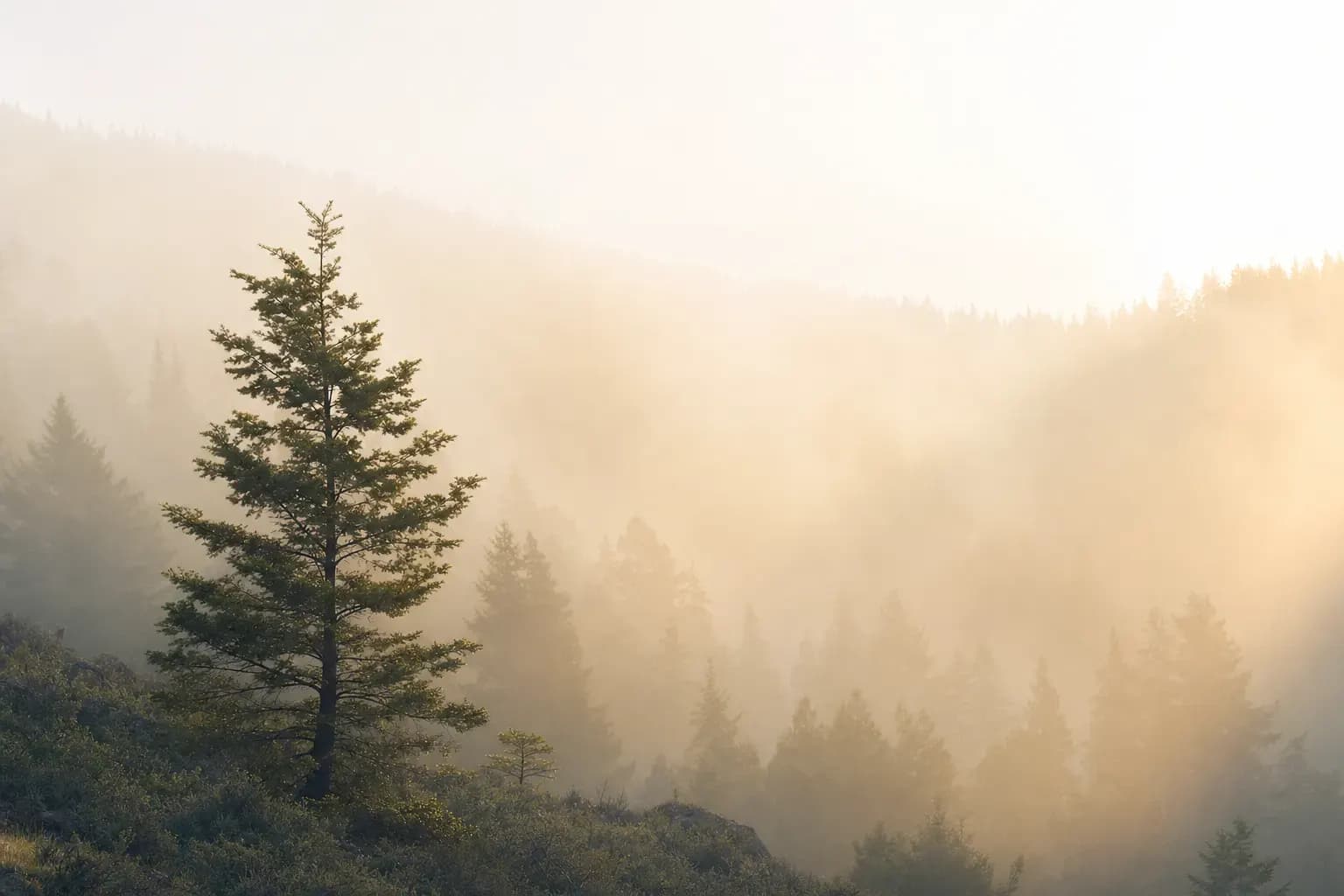
Générée par IA
Capturer
The extraction that starts in the seeing is finished with the lens, and in the forest the tool is usually a telephoto, not for reach, as in wildlife, but for geometry. A long lens's narrow angle of view carves a small ordered passage out of a wide disordered scene, and the compression of shooting from farther back stacks trunks and layers into a single graphic plane, especially through fog. A wide lens in an interior does the opposite: it invites everything in, and everything accepts. Work the scene with feet before glass: in the middle distance, a few steps sideways swings foreground stems on or off distant trunks and remakes the frame entirely.
And take the camera to the subject's height. Flora shot from standing height reads as ground; the same subject at its own eye level, with the lens low, stands against a background that has fallen away into softness. Much of this genre is shot from the knees, and the frames show it.
Wind is the genre's standing tax, and it compounds at close working distance: the closer the subject, the larger any movement lands on the sensor, so a swaying stem that a distant scene would absorb becomes smear in an intimate one. The frame has two honest answers and one dishonest one. Freeze it truly (raise the shutter speed until motion is genuinely stopped, and let ISO pay) or commit to motion as the subject: a multi-second exposure that renders grass in wind as flowing gesture, or moving water as something chosen. The dishonest answer is the middle, where a shutter speed almost fast enough leaves foliage half-sharp, and the frame reads as error rather than intent. Wind also breathes (gusts pass, lulls follow) so the cheapest sharpness in nature is patience: frame, wait out the gust, and shoot the still seconds.
With moving water, the shutter is a stylistic commitment made at capture: fast speeds hold texture and spray as texture; around a half-second to a couple of seconds, water goes to silk while keeping strands and structure; stretch to many seconds and it flattens toward mist. All three are legitimate. Drifting between them by accident is not.
Two pieces of equipment earn their place in this genre more than any other. The first is a polarizer, because so much of nature is wet and shiny: foliage, stone, and water all carry a specular glare that sits on top of their color like frosted glass, and a polarizer, rotated while watching the effect, strips that sheen so wet leaves go deep green and a stream's surface either clears to the bed below or holds the reflection (the rotation chooses). The effect is strongest working at right angles to the sun and fades toward none when the sun is ahead or behind; it also costs light, commonly between one and two stops, which matters in a dim interior. On wide frames that include sky the polarization can band unevenly across the blue, but in the forest and at the stream, where this filter does its real work, that caveat rarely applies.
The second is a tripod, and not as a formality: the genre's favorite light is dim and even, its favorite apertures are middling-to-small, its favorite ISO is low, and that arithmetic lands on exposure times no hand holds. The tripod also slows the frame down, and in a genre built on subtraction, deliberateness is a feature.
Depth of field asks for a real decision, because the intimate scene sits in an awkward zone: close enough that depth thins the way it does approaching close-up work, far enough that the frame often contains real depth to cover. Choose which photograph it is. An isolated subject (one fern, one bloom) takes a wide aperture and a distant background, and the near-macro physics work in the frame's favor. A small scene with structure (the stream braid, the trio of trunks) needs the aperture stopped down until the scene's actual depth is covered, checked by magnifying the near and far edges, not guessed.
And there is a floor under that adjustment: at the smallest apertures, diffraction begins softening everything the depth was meant to protect, so the working range lives in the middle of the ring, and a scene too deep for it is solved by moving back or aligning the frame with the subject's plane rather than cranking past the lens's sweet spot.
- Moving water
- fast = texture · ~0.5–2 s = silk with structure · many seconds = flat toward mist
- Wind
- either truly freeze (raise shutter, let ISO pay) or commit to motion, never the half-sharp middle
- Polarizer
- strips glare off wet leaves and water; strongest at right angles to the sun; costs 1–2 stops
- Depth of field
- the middle of the ring: one subject wide, a structured scene stopped down, checked at both edges
Traiter
Green is the hardest color in the edit, and nature is the genre made of it. Global saturation is the classic failure: pushed even modestly, foliage slides toward an electric yellow-green no forest has ever produced, and the frame announces its edit from across the room. Work the greens selectively instead (a touch less saturation than the slider suggests, luminance shaped so the foliage holds depth rather than glowing) and mind the color casts the scene itself created: light under a canopy has filtered through leaves and arrives green-tinted, light in open shade arrives blue, and a white balance chosen deliberately, rather than inherited from auto, is often the single largest color correction the frame needs. The target is the restraint test: the edit should return the scene the eye remembers, which is always quieter than the slider's opinion of it.
Atmosphere deserves protection from the tools that measure it as a defect. Fog and mist read to a contrast slider, and to dehaze especially, as a problem to remove, and a frame built on atmospheric depth can be flattened into ordinary gray by the very adjustment meant to rescue it. If the fog is the subject, the separation it created is the value: keep the contrast moves local and gentle, and let the far layers stay faint. Local work earns more in this genre than global: forest frames arrive with hot spots (a bright patch of sky through the canopy, a pale stone) and burning those quiet, while lifting the subject a breath, guides the eye through a complex frame the way the light should have. Cleanup has a modest honest range: litter, a stray bright twig cutting a frame edge. Rebuilt scenes (skies swapped, elements composited in) drift out of nature photography into digital art; the genre's credibility runs on the sense that the moment occurred.
And the honest truth, which in nature is a matter of physics and calendars: post cannot rescue what the capture did not hold. No slider un-blurs foliage the wind moved under an in-between shutter: that detail was never recorded. No highlight recovery rebuilds a canopy hot spot that clipped in dappled sun; a range the sensor could not span in one frame is gone, not hidden. And no edit summons the fog that never came, greens a season that had already turned, or restores the bloom that closed two days before the visit. Those failures are capture-limited: decided by the light, the moment, and the access, all of which were settled before the shutter fired. The fix is not in the software. It is a forecast watched, a date circled, and the same trail walked again.
Évaluer
Self-critique with the same lens the product uses. The FinalFrame Score is a lane-weighted blend, and the critique names ONE bottleneck, the single highest-leverage weakness in the frame, not a per-category report card. Read it as the answer to "what do I change before the next walk," because in a genre built on return visits, that is exactly what it is.
For nature frames in the 6–7 band, the bottleneck is most often extraction or light: the frame holds a real scene but no single subject claims it (an inventory of forest rather than a photograph in it) or the light is the ordinary light of an ordinary hour, even and characterless, no weather or angle doing any work. At 8 and above, the bottlenecks shift to fine margins: a bright exit at a frame edge pulling the eye out, one hot patch of sky through the canopy, greens pushed a notch past believable, foliage at 100% carrying motion the frame didn't commit to.
- Name the subject in five words or fewer: if the words are a place, not a subject, the frame knows it.
- Walk all four edges looking for bright exits and half-cut stems.
- Zoom to 100% on the foliage: is motion either genuinely frozen or plainly intended?
- Shrink to a thumbnail: does one thing still read, or does it read as woods?
Pourquoi un 6 n'est pas un 8
The 6 is correct, and correctness is its ceiling. The exposure holds, the focus landed, the scene is real and even attractive. But the frame includes rather than extracts (trunks, undergrowth, and sky all present, none of them chosen) and the light is whatever the hour happened to provide: no fog, no frost, no backlight through the leaves, nothing ephemeral caught in the act. It is a record of a place on an average day, and the diagnostic tell is the caption: the one that fits is the name of the trail.
An 8 is an ephemeral state made permanent. Something time-limited is in the frame (fog threading the stand, frost on the seed heads, the one week of copper, low light pouring through translucent leaves) and one subject owns the composition, with every other element either supporting it or gone. The order feels found, not arranged: a passage of alignment carved out of the forest's noise, at the subject's own height, in light that was waited for. The caption that fits names a condition and a moment, not a location, and that difference was decided by a forecast watched, a composition banked in advance, and an hour spent standing in the cold while the fog did its brief work.
So walk it again, for the one thing the critique named. If it was extraction, go back with a longer lens and a five-word ceiling, and leave every frame that describes the place instead of a subject unshot; if it was light, stop shooting the ordinary hour: put the visit where the forecast says fog, frost, or backlight will be, and scout the composition before it arrives. If the fix is real, you'll see it on the back of the camera before the score shows it: the next critique names a different limit, and the FinalFrame Score has room to move, because the frame has stopped asking ordinary light to do extraordinary work. And if the same bottleneck is named again, that is information, not indictment. Nature runs on the planet's schedule, not the photographer's: fog, frost, bloom, and turning leaves are granted, never summoned, and some returns to the same trail hand back the same flat gray hour no matter how well the visit was planned. A repeat is often a reading of the conditions the season offered, not of the craft brought to them, and the remedy may simply be the sixth visit instead of the second, a different month, or the patience to keep the composition banked until the weather finally spends it. The score follows the moment, and in this genre the moment keeps a calendar. Go be there when it's kept.
Leçons liées
Voyez-le sur votre propre photo
La façon la plus rapide de comprendre le score, c'est d'en lire un sur une image que vous connaissez bien.
Critiquer une photo